hero media

Review – The Cafe Royal London

We go undercover to review London’s Cafe Royal – part of six-star hotel, The Wellesley in Knightsbridge. By David Whitley

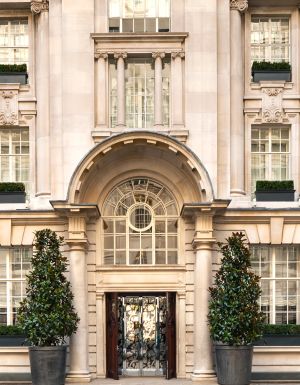
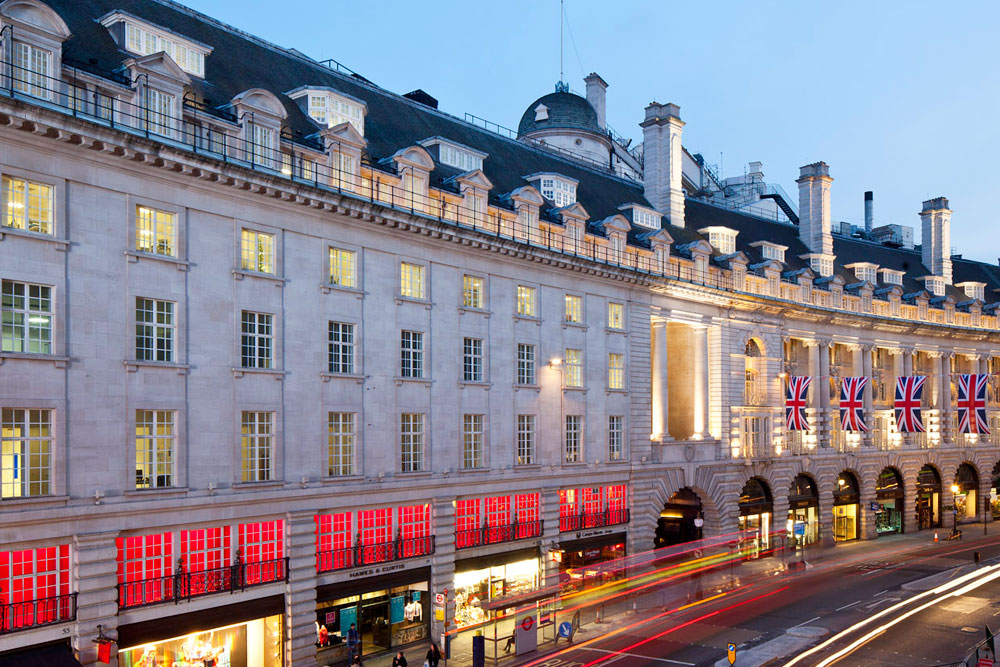
London’s other big new hotel opening is the Café Royal, once the jewel in Regent Street’s crown.

As befitting its position between boho Soho and moneyed Mayfair, it was once the place where the arts world and high society collided.

A famed hangout of Oscar Wilde, HG Wells, Winston Churchill and Edward VIII, it reopened in December 2012 after four years of dramatic overhaul.

Some old features have been retained and rejuvenated – the gaudily gilded Grill Room has been turned into a champagne lounge that gleams with fussy detail.

But it’s in jarring juxtaposition to what has been introduced by architect David Chipperfield, who has the Neues Museum in Berlin and Palace of Justice in Salerno on his CV.

The hotel’s corridors make you feel like you’re walking down an ethereal tunnel towards the afterlife. There’s no decoration to alleviate the intimidating calm brownness of the carpet and entirely wooden walls.

Yet this limbo-like serenity is lifted up a notch in the rooms. They’re clad with huge grey bevelled tiles, designed to look like the monolithic Portland stone that gives Regent Street its unified, distinctive exteriors.

The theme continues in the bathroom, albeit with enveloping grey-white Carrara marble and a heated floor providing extra luxe points.

The overall effect is staggeringly impressive, although it makes no attempt at being warm, soothing or relaxing. Think burial chamber of a great civilisation’s mighty emperor rather than cosy B&B.

There’s a dystopian, futuristic, post-Apocalyptic sci-fi feel, like you’ve just emerged from cryogenic freezing. I half expected to wake up and find a holographic nurse by the side of my bed saying: “You’ve been asleep for quite some time, Mr Whitley – you have a lot to catch up on."

The vacuum-like soundproofing adds to this feeling. Despite the proximity to the screeching madhouse of Piccadilly Circus, the rooms are eerily silent.

That shouldn’t be the case in the Ten Room, Café Royal’s open plan restaurant. With its sink-in red leather comfy seats and all day British brasserie menu, it feels a better fit for languorous gossip-filled lunches than evening fine dining.

That, of course, is entirely in keeping with illustrious heritage – although the look is again strikingly modern.

The buzz isn’t quite there yet, and it’s hard to escape the feeling that Café Royal has opened before it is truly ready.

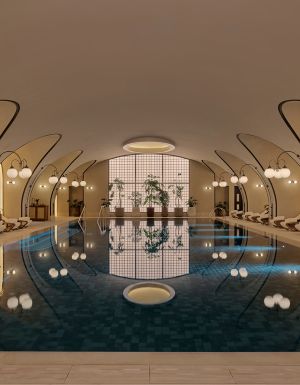
The 1200 square metre spa complex that should be one of the hotel’s key selling points is still under construction, while the furnishing of the rooms occasionally seems rushed and ill thought through.

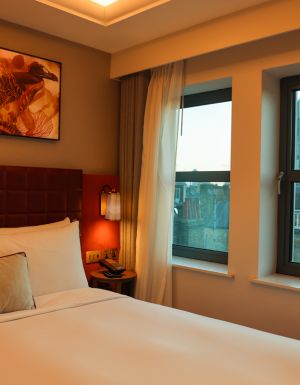
For example, our room had a wiring problem which meant it was impossible to turn off the large lamp in the corner without lifting a floorboard and pulling the plug out. Meanwhile the bed – two singles pushed together and covered so thinly that we could feel the gap – was shamefully poor for a hotel of this price bracket and supposed calibre.

Management says it is aware of these issues and is addressing them as quickly as possible. For now, however, it is not pulling off the delicate marriage of vision and execution.

And although it has a very different take on how to makeover a building with many stories to tell, that’s something The Wellesley has largely perfected.


The Details – Café Royal
68 Regent Street, London
+44 20 7406 3333
hotelcaferoyal.com

The IT Verdict:
David Whitley who paid his own way says:
“A barnstorming piece of radical architectural chutzpah that should pull in 21st century artists and aristocracy. But flaws of rushed opening are too evident – give it six months to blossom."

Notes
David paid $420 for a Portland Room. At check-in he was upgraded to a Portland Deluxe room and was given a free bottle of champagne.

Want to see more stories from International Traveller in your Google search results?

  1. Click here to set International Traveller as a preferred source.
  2. Tick the box next to "International Traveller". That's it.
hero media

What the European heatwave means for your summer travel plans

Temperatures are soaring this summer, breaking records across Europe and the UK. 

Euro summer is a feeling like no other. But when a heatwave hits? The dream trip quickly turns into a sweaty mess. Extreme heat is sweeping Europe and the UK this week, with record-high temperatures impacting travel plans across the continent.

And while Australian summers are typically hotter in absolute temperature, many European cities aren’t equipped for high temperatures, resulting in unbearable weather.

Why is it so hot in Europe?

Signs of a hot summer loomed in May, when the mercury hit unprecedented spring highs. Now, extreme high temperature warning alerts have been issued in countries such as Spain, Italy, France, England, the Netherlands and Germany.

France saw its hottest day on record on Wednesday, with an average temperature of 30°C across the day and night. This surpasses the average temperature for June, which is 15°C to 25°C. Dozens of people have died, including 40 from drowning.

In Spain, 212 deaths have been linked to the heatwave.

The UK recorded its hottest June day ever on Wednesday with temperatures soaring to 36.1°C. In an article published by the Met Office – the UK’s national meteorological service – Professor Stephen Belcher CBE, Met Office Chief Scientist, shared his concerns about June’s heat. “To see temperatures like this in the UK in June is sobering. Events like this bring home the implications of climate change, with very high temperatures and humidity bringing significant health implications from heat stress, as well as impacts to a range of sectors such as transport, energy and water supply,” he said.

Heatwaves are becoming increasingly common in Europe and the UK, neither of which is prepared for such extremes. The World Meteorological Organization reported that in 2025, at least 95% of Europe experienced above-average annual temperatures and that the continent was heating up twice as fast as the global average.

How travel is impacted

A pharmacy sign displaying 40 degrees Celcius
A pharmacy broadcasting local weather data. (Credit: Getty/Dragoncello)

During a heatwave, power grids, water systems and transport networks can be affected, resulting in disrupted itineraries for travellers. In France, power outages have left thousands without electricity and early closures have been implemented for two of Paris’s biggest attractions, the Eiffel Tower (early afternoon rather than late at night) and the Louvre (two hours early). Eurostar cancelled its London to Paris and Paris to London services from the 22nd to the 25th, and major UK rail companies have been advising travellers to avoid using trains where possible, or to travel during early hours.

If a heatwave is predicted, being flexible with your itinerary and having fully refundable/changeable tickets is key, as extreme heat can force the cancellation of outdoor activities, impact rail and flight services and change the opening hours of sites and eateries.

Why does summer in Europe often feel hotter than summer in Australia?

people swimming in the Canal Saint-Martin in Paris
People swimming in the Canal Saint-Martin in Paris to cool off. (Credit: Rachael Thompson)

With some of the highest UV levels in the world, Australians are no strangers to the heat, adapting well to intense weather. But our infrastructure is largely equipped to withstand soaring temperatures with climate-responsive passive design, refrigerated air conditioning or evaporative coolers, as well as swimming spots aplenty.

Buildings in Northern and Western Europe and the UK, however, are constructed to retain heat and handle frosty winters. The lack of universal air conditioning means it generally feels hotter even though the temperature on your app might not look it. During a heatwave, it can feel like you’re in a sauna as cities act like heat traps.

How to stay cool and prepare for another heatwave

Relief is expected across Europe and the UK later this week, but more heatwaves are still possible in the coming months. Summer heat typically peaks in July and August.

Public transport often doesn’t have air conditioning, and buses in particular can be swelteringly hot. If you’re heading outside or your accommodation has no air conditioning, it’s worth buying a spray bottle and a handheld fan from a pharmacy or tourist stand. Check ahead of time if restaurants and cafes have air conditioning and make a booking in advance. The highest temperatures typically hit between 3pm and 6pm, so aim to head outdoors outside of these hours.

Rising temperatures invite travellers to enter a more intentional era of seeing the world. Now more than ever is the time to embrace lower-impact “coolcations” and off-season getaways.