hero media

How to feast like a local on a foodie tour through Cambodia

An unflinchingly authentic food tour around Cambodia serves up a slice of real life and culture.

There’s no mistaking what I’m about to eat. The rodent is splayed and prone on a roadside grill with its tail dangling over the edge, teeth bared and dauntingly intact. My brain struggles with the notion that this is a good idea. I watch with mild unease as the best rat is selected and hoisted up by its charred tail for all to appreciate. It lands with a thwack on the chopping block, where it’s swiftly jointed and served in situ with a dipping sauce.

Facing culinary fears: from rat to rotisserie pork
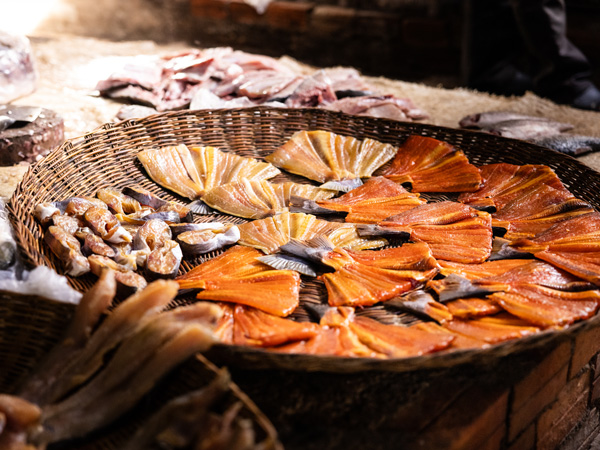
Markets in Siem Reap, Cambodia
The food markets of Siem Reap are brimming with local cuisine.

Standing in the dust under a tattered tarpaulin en route to Battambang from Siem Reap, I hesitate, briefly, at the prospect of partaking in this snack. Some self-talk is required to proceed. This is what I’m here for. I’ve joined a seven-day Intrepid Travel adventure, one of Southeast Asia’s most memorable journeys. The goal? To discover the culinary traditions of this beautiful country, and so if rat is on the menu, rat is what I shall eat.

And I do. And of course it tastes like chicken. But this is no filthy urban scavenger; it’s a rural, clean-living rice paddy rat, which enjoys a diet of the ubiquitous grain. Let’s be honest, a serving of rodent marinated in pepper, garlic, palm sugar and salt is going to be far better for you than the cheeseburger you’d usually devour on a road trip. Although relief ensues when we’re herded back onto the bus before the opportunity to sample the coiled snakes and spread-eagled frogs presents itself.
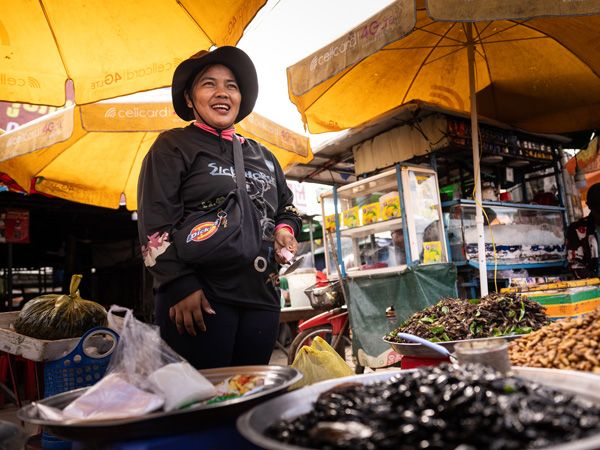
Markets in Siem Reap, Cambodia
Meet locals as they serve up their favourite authentic snacks.

Our guide, the liberally smiling Fila Heng, is giddy with delight that his Western charges have sampled a delicacy of his beloved Cambodia and rather enjoyed it. Throughout the trip, Fila is frequently given to directing our driver to pull over so he can bound off to purchase this or that for us to try, from bags of sugary, fried biscuits to rustic rotisserie pork.

With each snack is a story, a recounting of history – national or personal – and a ceaseless spring of exuberance. I’ve been on Intrepid Travel tours before, and the common thread is that its tour leaders are genuine rock stars with an authentic zeal for their country.

The curiosities and delights of Puok Market
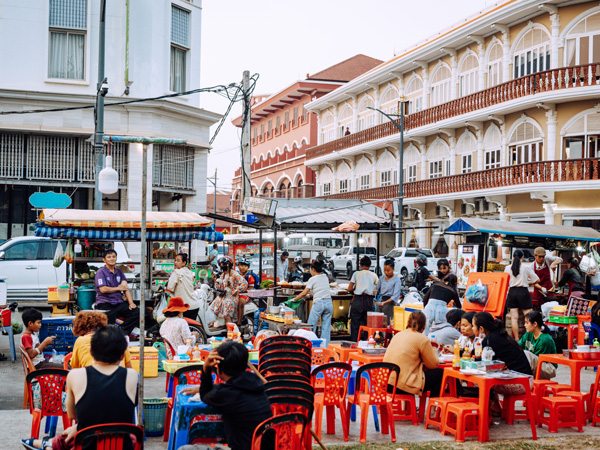
Markets in Siem Reap, Cambodia
The best way to tackle markets is with a local guide. (Image: Getty Images/Nikada)

This couldn’t be more evident than when Fila leads us through Puok Market after another swift swerve off-road, just 20 minutes from Siem Reap, considered one of the world’s most incredible cities. Filo is hailed by the sellers with jovial quips as we weave through the tightly packed snarl of stalls. Despite translations being necessary, the entire group falls into a laughter-filled exchange with the ladies of the market. Noting our snapping cameras, they joke that their faces might soon end up on soy sauce bottles back in Australia.

Fila winds us through stalls piled high with rambutans, mangosteens, longans, snake and dragon fruits, and past baskets fanned with smoked fish, bright-red sausages, netted tubs of thrashing catfish and pigs’ heads gazing skywards. But it’s the enormous trays of insects that Fila has in mind.

He selects a large, shiny-black water beetle, casually pops off its head and crunches down with considerable gusto. It’s reminiscent of a scene from Indiana Jones and the Temple of Doom and a little meatier than I like my insects. But the crickets stir-fried with pork fat, lemongrass, makrut lime leaves and chilli are deliciously snackable.

Why food culture in Cambodia is more than just flavours
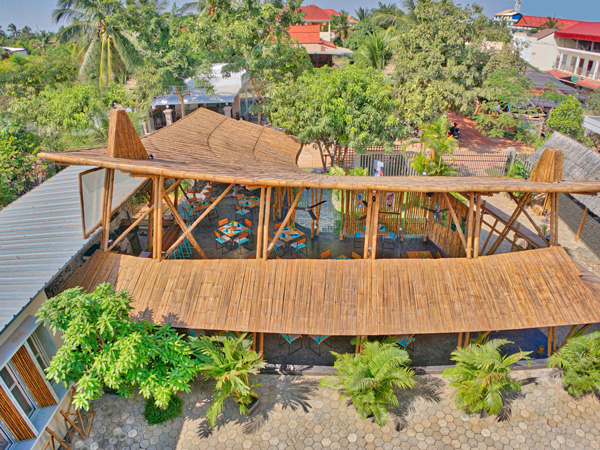
Spoons restaurant in Cambodia
Spoons Cambodia is a good restaurant with a great cause.

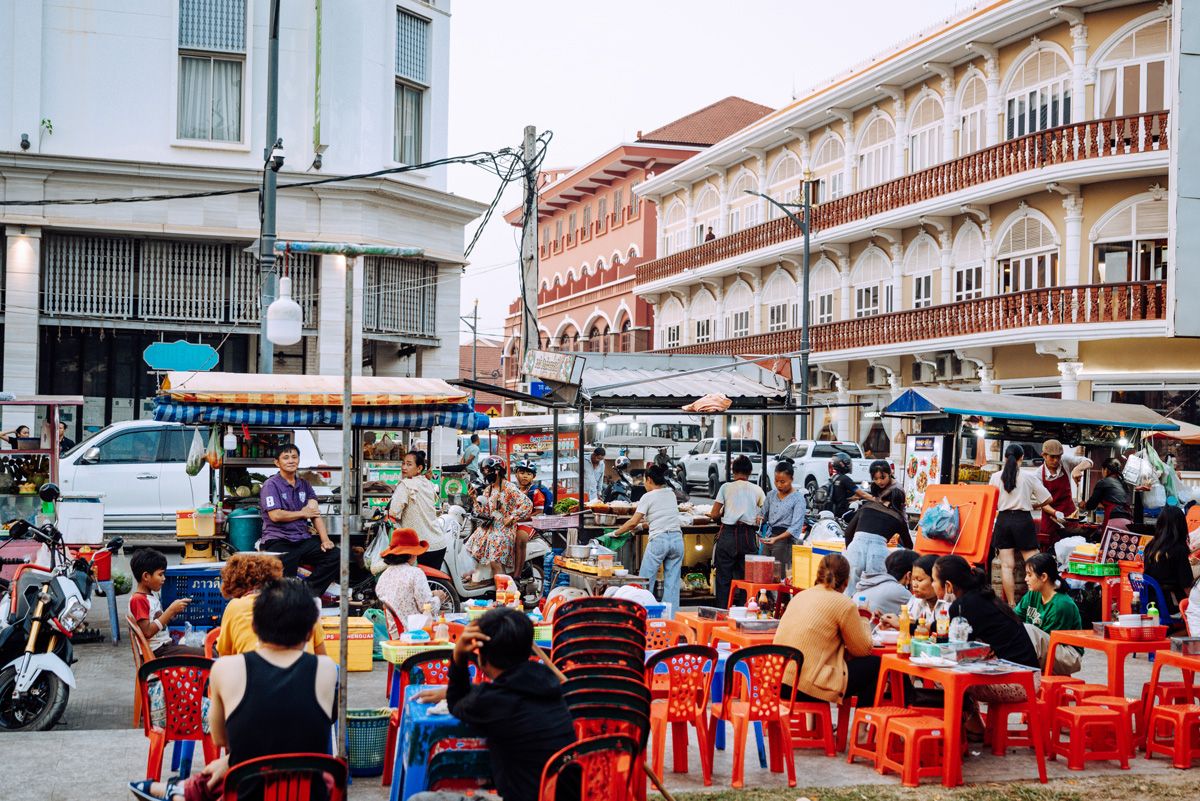
It’s not all insects and rodents, though. The food culture in Cambodia is highly approachable, steeped in tradition and redolent of the region’s ingredients, such as the prized Kampot pepper. We spend an evening wandering by the riverside and snacking on classic Khmer street food in Siem Reap. Guided by Fila, we tuck into smoky-sweet beef skewers hot off the grill and pork rolls that are similar to a bánh mì, but dialled up with tangy green mango and alabaster lard.

We also sip on cocktails made with local rice wine. And dine on nime chow (Cambodian spring rolls) at Spoons Cambodia, a social enterprise that trains students out of poverty through hospitality skills. We also enjoy the King’s go-to dish, fish amok, a mousse-like leaf-wrapped curried fish at the refined Malis. And sample Fila’s favourite soup filled with delicate bamboo shoots and pungent smoked river fish.
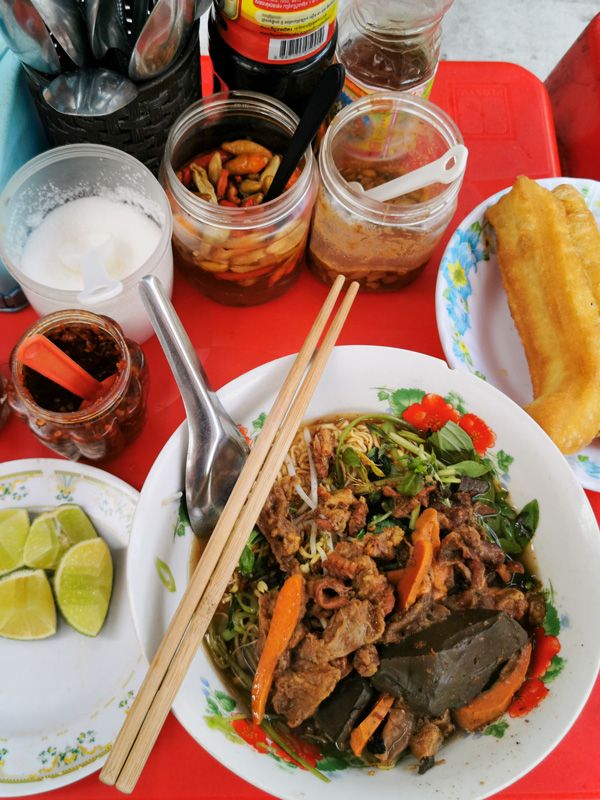
Nam banh chok dish in Cambodia
Nam banh chok is a traditional Khmer breakfast dish. (Image: Getty Images/Nalidsa Sukprasert)

It’s the humble Khmer breakfast dish called nam banh chok, though, that I continue to crave. Venturing to the noodle-famous village of Preah Dak, we relish bowlfuls of handmade yellow rice noodles submerged in a coconut- and fish-based sauce. The dish embodies that holy trinity of sweet, sour and savoury, which the Southeast Asian culinary canon masters so well.

Without being privy to the work that goes into making these slippery strands, you might think this was a simple dish. Before we sit down to slurp, we watch everyone in the family, from grandma to grandson-in-law, partake in the production process. A lot of work is involved to soak, grind, steam, pound, knead and extrude the rice into noodle nests by hand using an impressive stone mill. There is a joyful purpose and evident pride in the result.

How families are upholding tradition in the face of change
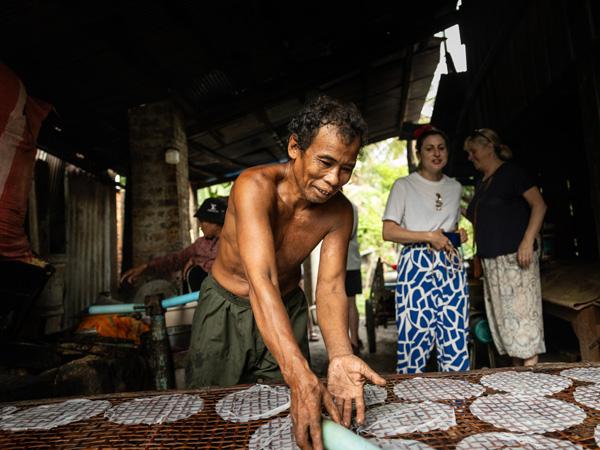
Traditional rice paper making in Battambang, Cambodia
Visit families still making rice paper in Battambang on a Soksabike tour.

While industrialisation has alleviated much of the labour that goes into producing traditional foods in Cambodia, there remains a dwindling number of families that continue to specialise in these crafts. In Battambang, we pedalled the back roads with social enterprise company Soksabike to drop in on families still making rice paper, dried banana and bamboo sticky rice the old-fashioned way.

The recurring theme was a perseverance to preserve this important part of Khmer culture, despite the younger generation opting for office jobs over days spent crouching by cauldrons of steaming rice. It’s both understandable and somewhat devastating.
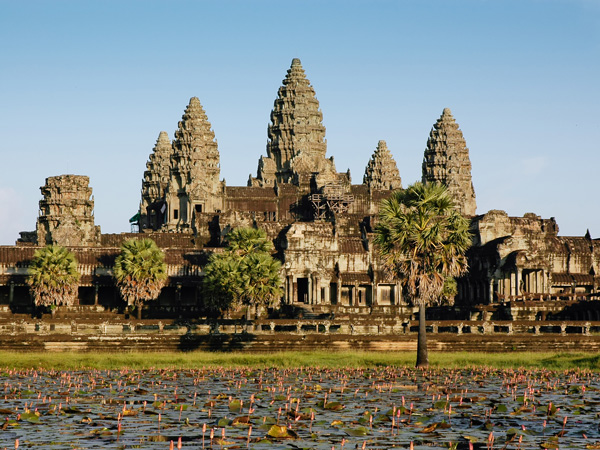
Angkor Wat in Cambodia
Don’t miss the UNESCO World Heritage Temples of Angkor Wat. (Image: Getty Images/Hippo Studio)

It’s been a slow crawl back from the decimation wrought by the Khmer Rouge in the 1970s. But there’s a definite sense that no one wants to give the tragedy airtime. They’d rather focus on the tenacity and achievements of the Khmer people. After all, the Khmer Empire, which flourished between the 9th to 13th centuries, was one of the most powerful in the world, building incredibly intricate temples, such as the sprawling UNESCO World Heritage Temples of Angkor.

Weekly travel news, experiences
insider tips, offers,
and more.

Beyond your taste buds: experience the real Cambodia
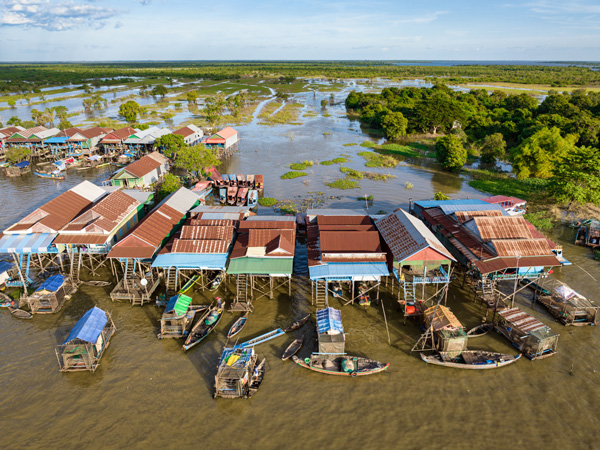
Tonlé Sap in Cambodia
Tonlé Sap is an inland lake with floating villages. (Image: Getty Images/M Lenny)

The soothingly symmetrical Angkor Wat is an ethereal sight at sunrise as soft, lilac hues slowly coax the towers out from the darkness. Ta Prohm, or Jungle Temple, which you may remember from the Jolie-era Lara Croft: Tomb Raider movie, exists here in an enigmatic clutch of tree roots as the encroaching jungle indolently ingests the stone monument.

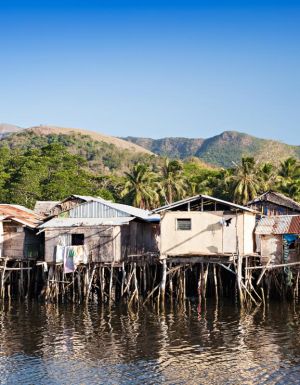
Other examples of mystifying innovation and beauty in Cambodia include myriad temples that tippy-toe on mountaintops and the floating villages of inland lake Tonlé Sap – haphazard watery outposts that appear as if conjured by some mysterious deity.

There is a palpable arc of history, some of it uplifting, some heartbreaking, that canopies Cambodia. But the essence of warmth and light that lives in the Khmer people is rich and tantalising and finds its way into the incredible food of this country. It’s a pink plastic tub of blue crabs bobbing with iridescent green and red chillies. It’s the quick-smiling locals serving scoops of golden silk cocoons. And it’s the heady scent of the rice flower in bloom.
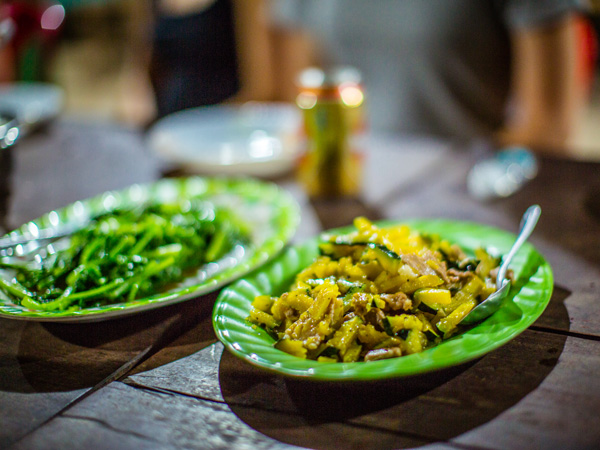
Traditional food in Cambodia
Vegetables are a staple of Cambodian cuisine. (Image: Ryan Bolton)

I consider all this as I wait for a bat colony to make its nightly exit from the innards of an ominous-looking cave at Phnom Sampov. The bats are running late, so I see what Fila’s up to at a nearby table. He’s helping himself to a willing stranger’s plate of balut.

He offers me a taste while demonstrating how to eat the developed egg embryo. I spy the immature beak and feathers of the never-to-hatch chicken and politely decline. No amount of self-talk can reprogram my Aussie sensibilities to find an entombed embryo appealing. I’ll have another serve of rat, though.

Intrepid Travel’s eight-day Cambodia Real Food Adventure winds from Phnom Penh to Siem Reap, sampling Khmer flavours, culture and history. Prices from $1880; single supplement from $270.

Want to see more stories from International Traveller in your Google search results?

  1. Click here to set International Traveller as a preferred source.
  2. Tick the box next to "International Traveller". That's it.
Lara Picone
Working for many of Australia’s top publications, Lara Picone has had the distinct pleasure of writing, editing and curating content about the finer things in life for more than 15 years. Graduating from Macquarie University with a Bachelor of Arts in Communication, her editorial foundation began at Qantas: The Australian Way magazine, before moving on to learn the fast-paced ropes of a weekly magazine at Sunday Magazine and picking up the art of brand curation at donna hay magazine. Pivoting a near-problematic travel lust into a career move by combining it with storytelling and a curious appetite, her next role was as Deputy Editor of SBS Feast magazine and later Online Editor of SBS Food online. She then stepped into her dream job as Editor of Australian Traveller before becoming Online Editor for both International Traveller and Australian Traveller. Now as a freelancer, Lara always has her passport at-the-ready to take flight on assignment for the Australian Traveller team, as well as for publications such as Qantas Magazine, Escape and The Weekend Australian. As ever, her appetite is the first thing she packs.
View profile and articles
hero media

5 things every hotel needs for a more restorative stay

    Kate Bettes Kate Bettes
    Wellbeing means different things to different travellers. Here’s how to pick a hotel that gets it right for you.

    The best wellness holidays aren’t necessarily spent wrapped in a spa robe. Sometimes they’re found around a dinner table in Cambodia, on a hiking trail in New Zealand or after finally beating jet lag on the other side of the world. The hotel you choose is what makes them happen.

    1. Easy access to good food

    meals from Novotel Bangkok Sukhumvit 20
    Taste delicious meals at Novotel Bangkok Sukhumvit 20.

    One of the quickest ways to derail healthy habits on holiday is to spend half of it working out where to eat instead of digging into the culture around you. Thankfully, Novotel has done much of the hard work already, with chefs building menus that lean into the flavours, ingredients and traditions of each destination.

    In Sihanoukville, Cambodia, Korkor soup – often dubbed ‘Cambodian ratatouille’ – sits alongside raw blue crab dressed with lime and chilli, best enjoyed with views across the Gulf of Thailand.

    In the lovingly chaotic city of Bangkok, the presence of food cranks up the sociability. At Novotel Bangkok Sukhumvit 20, you can settle in with mango sticky rice and stranger-turned-friends beside the pool at Sky on 20 rooftop bar, or bring them along to tackle river prawns and stir-fried crab with holy basil at the buzzing Crab Paradise Dinner Buffet.

    Then Novotel Dubai Al Barsha welcomes you with a laidback twist on the level of indulgence the Middle Eastern city is best known for up on Deck Se7en. Looking towards Burj Al Arab, the rooftop lounge has everything from Mediterranean-style dishes like seabass ceviche to Italian prosecco sundowners.

    At the other end of the scale, in the hills that surround the Novotel Bali Ubud Resort, calm comes from nature. At Siralada restaurant, Balinese traditions shape the menu while thunder rumbles over the surrounding jungle – proving the setting is as nourishing as the food itself.

    While at Novotel Nha Trang, chef Kieu Thi My Hanh and her team showcase Vietnam’s knack for balancing freshness, texture and fragrant herbs. Pho remains a favourite, while seafood salad with pomelo and mango brings those flavours together in one bright dish.

    It’s all an approach backed by partnerships with expert food creators such as Alfie Steiner, whose plant-forward recipes prove healthy food should never taste plain.

    2. Better sleep options

    Novotel Bali Ubud Resort room
    Sleep deeply with Novotel.

    There are few travel experiences more disappointing than arriving in a new country, determined to seize the day, only to fall asleep fully clothed by 3pm.

    For Australian travellers, jet lag is often an unavoidable part of the journey. That’s one reason Novotel runs sleep-focused initiatives that help guests adjust quickly without compromising on health. We’re talking partnerships with Sydney-based sleep specialist Olivia Arezzolo, known for her advice on everything from better sleep habits to beating jet lag, alongside features like pillow menus, in-room yoga content and tailored sleep guidance.

    The sooner you’re operating on local time, the sooner you can get back to more pressing matters – like deciding which spa treatment to book.

    3. More ways to move

    woman hiking around queenstown new zealand
    Stay at Novotel Queenstown Lakeside and explore local hiking trails. (Credit: GettyI mages/ naruedom)

    Every place in the world has its own way of getting you moving: whether that’s hiking up ice-bitten mountains before a sauna or gentle stretching by the pool before a facial. From fitness centres to spas, Novotel recognises that wellbeing rarely looks the same.

    At Novotel Queenstown Lakeside, activity is inescapable. Here, hiking trails, ski fields, bungee jumps, and white-water rafting have made the region famous. The hotel’s location on the shores of Lake Wakatipu means less time spent organising yourself and more time out there experiencing them. To top it all off, you can book a private hot tub for the evening before heading back into the wilderness tomorrow.

    Bali, of course, takes a softer approach. At Novotel Bali Ubud Resort or Novotel Bali Nusa Dua, movement is less about conquering a mountain and more about a dance class between the tropical gardens and lagoon pools. Afterwards, the spa takes over, with traditional treatments like a Lulur body scrub: a combination of rice, turmeric, sandalwood, ginger and jasmine that’ll soothe muscles already relaxed by the Balinese heat.

    4. Better connections

    Novotel Sharm El Sheikh
    Kids will love a stay at Novotel Sharm El Sheikh.

    One of the best things about travel is that it gives your family stories you’ll be telling for years. Novotel helps create them with activities that bring everyone together, whether that’s trying something new, learning a local skill, or simply spending more time together.

    Go for a distinctly Thai twist at Novotel Phuket Vintage Park, where many of the family activities draw on local culture. Kids can try everything from beginner Thai boxing and language lessons to umbrella painting and – a pastime beloved by children the world over – pool foam parties. Everyone is welcome to join in, whether that’s getting splashed, covered in paint, or simply watching their children discover a new side of Thailand during the dedicated Family & Kids Day.

    A different adventure awaits at Novotel Sharm El Sheikh. Kids could be perfectly content with discos, drawing classes and new holiday friends, but the Red Sea has other ideas. Sitting on the edge of Naama Bay, days here might involve snorkelling colourful reefs, taking a boat trip to Ras Mohammed National Park or heading into the desert by quad bike or camel for a Bedouin-style dinner beneath the stars.

    5. Location is everything

    Surin Beach, Choeng Thale, Thalang District, Phuket, Thaiföld
    Explore Phuket’s gorgeous beaches. (Credit: Bence Biczo)

    Everyone’s idea of wellness looks a little different. With more than 600 hotels across 65 countries, Novotel gives guests the freedom to choose the destination that suits them best. Whether that’s a beachside escape in Phuket, an alpine expedition in Queenstown or a city break in Bangkok, there’s a good chance a Novotel isn’t far away.

    All that’s left? Choosing your version of wellbeing.

    Discover stays to inspire your everyday at novotel.accor.com.