hero media

Review: Hotel Raquel, Old Havana, Cuba

Economically poor, but culturally rich: chaotic Cuba is like nowhere you’ve visited before. Nigel Herbert finds this haven in Old Havana.

The quest for communist utopia has extracted a price on Cuba.

Cuban history

With over 600 years of history, this port city’s architecture reflects the conquest, occupation and plundering of the victors of the island state. But for many of these buildings it is the end of days. A tropical climate and 50 years of neglect from a centrally planned economy has taken its toll.


The Cubans even have a word for it: Derrumbe. It means building collapse. Many of these once magnificent buildings are inexorably decaying from the inside. And it’s heartbreaking to see.
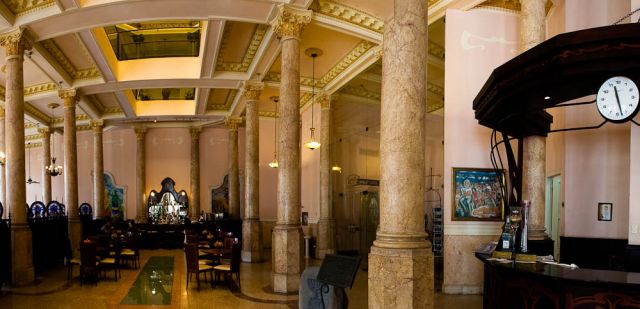
Hotel Raquel's vaulted foyer.
Hotel Raquel’s vaulted foyer.

Spectacular buildings that would be preserved by stern faced ladies in Birkenstocks and their bearded husbands in the western world are simply not a priority in Cuba.


It’s understandable. People are just trying to do enough to make ends meet with their miserable government stipend. When your biggest concern is how you are going to feed your family – saving something architecturally significant is never going to be a priority. So it’s a pleasure to find one of these majestic old buildings has been lovingly restored and converted into a hotel.

Getting to the hotel

If it’s your first visit to Cuba and you go straight to the Hotel Raquel from the airport in your shiny, nearly new 1956 taxi, the ride is a real eye opener. You will pass kilometres of huge decaying warehouses on roads that become progressively more potholed. As you near Old Havana your thoughts will turn from “we were just overtaken by a guy driving a tractor" to “where the bloody hell has the road gone?"


After 10 minutes you realise that this is a magnificent chaos. A safe chaos. But just one giant, bewildering mess. As an elderly German confided in me quite conspiratorially “Eeett eez like Berlin in 1946". And I can only assume he is correct.

The facade and rooms

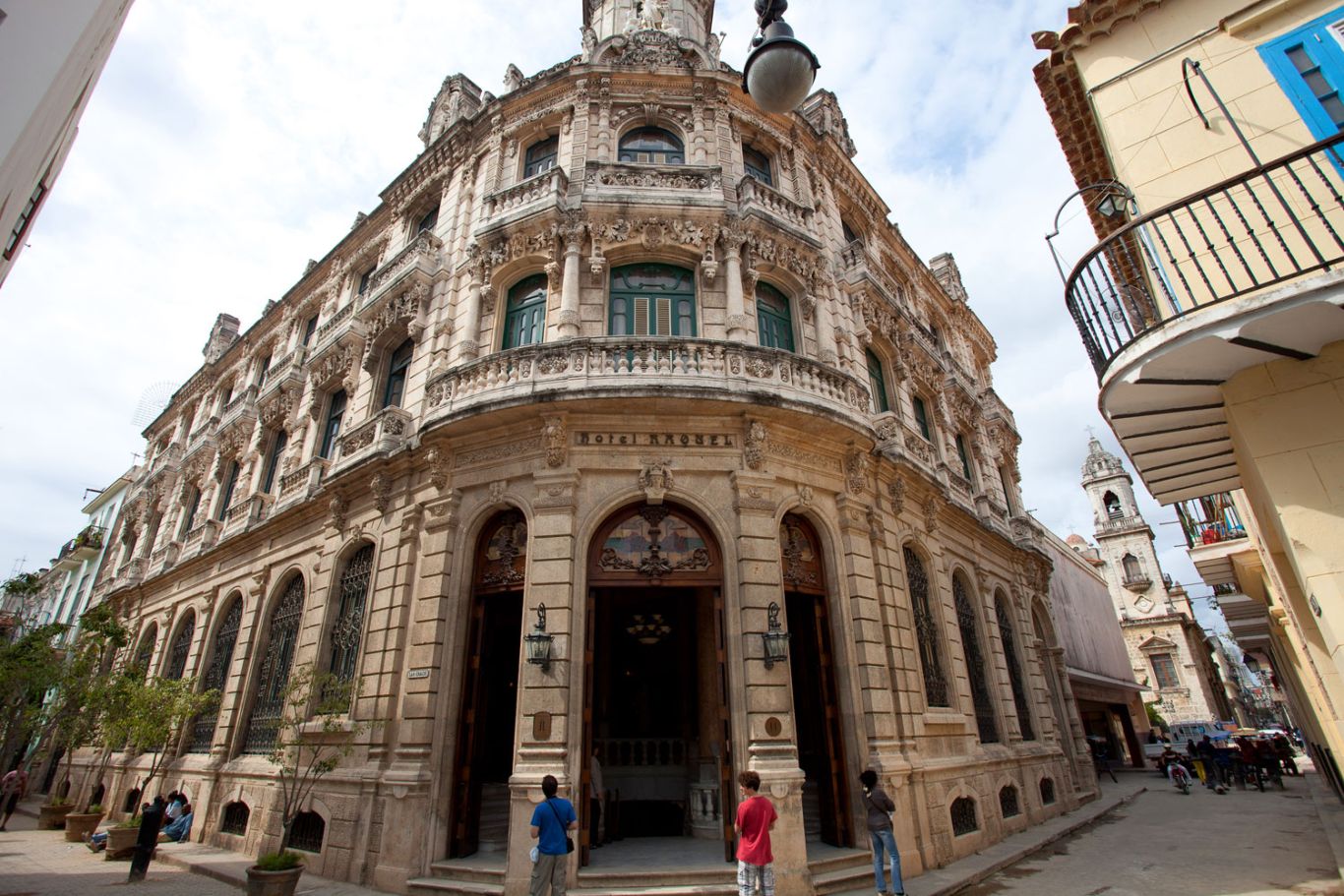
Hotel Raquel sits with its ornate baroque façade in the ancient cobblestoned streets amongst this chaos. The building feels like Sydney’s QVB was converted into a hotel, then dropped into a Parisian street that was abandoned… at the end of WWII. In fact it was originally a bank built in 1908.
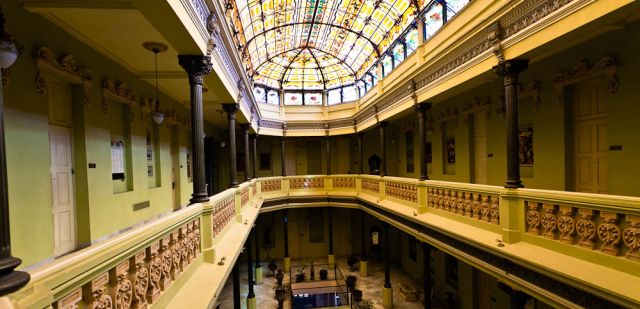
Nigel compared Hotel Raquel with Sydney's QVB building - well, sort of.
Nigel compared Hotel Raquel with Sydney’s QVB building – well, sort of.

With its huge vaulted foyer and stained glass roof, the building is spectacular. But unfortunately, like everything Cuban there are contradictions and riddles throughout. For instance, a large number of the rooms in the hotel have no windows. But the bedrooms are large with huge ceilings, air conditioning and a palatial feel. The bathroom is well appointed and there is plenty of storage. There is even a gleaming old-school 34-centimetre TV encased in a cupboard.


All in all the rooms feel right. The renovation has been sympathetic to the period – not easy for a hotel that has an ornate brass elevator over 100 years old that you need to open and close yourself.
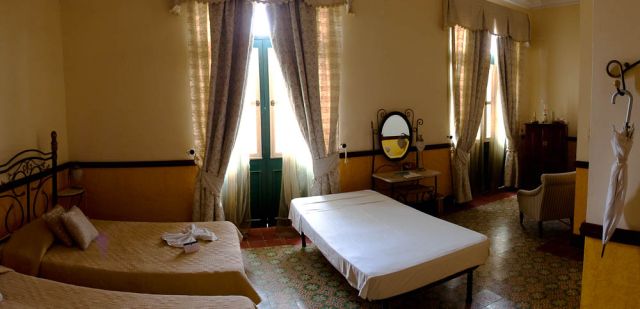
Hotel Raquel's rooms have the spacious, palatial feel to them.
Hotel Raquel’s rooms have the spacious, palatial feel to them.

The service, food and drinks

And the service is strange. Everyone on the service staff should be congratulated for their attentiveness, but less so for their working style. For instance, breakfast at the hotel is like breakfast served at almost every other hotel in Cuba: terrible. The eggs are cooked many, many, many hours prior and left to toast in a bain-marie. There might be some tomato if you are lucky. Cuba’s attempt at a western-style breakfast buffet is truly horrible. The bread and the coffee? Divine. But they have been doing that for years.


Where it gets really interesting is watching the waiter clear the table next to mine while I eat breakfast. He would go to the table, take a plate and return to the kitchen. Thirty seconds later he was back. To collect another plate or possibly a glass, then return to the kitchen.


Anyone who works in the service industry would be mortified, but it’s the Cuban way, as the well dressed man in the Panama hat a few tables away explained to me. A communist country has no real motivation to seek any efficiency. And it percolates into their way of doing business with tourists. So grumbling bell boys and waiters behaving strangely are just something you need to get used to and, after a couple of days, embrace.


You want a mojito? The staff at the Hotel Raquel will rustle one up quickly and it will be just heavenly. Mojito, like coffee, is local – something they are used to and can do well.


That’s what makes Cuba so great. Sure it’s chaotic, but people are eager to please. Even if it means cooking you horrific eggs.

Weekly travel news, experiences
insider tips, offers,
and more.

The Details


Hotel Raquel, Calle Amargura, No. 103 esq. a San Ignacio, Old Havana, Cuba. see the website.
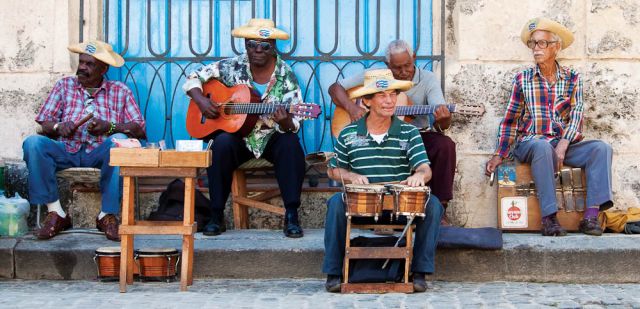
Old Havana style.
Old Havana style.

The IT verdict


Nigel Herbert, who visited anonymously and paid his own way, says: “A remarkable hotel. Remarkable because it only has 24 rooms and it is one of the only hotels in Old Havana that have the internet. This hotel anywhere else in the world would cost $500 a night. When Cuba get’s its mojo back this will be in all the catalogues of expensive, romantic weekend away destinations."


Nigel paid $108 per night for a standard room.


Bias-free: All IT reviews are conducted anonymously, and our writers pay their own way – so we experience exactly what you would

Want to see more stories from International Traveller in your Google search results?

  1. Click here to set International Traveller as a preferred source.
  2. Tick the box next to "International Traveller". That's it.
hero media

8 grand journeys across Latin America

    From camping along alpine meadows in Patagonia to cruising the Amazon, these are the best Latin America journeys to tick off your bucket list.

    1. The Q Circuit in Patagonia

    Travelling with: Emma Ventura

    the Torres del Paine mountains in Patagonia, Chile
    A turquoise lake surrounded by snow-capped peaks at Patagonia’s Torres del Paine National Park. (Image: Getty/ MBPROJEKT_Maciej_Bledowski)

    Tolkienian peaks, pristine lakes and snow-bloated rivers are highlights for most visitors spending a couple of days in Chile’s Torres del Paine National Park. But for the more intrepid, the real rewards come from a 10-day solo circumnavigation of the Q Circuit, camping along tracks that become more sparsely trodden the further you head into the park’s astonishingly diverse landscape – think glacial passes and granite spires, alpine meadows and forest paths. Five-star lodges might provide a break from Patagonia’s infamously feisty weather, but there’s nothing like carrying your own kit, a chance encounter with an elusive puma, and a crackling wood stove in a remote refugio for delivering the kind of fulfilment that money just can’t buy.

    2. The jungles of Central America

    Travelling with: Megan Arkinstall

    women traversing the Mistico Hanging Bridges in La Fortuna, Costa Rica
    The Mistico Hanging Bridges in La Fortuna are perched above the forest floor.

    Emerging from the seas millions of years ago, the isthmus that is Central America is a tropical sanctuary of jungle-clad volcanoes, thunderous waterfalls and mist-shrouded rainforests, fringed by coral reefs. At its heart, Costa Rica is the land of pura vida (pure life), a tiny country that is home to six per cent of the world’s biodiversity – think toucans, macaws, anteaters, tapirs, jaguars, sloths – with verdant rainforest carpeting more than half the country. It’s a land to explore on two feet, two wheels and with two paddles. Do all three on Intrepid Travel’s eight-day Costa Rica: Hike, Bike & Raft tour and G Adventures’ 16-day Costa Rica Adventure.

    a toucan in the rainforest of Costa Rica
    A rainbow-billed toucan in the rainforest of Costa Rica. (Image: Getty/Freder)

    3. Dance across Latin America

    Travelling with: Elizabeth Whitehead

    samba dancing in the street, Brazil
    Put on your dancing shoes in Latin America. (Image: Getty/Pollyana Ventura)

    Don your tassels and get flirty cha cha-ing in Havana. Feel the heat dancing Argentine tango at a milonga in Buenos Aires. Hear the pulse of percussion as you samba in Rio. In Latin America, movement is an expression of culture, celebration and passion. You don’t have to be a professional to partake, and there are plenty of dance schools where foreigners can learn the basics. It’s easy as one-step, two-step, cha-cha-cha.

    4. Hike to Colombia’s Lost City

    Travelling with: Sarah Reid

    the terraces of Lost City, Colombia
    The Lost City is Colombia’s best-kept secret. (Image: Getty/Charly Boillot)

    Reaching the ancient ciudad perdida (‘Lost City’) of Teyuna hidden within the steamy jungles of northern Colombia is a surreal moment, amplified by the challenging three-to-five-day return trek to get there. Built by the Indigenous Tairona People around 800 CE, this labyrinthine complex of stone staircases and circular platforms has only been partly excavated since treasure looters stumbled upon it in 1972. Limited tourism infrastructure adds to the Indiana Jones vibe. Intrepid Travel’s new Lost City Trekking in Colombia tour includes a respectful visit to a Wiwa community to learn more about their Tairona Ancestors and traditional way of life.

    5. The Galápagos Islands

    Travelling with: Carla Grossetti

    the Observation Lounge at the top of the Silversea ship
    Visit the remote Galápagos Islands on a Silversea cruise.

    Expect the brackish air around the Galápagos Islands to be mixed with the gritty odour of bird droppings and pungent tang of sea lion BO. Twist your binoculars until the black eye of the giant Galápagos tortoise fills the other end, and you might imagine yourself to be quite the adventurer centuries after the inhabitants of these islands inspired Charles Darwin’s theory of evolution. Get onboard a cruise with operators like Silversea, HX Expeditions, Celebrity Cruises and Metropolitan Touring to see the remote archipelago of 19 islands loom into view just 900 kilometres off the coast of mainland Ecuador.

    a blue-footed booby on the Galapagos Islands
    A blue-footed booby on the Galapagos Islands. (Image: Getty/Bruce Campos)

    6. Pantanal, Brazil

    Travelling with: Carla Grossetti

    a Jaguar walking on the banks of a river, South Pantanal, Brazil
    Spot a jaguar in the world’s largest tropical wetland. (Image: Getty/ Dgwildlife)

    Brazil’s Pantanal, the world’s largest tropical wetland and a UNESCO World Heritage site, is reportedly one of the best places on Earth to spot jaguars. This vast landscape of flooded plains and savannahs also shelters more than 650 species of birds (such as the toucan and hyacinth macaw) as well as various reptiles including the yellow anaconda and cold-blooded caiman (a type of crocodilian). Add capybaras, giant anteaters, maned wolves, giant river otters and South American tapirs to your wildlife bingo card, too. And find a tour that includes piranha fishing, if you dare.

    7. Salar de Uyuni in Bolivia

    Travelling with: Carla Grossetti

    the salt flats in Bolivia
    Immerse yourself in the world’s largest salt flats. (Image: Getty/ Olga Gavrilova)

    Bolivia’s Salar de Uyuni covers more than 10,500 square kilometres, making it the world’s largest salt flats. The salt flats of Uyuni were formed more than 40,000 years ago when several prehistoric lakes dried up and left a bed of rich minerals behind. Stay at Luna Salada, where the walls and furnishings are made from dense bricks of packed salt, so you can immerse yourself in this ethereal landscape. Visit southern Bolivia during the dry season when the salt crystallises into mesmerising shapes and patterns.

    8. The iconic sites of Peru

    Travelling with: Megan Arkinstall

    scarlet macaws at a cliff in the Amazon
    The Amazon is home to diverse birdlife such as wild scarlet macaws.

    Hiking the Andes. Cruising the Amazon. It’s the stuff of legends. From the vast expanses of Lake Titicaca to the archaeological wonder of Machu Picchu to the Amazon Basin, one of the greatest remaining wildernesses on Earth, you can stitch Peru’s epic sites together on tour with andBeyond or Abercrombie & Kent. To sweeten the experience, both luxury operators are launching new state-of-the-art vessels on the Amazon River in September 2025 and July respectively.

    the superior suite onboard andBeyond Amazon Explorer
    Stay in a superior suite onboard andBeyond Amazon Explorer.
    Review: Hotel Raquel, Old Havana, Cuba





