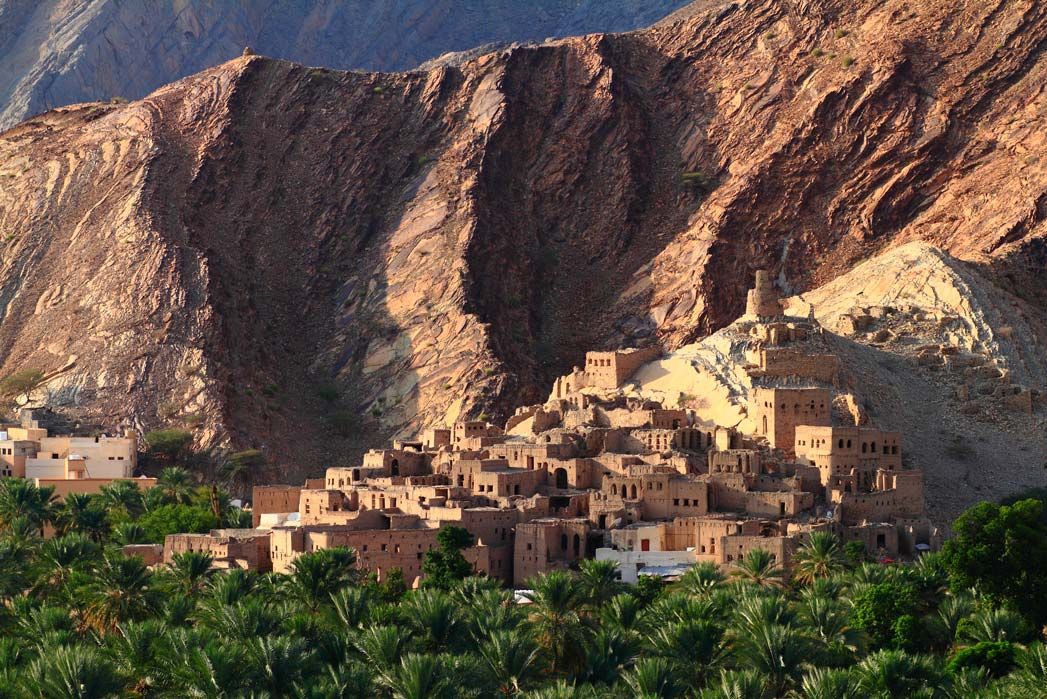

Oman may very well be the hidden gem of the Middle East.
Standing with two strangers in a remote corner of an exotic land, hearing the languid soft twang of an Australian accent is a surprise. I should be used to it by now. We seem to turn up everywhere. But it always catches me unaware. “It’s like a fairyland." I turn to the women next to me who has broken my meditation by reading my mind. I smile, then chuckle. “Yeah, it sure is." Michelle from Brisbane had just spoken out loud the words that I had been desperately trying to grasp since I arrived in Oman two days earlier.
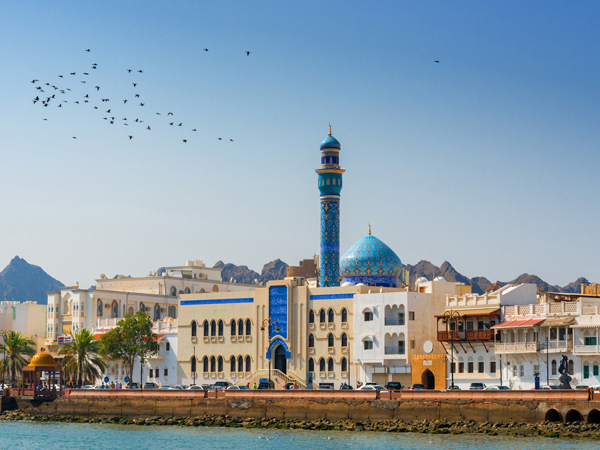
The Making of Oman
Oman’s recent history reads like a fairytale.
The isolationist, backward and controlling Sultan Said bin Taimur placed his son and heir under house arrest for having ideas that are too modern and forward-thinking. The son rises and, in an almost bloodless coup (legend has it the Sultan shot himself in the foot, so as not to appear meek and spineless), takes over the country and exiles his father to England. Sultan Qaboos’ ascension to the top ushers in a new golden era where the people are happy, content and love their ruler. The fairytale unfolded in 1970.
Today the Omanis are very, very appreciative, and fond of their ruler. You would be too if you didn’t have to pay taxes and the government granted you up to four parcels of land if ‘you would just please fill in the forms’. But Sultan Qaboos’ reign is about so much more than mere materialistic gain, even if the Omanis themselves don’t see it that way. When Qaboos put dad into retirement, the country had a single sealed road just six kilometres long, one hospital and three schools with a total of 900 students. Today there are more than 60 hospitals and more than 1000 public schools. Education and healthcare are free and the youth literacy rate is almost 98%. It’s a country that has truly taken a huge leap forward.
No wonder the Omanis are an easy-going bunch.
The charming people of Oman
“What do you mean your name is Masoud?" I cry at Yousef who, it now turns out, is not who I thought he was. “Why didn’t you correct me? I have been calling you Yousef for the last three days." He just smiles at me. Yousef cum Masoud is the very model of a genteel Omani gentleman.
Impeccably groomed with a strong Arabic nose and well-trimmed beard, he’s quick to smile and laugh, seems to do everything effortlessly and at every stop on our four days together, shares a laugh with yet another old friend he’s run into. We bond over our love for our children and his son’s love of FC Barcelona – a fond topic of ours over the many kilometres we cover. He’s a typical Omani: an exemplary kind and generous Muslim – polite to the end with impeccable manners.
Several times a day strangers stop Masoud and ask to take a photo with him in his Dishdasha. Every time he smiles and says, “Of course". It starts to annoy me and I want to tell the happy snappers to get lost – it’s rude to stare at a guy in a dress. Yet Masoud enjoys it. I ask him about it and he just shrugs his shoulders, “It’s different to where they are from." Sure, but how does that make it okay?
Masoud teaches me that the Omanis are so proud of their heritage, their country and their lifestyle that they just want to make sure people leave feeling like they had a good time and appreciating what they do; a fairytale country of magic.
The magical mountains of Oman
Oman’s Al Hajar Mountains make it very physically different to and geographically more interesting than its Arabian Peninsula neighbour, and the country it most often gets compared to the UAE. The two nations are like chalk and cheese. Oman is Colin Firth to the UAE’s David Beckham.
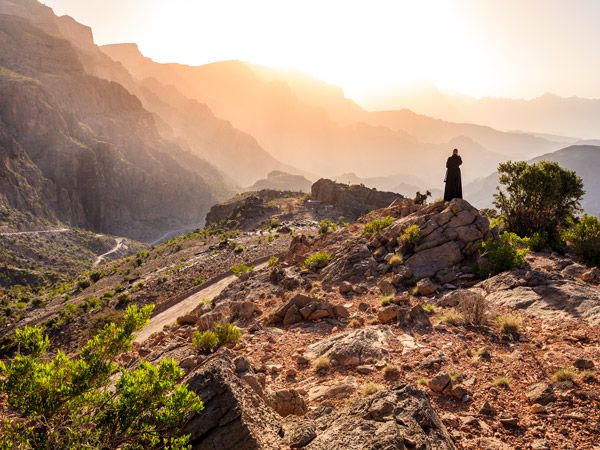
I spend most of my time in the mountains. Quite spectacularly, the mountains start rising fiercely out of the rocky sandy landscape just minutes outside Muscat. The peaks form a formidable barrier that historically divided the area’s interior tribes from its far more cosmopolitan coastal rivals.
These days, it’s a mere one-and-a-half-hours to Nizwa and then another hour up to the locals’ most beloved region of the mountainous interior, Jabel Al Akhdar, ‘the Green Mountains’. In what is a great example of selling your best asset, the Green Mountains are in fact grey or yellow for much of the year.
Then, in a burst of spring and summer life, the terraces that cling to the edges of steep deep gorges explode into colour, mostly green. The greening kicks off with roses and the much sought-after rose harvest in early spring, from late March to mid-May, for the manufacture of rose water. As the roses dwindle, pomegranates, peaches, almonds, walnuts, figs and apricots take their place.
It is during this period, in the height of summer when the rest of Oman is sweating its very proper socks off, that Jabel Al Akhdar hits peak season. The mountains are beautifully cool thanks to the elevation. From the pool terrace at Sahab Hotel, a setting sun kisses the pink and yellow village houses of Al Ayn. The houses cling to the ravine edges, seemingly pulling their tortoise-shell-shaped plots of date palms and crops in close for warmth from the cool night ahead.
While the Jabal Al Akhdar gorges are very narrow slices out of the land, at Jabel Shams (Sun Mountain) 90 minutes north of Nizwa, it seems like a giant has gouged gaping holes out of the earth on a scale hardly comprehensible. Masoud, like a magician, times the revelation perfectly.
Driving across the plateau after another steep climb, we round a turn as Masoud says, “Welcome to the Omani Grand Canyon". It’s so unexpected I blurt out “Oh my {beeping} god". I apologise immediately, feeling incredibly uncouth in comparison to Masoud’s impeccable politeness, but I suspect he’s secretly pleased, it’s an indication of the success of his trick.
As the highest point in Oman this is the first place struck by the suns rays every day, hence the Sun Mountain moniker. From on top of the mountain, the earth disappears off a cliff to about one-and-a-half kilometres below. And right at the bottom of the chasm a small cluster of date palms indicates a village.
Historical forts of Oman
If Australians turn up in every corner of the globe, then somewhere in the wilderness we’re admiring, there will always be a group of Germans decked out in the latest walking gear, bashing their way along a track. I find them in the Jebel Shams, like ants halfway down the cliff face. Being so close to Europe, the Germans have discovered Oman and have taken to exploring it with much greater enthusiasm than we Aussies. Yet when I speak to the intrepid walkers that night, they too feel as if Oman is the best-kept secret in the Middle East.
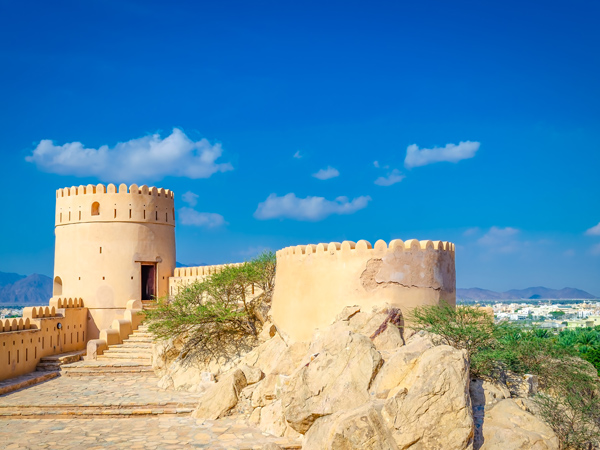
Michelle from Brisbane and I had actually been looking at World Heritage-listed Bahla Fort when we met. Oman has more than 1000 forts, towers and castles, which are so ubiquitous that one becomes blasé until something outrageously spectacular comes into view.
Jibreen Castle stands singularly on the billiard-table-flat plains an hour north of Nizwa. While Nizwa Fort is the most visited site in the country, Jabrin is in fact far more beautiful. For all its intimidation externally, internally Jabrin Castle is an oasis of fine intricate artwork. The ornate paintings on the roof and exquisite relief carvings on the stairwell to the Sultan’s bedroom are magnificent detailed artworks.
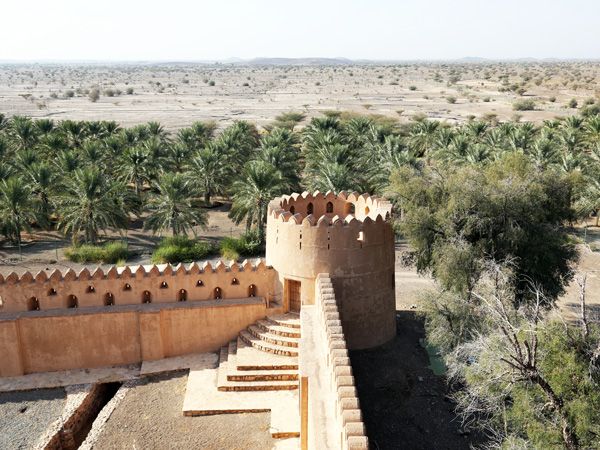
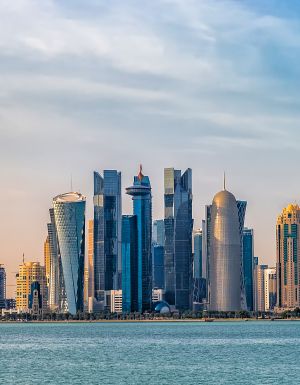
Nizwa Fort is by far the most intimidating of the Omani forts. The 35-metre-tall tower sits squat in the middle of town, like a pink schoolyard bully in the middle of the pitch daring anyone to try and move them. Oman takes the concept of travelling in the Middle East and turns it on its head. The misconception of glitzy high rises and uber glam resorts on reclaimed land are replaced by a more serene, contemplative fairyland. A country of such romance, history and genteel genuine hospitality, it is an enigma; a utopian mirage that is actually not mythical but within grasp.
How to get to Oman
Etihad flies direct to Abu Dhabi twice daily from Sydney, daily from Melbourne, and daily with a Singapore stopover from Brisbane. Connections to Muscat operate twice daily.
When to travel to Oman
Oman is the most unusual Middle Eastern destination in that at any given time one region of the country will be at its best.
But for most of the sites, the best time to see Oman is November to mid-March. The Jabel Al Akhdar is at its best from May to July, but the rest of the country is stiflingly hot and the monsoon is in full swing in the tropical south, although is spectacular to witness.
Where to stay in Oman
Where to stat in Muscat
Shangri-La’s Barr Al Jissah Resort & Spa is where you want to book. There are three five-star hotels in the one complex that caters to all travellers. The hotels all face the beach.
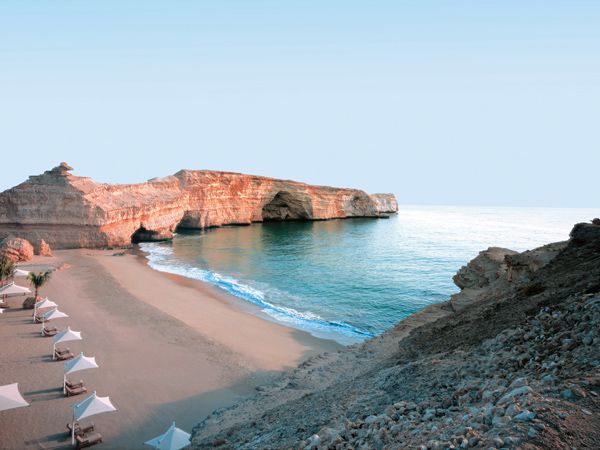
1. Al Husn – the most exclusive and designed for couples. Guests have access to a stunning private beach and infinity-edge pool. The mini bar is all complimentary as are cocktails at 5 pm every day in the central courtyard. The two restaurants are serious affairs; the modern Sultanah and the exquisitely designed Moroccan restaurant Shahrazad.
Address: Muscat 100 Muscat, Muscat 644, Oman
2. Al Bandar – slightly more corporate and attracts conferences. It has the majority of eateries and bars.
Address: OM Al Jissah Street, 100, Oman
3. Al Waha – the largest resort in the complex and is totally dedicated to family holidays with a kids club, children’s pools and aquatic play area.
Address: Al Jissah Street, Muscat 100, Oman
Outside Muscat, hotels are usually rustic to basic.
Weekly travel news, experiences
insider tips, offers, and more.
Where to stay in Jabel Al Akhdar
Sahab Hotel has the most stunning views of the terraced farms and gardens at Jabel Al Akhdar – the best is at sunrise. The four-star rooms are comfortable without being luxurious, the bathroom a little cramped and the restaurant is not bad if a little limited in the menu. The pool is gorgeous even if the water is freezing, so head to the heated jacuzzi. This is a dry resort.
Address: Sayq, Oman
Where to stay in Nizwa
Falaj Daris Hotel is single story motel-style accommodation. The central courtyard is divided into two with a pool in each quadrangle.
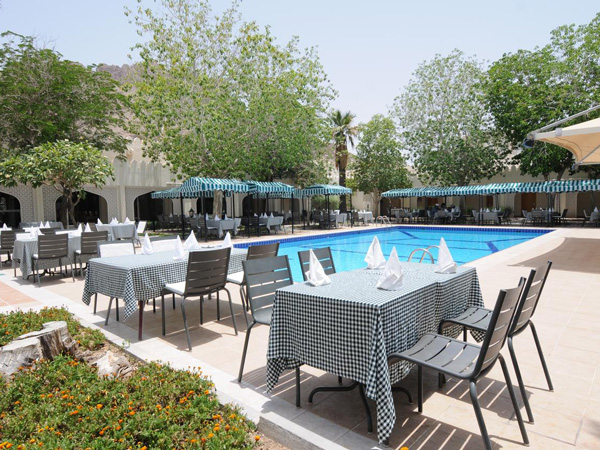
Address: Nizwa, Oman
Touring and tours of Oman
Oman is a destination where a guide is very helpful, if only for a few days to get your bearing. Our guide Masoud was part of Eihab Travels who can be booked in Australia through Bench International.
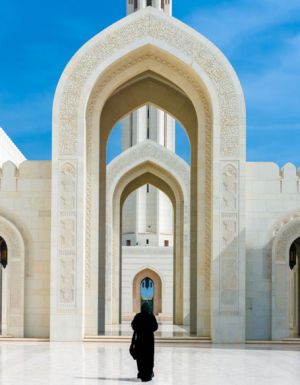
You can’t leave Muscat without visiting the Grand Mosque. It’s a sight to behold and a meticulously crafted building on a scale that is hard to believe.
Dropping in on the Bait Al Zubair Museum, which tells the story of the Omani people in great detail. Put aside at least half a day.
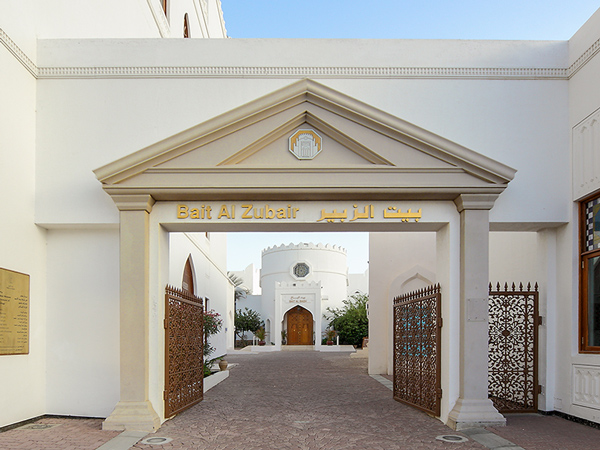
Spending the other half of your day in the Muttrah Souq. It’s shopping but not as you know it – you can pick up exquisite textiles and jewellery.
The best thing about travelling in Oman
An authentic experience, which is clearly not contrived. This is the true traveller’s Middle East.
The worst thing about travelling in Oman
Driving. The Omanis make the Italians look like Captain Cautious on the roads. It’s just best not to watch.
Tips and tricks for travelling in Oman
Dress codes are not a problem. To be culturally sensitive wear long trousers and if you’re a woman, long sleeves.
The cuisine is distinctly sub-continental with the main dish being an unspicy version of the Indian rice dish Biryani.
If this article made you keen on visiting Oman, check out our ultimate travel guide to this Middle Eastern secret.
Want to see more stories from International Traveller in your Google search results?
- Click here to set International Traveller as a preferred source.
- Tick the box next to "International Traveller". That's it.