
hero media

Five ways to eat haggis

Considered Scotland’s national dish, haggis – a mix of offal (sheep hearts, livers and lungs), onions, oatmeal, suet, spices and salt boiled in a sheep’s stomach (or sausage casing) – is a lot more delicious than it sounds (no, really), and a definite must-try when visiting.


Here are five ways to eat what Robert Burns called the “Great chieftain o’ the puddin’-race".

1. Traditional

If you want to try the purist’s version of haggis, it needs to come with neeps (turnip) and tatties (potato). Contrary to popular belief, you don’t eat the sheep’s stomach encasing the ingredients; the boiled pudding is sliced open and the contents are spooned out and plated up with generous mounds of mashed turnip and potato. Interest is often added with the inclusion of a creamy whisky sauce on the side.


Some of the best places to try it in Edinburgh are The Last Drop, an atmospheric pub complete with its own ghost in the historic Grassmarket, the Royal McGregor on the Royal Mile, the mile-long road leading from Edinburgh Castle to the Palace of Holyroodhouse, and Whiski Bar & Restaurant, also on the Royal Mile, where you can chase it down with one of the 300 or so malt whiskies on offer.


In Glasgow, try Stravaigin in the city’s West End, and local institution Ubiquitous Chip. And if the whole offal thing seems, well, awful, you can also try the vegetarian option made with legumes and mushrooms: Hendersons of Edinburgh has vegan haggis, tried and tested since 1962.
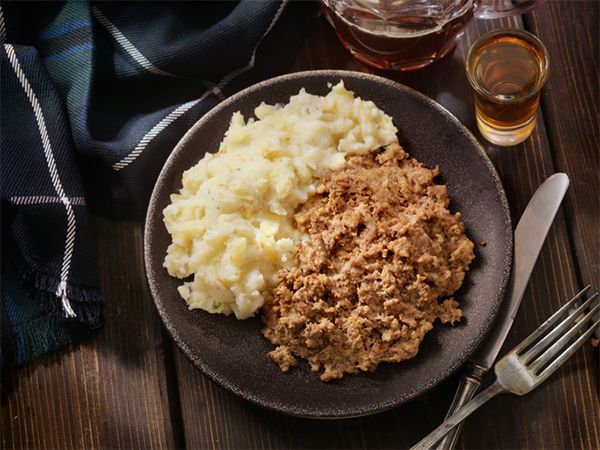
Traditional Haggis
A traditional plate of Haggis is a bucket list item all on it’s own

2. Nachos

Nachos has become a staple on menus across the world, but Scots have figured out a way to make it all their own: haggis nachos. I was sceptical, trust me. Something about the pairing of avocado and haggis gave me serious pause for thought, but having pushed aside my doubts, this dish turned out to be a taste sensation.


A base of corn chips is piled high with haggis, melted cheese, diced tomato, sour cream and guacamole; the mellow gamey meatiness of the haggis is the perfect complement to the salty crunch of the chips and the slightly sweet tang of the sour cream, while its spiciness delivers the oomph that would usually be supplied by chillies.

Haggis nachos
Haggis nachos combine the best of both worlds

3. Crisps

The perfect option for those who want to say they have tried haggis without actually trying it, Mackie’s of Scotland makes haggis and cracked black pepper crisps (never potato chips or chips), which are widely available in corner shops and supermarkets. Rest assured, the zing of the pepper tends to mask any meaty taste that may be present.

4. Toasted sandwich

The ultimate comfort-food offering is cranked up a notch with the inclusion of haggis; the best toasties (full disclosure: I tried quite a few on my visit to Scotland) should have a base of thick-sliced granary bread, with a robust local Scottish cheddar melting and melding with the haggis. One of the best sandwiches on offer (served up in the tearoom located in the old kitchens of the 800-year-old Fyvie Castle in Aberdeenshire, no less) had a caramelised red-onion marmalade that added a sweet tang to the unctuous filling.


To DIY at home, MacSween offer a pretty tasty home-cooked recipe that’s just waiting for your signature flare.

MAcSween haggis toastie
MacSween haggis toastie is an entry-level alternative

Weekly travel news, experiences
insider tips, offers,
and more.

5. Battered and fried

To experience haggis like a local, it is best to head to the nearest ‘chippy’, the local fish-and-chip shop – of which there is at least one in every town, no matter how small. Order a haggis supper consisting of a thick haggis sausage dipped in batter and deep fried, served with a portion of thick-cut chips.


When in Edinburgh, definitely say yes to the offer of ‘salt and sauce’ with your supper: Scottish chip-shop sauce is an ambrosial mix of brown sauce and vinegar that perfectly completes the offering. A deep-fried Mars bar (yes, this is a thing) for dessert is optional.

Want to see more stories from International Traveller in your Google search results?

  1. Click here to set International Traveller as a preferred source.
  2. Tick the box next to "International Traveller". That's it.
hero media

What the European heatwave means for your summer travel plans

Temperatures are soaring this summer, breaking records across Europe and the UK. 

Euro summer is a feeling like no other. But when a heatwave hits? The dream trip quickly turns into a sweaty mess. Extreme heat is sweeping Europe and the UK this week, with record-high temperatures impacting travel plans across the continent.

And while Australian summers are typically hotter in absolute temperature, many European cities aren’t equipped for high temperatures, resulting in unbearable weather.

Why is it so hot in Europe?

Signs of a hot summer loomed in May, when the mercury hit unprecedented spring highs. Now, extreme high temperature warning alerts have been issued in countries such as Spain, Italy, France, England, the Netherlands and Germany.

France saw its hottest day on record on Wednesday, with an average temperature of 30°C across the day and night. This surpasses the average temperature for June, which is 15°C to 25°C. Dozens of people have died, including 40 from drowning.

In Spain, 212 deaths have been linked to the heatwave.

The UK recorded its hottest June day ever on Wednesday with temperatures soaring to 36.1°C. In an article published by the Met Office – the UK’s national meteorological service – Professor Stephen Belcher CBE, Met Office Chief Scientist, shared his concerns about June’s heat. “To see temperatures like this in the UK in June is sobering. Events like this bring home the implications of climate change, with very high temperatures and humidity bringing significant health implications from heat stress, as well as impacts to a range of sectors such as transport, energy and water supply,” he said.

Heatwaves are becoming increasingly common in Europe and the UK, neither of which is prepared for such extremes. The World Meteorological Organization reported that in 2025, at least 95% of Europe experienced above-average annual temperatures and that the continent was heating up twice as fast as the global average.

How travel is impacted

A pharmacy sign displaying 40 degrees Celcius
A pharmacy broadcasting local weather data. (Credit: Getty/Dragoncello)

During a heatwave, power grids, water systems and transport networks can be affected, resulting in disrupted itineraries for travellers. In France, power outages have left thousands without electricity and early closures have been implemented for two of Paris’s biggest attractions, the Eiffel Tower (early afternoon rather than late at night) and the Louvre (two hours early). Eurostar cancelled its London to Paris and Paris to London services from the 22nd to the 25th, and major UK rail companies have been advising travellers to avoid using trains where possible, or to travel during early hours.

If a heatwave is predicted, being flexible with your itinerary and having fully refundable/changeable tickets is key, as extreme heat can force the cancellation of outdoor activities, impact rail and flight services and change the opening hours of sites and eateries.

Why does summer in Europe often feel hotter than summer in Australia?

people swimming in the Canal Saint-Martin in Paris
People swimming in the Canal Saint-Martin in Paris to cool off. (Credit: Rachael Thompson)

With some of the highest UV levels in the world, Australians are no strangers to the heat, adapting well to intense weather. But our infrastructure is largely equipped to withstand soaring temperatures with climate-responsive passive design, refrigerated air conditioning or evaporative coolers, as well as swimming spots aplenty.

Buildings in Northern and Western Europe and the UK, however, are constructed to retain heat and handle frosty winters. The lack of universal air conditioning means it generally feels hotter even though the temperature on your app might not look it. During a heatwave, it can feel like you’re in a sauna as cities act like heat traps.

How to stay cool and prepare for another heatwave

Relief is expected across Europe and the UK later this week, but more heatwaves are still possible in the coming months. Summer heat typically peaks in July and August.

Public transport often doesn’t have air conditioning, and buses in particular can be swelteringly hot. If you’re heading outside or your accommodation has no air conditioning, it’s worth buying a spray bottle and a handheld fan from a pharmacy or tourist stand. Check ahead of time if restaurants and cafes have air conditioning and make a booking in advance. The highest temperatures typically hit between 3pm and 6pm, so aim to head outdoors outside of these hours.

Rising temperatures invite travellers to enter a more intentional era of seeing the world. Now more than ever is the time to embrace lower-impact “coolcations” and off-season getaways.