hero media

Shakespeare fans: 6 unmissable things to do in England

We take you to the unmissable places around England that shaped the world-renowned poet, playwright, and actor. A not-to-be-missed list for every Shakespeare fan.

1. Shakespeare’s Birthplace
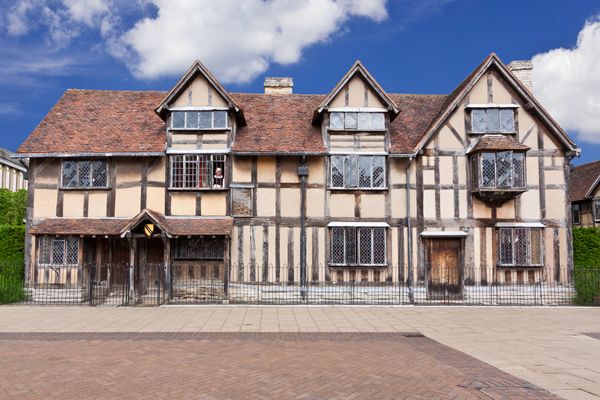
The restored 16th-century half-timbered house situated on Henley Street, is believed to be the birthplace of William Shakespeare and is now a museum.

Pay a visit to the restored Tudor mansion in Stratford-upon-Avon where the Bard of Avon was born, and lived until after he was married.


A hands-on insight into Shakespeare’s early life, this landmark building is also a shrine to his career.


Be sure to check out the ‘Friends and Family’ display, which focuses on his nearest and dearest and the relationships he shared with friends, neighbours, drinking companions and colleagues.


Address: The Shakespeare Centre, Henley St, Stratford-upon-AvonWarwickshireCV37 6QW

2. Shakespeare’s Schoolroom and Guildhall
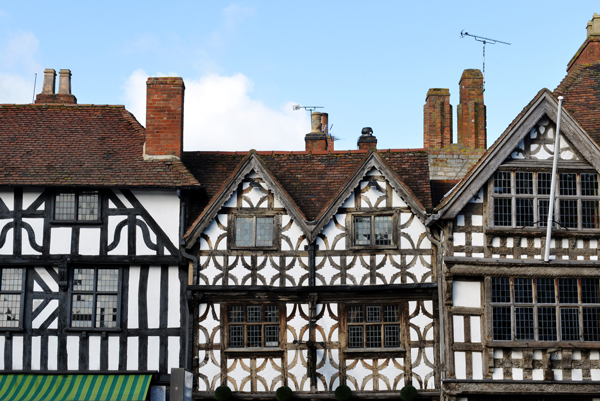
Shakespeare's home town
The gorgeous wooden buildings on Church street in Shakespeare’s home town.

Going back to where it all began, Shakespeare’s Schoolroom and Guildhall in Stratford-upon-Avon underwent a £1.8 million restoration project in 2016 and has been opened to the public since.


This is the school that Shakespeare attended as a boy from about 1571 to 1578, the place where he would have first experienced theatre, which now features a recreated classroom from his academic years.


Built between 1418 –1420, the Guildhall has been described by historian Michael Wood as ‘one of Britain’s most atmospheric buildings’.


Address: Shakespeare’s Schoolroom & Guildhall, Church Street, Stratford-upon-Avon, Warwickshire, CV37 6HB

3. Shakespeare Walking Tours
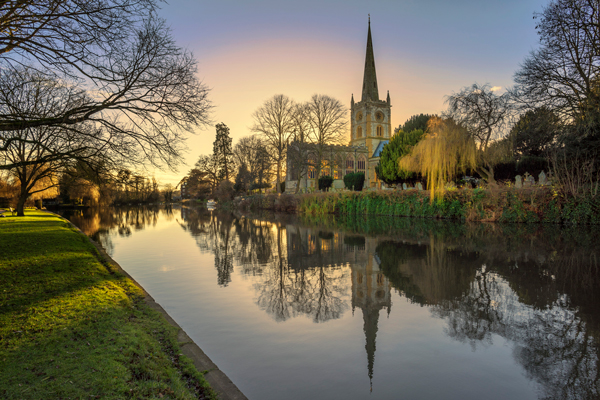
Shakespeare's grave
William Shakespeare is buried at Holy Trinity Church in Stratford-upon-Avon.

Take your time exploring Shakespeare’s hometown in Stratford-upon-Avon by taking your own self-guided tour. GPSmyCity is a downloadable app that turns your mobile or tablet into a personal tour guide. You will be able to follow the built-in GPS navigation to guide you along the tour to the most popular Shakespeare attractions. The Stratford-Upon-Avon Shakespeare Tour takes in seven attractions over a distance of 1.1 km and lasts for about one hour (but of course you can take as little or as much time as you like). The app also works offline, so you don’t need to worry about data while travelling abroad.


Download the app: GPSmyCity: Walks in 1K+ Cities from iTunes App Store or Google Play

4. New Place

Visit the New Place in Stratford-upon-Avon, Shakespeare’s home for the last 19 years of his life, which has become a significant heritage landmark.


Shakespeare wrote 26 of his best-loved plays as owner of New Place, which made it all the more devastating when the building was demolished in 1759 by the then owner, who was ticked off by visiting Shakespeare enthusiasts.


The re-imagined New Place will showcase how Shakespeare lived at the height of his career, as a family man, a homeowner and a successful entrepreneur.


Address: Shakespeare’s New Place, 22 Chapel Street, Stratford-upon-AvonWarwickshireCV37 6EP

5. Shakespeare’s Globe

No fan’s visit is complete without a visit to Shakespeare’s Globe theatre, overlooking the River Thames in London’s South Bank.
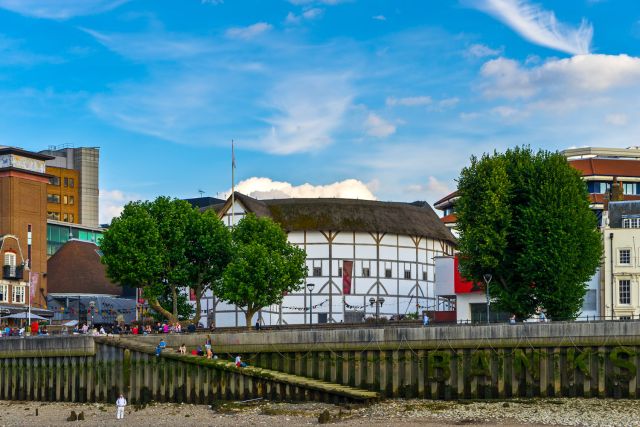
The Globe Theatre London
A sympathetic and accurate reconstruction of Shakespeare’s theatre.

Housing a modern reconstruction of Shakespeare’s Elizabethan playhouse, the Globe Theatre, here you can see one of the classics performed like theatre-goers did in Shakespeare’s day, standing in the rowdy ‘yard’ in front of the stage.


You can also tour backstage or visit the popular exhibition about Shakespeare’s life and how it intertwined with London.


Address: Shakespeare’s Globe, 21 New Globe Walk, Bankside, London, SE1 9DT

Weekly travel news, experiences
insider tips, offers,
and more.

6. Bard-style biking

Anne Hathaway's cottage
You can visit Anne Hathaway’s cottage in Stratford-upon-Avon.

Cycling-tour expert The Carter Company, offers a ten-night Shakespeare’s Way tour, following a route that the great playwright regularly took himself.


Beginning at Shakespeare’s Globe, where most of his plays were first performed, the itinerary meanders along the River Thames, pedalling through beautiful English countryside of the Cotswolds, passing Hampton Court, Windsor, Oxford (where Shakespeare often rested on this journeys between London and his hometown), Blenheim Palace to Stratford-upon-Avon in the Midlands.


Covering a leisurely 17 – 35 kilometres a day, it’s a gentle ride and it includes accommodation at country hotels and quaint inns along the way.


More information: Starts Fridays from London and finishes Stratford on Avon.


Are you planning a trip to London? Here is our guide to everything you need to know about London before you go.

Want to see more stories from International Traveller in your Google search results?

  1. Click here to set International Traveller as a preferred source.
  2. Tick the box next to "International Traveller". That's it.
hero media

What the European heatwave means for your summer travel plans

Temperatures are soaring this summer, breaking records across Europe and the UK. 

Euro summer is a feeling like no other. But when a heatwave hits? The dream trip quickly turns into a sweaty mess. Extreme heat is sweeping Europe and the UK this week, with record-high temperatures impacting travel plans across the continent.

And while Australian summers are typically hotter in absolute temperature, many European cities aren’t equipped for high temperatures, resulting in unbearable weather.

Why is it so hot in Europe?

Signs of a hot summer loomed in May, when the mercury hit unprecedented spring highs. Now, extreme high temperature warning alerts have been issued in countries such as Spain, Italy, France, England, the Netherlands and Germany.

France saw its hottest day on record on Wednesday, with an average temperature of 30°C across the day and night. This surpasses the average temperature for June, which is 15°C to 25°C. Dozens of people have died, including 40 from drowning.

In Spain, 212 deaths have been linked to the heatwave.

The UK recorded its hottest June day ever on Wednesday with temperatures soaring to 36.1°C. In an article published by the Met Office – the UK’s national meteorological service – Professor Stephen Belcher CBE, Met Office Chief Scientist, shared his concerns about June’s heat. “To see temperatures like this in the UK in June is sobering. Events like this bring home the implications of climate change, with very high temperatures and humidity bringing significant health implications from heat stress, as well as impacts to a range of sectors such as transport, energy and water supply,” he said.

Heatwaves are becoming increasingly common in Europe and the UK, neither of which is prepared for such extremes. The World Meteorological Organization reported that in 2025, at least 95% of Europe experienced above-average annual temperatures and that the continent was heating up twice as fast as the global average.

How travel is impacted

A pharmacy sign displaying 40 degrees Celcius
A pharmacy broadcasting local weather data. (Credit: Getty/Dragoncello)

During a heatwave, power grids, water systems and transport networks can be affected, resulting in disrupted itineraries for travellers. In France, power outages have left thousands without electricity and early closures have been implemented for two of Paris’s biggest attractions, the Eiffel Tower (early afternoon rather than late at night) and the Louvre (two hours early). Eurostar cancelled its London to Paris and Paris to London services from the 22nd to the 25th, and major UK rail companies have been advising travellers to avoid using trains where possible, or to travel during early hours.

If a heatwave is predicted, being flexible with your itinerary and having fully refundable/changeable tickets is key, as extreme heat can force the cancellation of outdoor activities, impact rail and flight services and change the opening hours of sites and eateries.

Why does summer in Europe often feel hotter than summer in Australia?

people swimming in the Canal Saint-Martin in Paris
People swimming in the Canal Saint-Martin in Paris to cool off. (Credit: Rachael Thompson)

With some of the highest UV levels in the world, Australians are no strangers to the heat, adapting well to intense weather. But our infrastructure is largely equipped to withstand soaring temperatures with climate-responsive passive design, refrigerated air conditioning or evaporative coolers, as well as swimming spots aplenty.

Buildings in Northern and Western Europe and the UK, however, are constructed to retain heat and handle frosty winters. The lack of universal air conditioning means it generally feels hotter even though the temperature on your app might not look it. During a heatwave, it can feel like you’re in a sauna as cities act like heat traps.

How to stay cool and prepare for another heatwave

Relief is expected across Europe and the UK later this week, but more heatwaves are still possible in the coming months. Summer heat typically peaks in July and August.

Public transport often doesn’t have air conditioning, and buses in particular can be swelteringly hot. If you’re heading outside or your accommodation has no air conditioning, it’s worth buying a spray bottle and a handheld fan from a pharmacy or tourist stand. Check ahead of time if restaurants and cafes have air conditioning and make a booking in advance. The highest temperatures typically hit between 3pm and 6pm, so aim to head outdoors outside of these hours.

Rising temperatures invite travellers to enter a more intentional era of seeing the world. Now more than ever is the time to embrace lower-impact “coolcations” and off-season getaways.

Shakespeare Fans: 6 Unmissable Things To Do in England