hero media

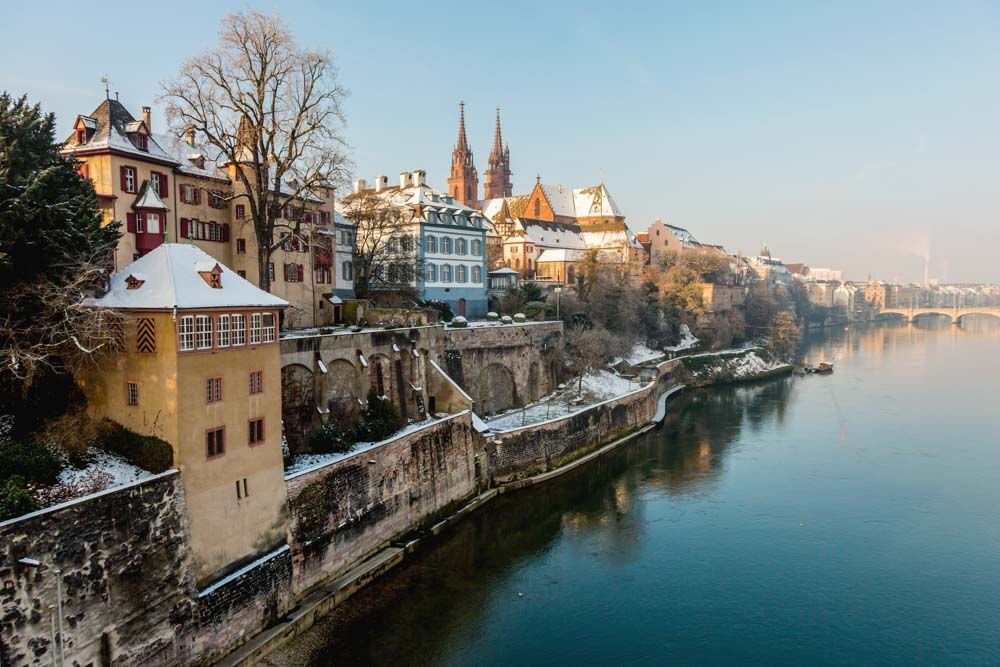
Basel, Switzerland; Essential city guide

In our essential Basel city guide, Robert Upe dives into the culture and unique food of Switzerland’s northern city, and partakes in one of the world’s most bizarre swimming experiences.

Known for

Its art fair, watch making, and the Rhine River.

Eat streets

Basel boasts a number of dishes all its own, from Basler flour soup – traditionally served with cheese and onion tart or suuri lääberli (sour liver strips); to sweet treats like Basler Läckerli – small gingerbread biscuits with a delicious sugar icing; and Mässmogge – colourful thumb-length sweets filled with a hazelnut mixture that reach their seasonal zenith at the Basel Autumn Fair or Basler Herbstmesse in October.

Basel also prides itself on its fine dining. Try Restaurant Gifthüttli, a classic Swiss pub/restaurant specialising in cordon bleu cooking; or Restaurant Stucki by Tanja Grandits, which has two Michelin stars and a faultless menu of artistically presented haute cuisine.

Out & about

Art Basel is one of the world’s premier art events, underlining Basel’s strong cultural and arts offering. But you can get an art fix all year round at some of the city’s world-renowned museums such as Kunstmuseum Basel, Fondation Beyeler, Kunsthalle, the Tinguely Museum, or about 40 others if you have the time.

For something fun, see the Hoosesagg Museum in the Old Town, the city’s smallest museum. There’s no door – just peer through the window at what’s on show.

The mighty Rhine River is a focal point of the city; take a lunch cruise along it or cross it via cable ferry. And one of the nicest ways to tour the city itself is in a vintage tram.

Insider’s secret

Public transport is free with a Mobility Card, available to guests staying at Basel hotels.

Retail reconnaissance

When looking for retail diversions in Basel you should start at the bustling Marktplatz.

The town’s central cobblestoned square is adjacent to the 500-year-old town hall, and market vendors here sell fresh and organic produce, spices, flowers and a fascinating array of smallgoods.

During the warmer months there are food vans, with big beach umbrellas to protect you from the sun, where you can fuel up with a wurstel sausage and mustard roll.

The Old Town is full of craftsman stores like the Johann Wanner Christmas House with its handmade baubles, decorations and Swiss souvenirs. Most shops are closed on Sundays.

The ultimate experience

Basel is an unlikely swimming destination, but one of the favourite warm-weather pastimes here is taking a dip in the fast-flowing Rhine River.

Baselians love to jump in whenever they can. It’s impossible to swim against the strong current, so go with the flow.

You’ll need a watertight bag, called a wickelfisch, for your clothes and towel. Available at local shops and some hotels, they also act as a buoyancy device as you float along.

Stick with the crowd to be safe, and to identify the easiest exit points from the river. Once you’re done, dry off and then take a gentle stroll back to your starting point, stopping for a wine and pretzel along the way.

Weekly travel news, experiences
insider tips, offers,
and more.

Caffeine hits

Try Stadthauscafe, with its delightful courtyard and good cake selection, as well as the equally good Fruehling or La Fourchette.

Stay & play

Affordable

Hotel Basel is well positioned in the heart of the Old Town.

Moderate

Hotel Teufelhof is a boutique art hotel with great style throughout. teufelhof.com

Luxe

Stepping up in class, Hotel Les Trois Rois is a grand property sitting pretty on the Rhine River, complete with a multi-award-winning restaurant, Cheval Blanc. 

Want to see more stories from International Traveller in your Google search results?

  1. Click here to set International Traveller as a preferred source.
  2. Tick the box next to "International Traveller". That's it.
hero media

What the European heatwave means for your summer travel plans

Temperatures are soaring this summer, breaking records across Europe and the UK. 

Euro summer is a feeling like no other. But when a heatwave hits? The dream trip quickly turns into a sweaty mess. Extreme heat is sweeping Europe and the UK this week, with record-high temperatures impacting travel plans across the continent.

And while Australian summers are typically hotter in absolute temperature, many European cities aren’t equipped for high temperatures, resulting in unbearable weather.

Why is it so hot in Europe?

Signs of a hot summer loomed in May, when the mercury hit unprecedented spring highs. Now, extreme high temperature warning alerts have been issued in countries such as Spain, Italy, France, England, the Netherlands and Germany.

France saw its hottest day on record on Wednesday, with an average temperature of 30°C across the day and night. This surpasses the average temperature for June, which is 15°C to 25°C. Dozens of people have died, including 40 from drowning.

In Spain, 212 deaths have been linked to the heatwave.

The UK recorded its hottest June day ever on Wednesday with temperatures soaring to 36.1°C. In an article published by the Met Office – the UK’s national meteorological service – Professor Stephen Belcher CBE, Met Office Chief Scientist, shared his concerns about June’s heat. “To see temperatures like this in the UK in June is sobering. Events like this bring home the implications of climate change, with very high temperatures and humidity bringing significant health implications from heat stress, as well as impacts to a range of sectors such as transport, energy and water supply,” he said.

Heatwaves are becoming increasingly common in Europe and the UK, neither of which is prepared for such extremes. The World Meteorological Organization reported that in 2025, at least 95% of Europe experienced above-average annual temperatures and that the continent was heating up twice as fast as the global average.

How travel is impacted

A pharmacy sign displaying 40 degrees Celcius
A pharmacy broadcasting local weather data. (Credit: Getty/Dragoncello)

During a heatwave, power grids, water systems and transport networks can be affected, resulting in disrupted itineraries for travellers. In France, power outages have left thousands without electricity and early closures have been implemented for two of Paris’s biggest attractions, the Eiffel Tower (early afternoon rather than late at night) and the Louvre (two hours early). Eurostar cancelled its London to Paris and Paris to London services from the 22nd to the 25th, and major UK rail companies have been advising travellers to avoid using trains where possible, or to travel during early hours.

If a heatwave is predicted, being flexible with your itinerary and having fully refundable/changeable tickets is key, as extreme heat can force the cancellation of outdoor activities, impact rail and flight services and change the opening hours of sites and eateries.

Why does summer in Europe often feel hotter than summer in Australia?

people swimming in the Canal Saint-Martin in Paris
People swimming in the Canal Saint-Martin in Paris to cool off. (Credit: Rachael Thompson)

With some of the highest UV levels in the world, Australians are no strangers to the heat, adapting well to intense weather. But our infrastructure is largely equipped to withstand soaring temperatures with climate-responsive passive design, refrigerated air conditioning or evaporative coolers, as well as swimming spots aplenty.

Buildings in Northern and Western Europe and the UK, however, are constructed to retain heat and handle frosty winters. The lack of universal air conditioning means it generally feels hotter even though the temperature on your app might not look it. During a heatwave, it can feel like you’re in a sauna as cities act like heat traps.

How to stay cool and prepare for another heatwave

Relief is expected across Europe and the UK later this week, but more heatwaves are still possible in the coming months. Summer heat typically peaks in July and August.

Public transport often doesn’t have air conditioning, and buses in particular can be swelteringly hot. If you’re heading outside or your accommodation has no air conditioning, it’s worth buying a spray bottle and a handheld fan from a pharmacy or tourist stand. Check ahead of time if restaurants and cafes have air conditioning and make a booking in advance. The highest temperatures typically hit between 3pm and 6pm, so aim to head outdoors outside of these hours.

Rising temperatures invite travellers to enter a more intentional era of seeing the world. Now more than ever is the time to embrace lower-impact “coolcations” and off-season getaways.