hero media

12 world-record breaking attractions found in Switzerland

Switzerland might be a small country that is roughly two-thirds the size of Tasmania, but this country is an overachiever when it comes to breaking world records.

You’ve read about the scenic train routes, the picturesque cycling routes and skiing in the shadow of the Matterhorn but the Swiss also have 12 world-record breaking attractions you’ll want to add to your travel itinerary.

1. World’s steepest cogwheel railway
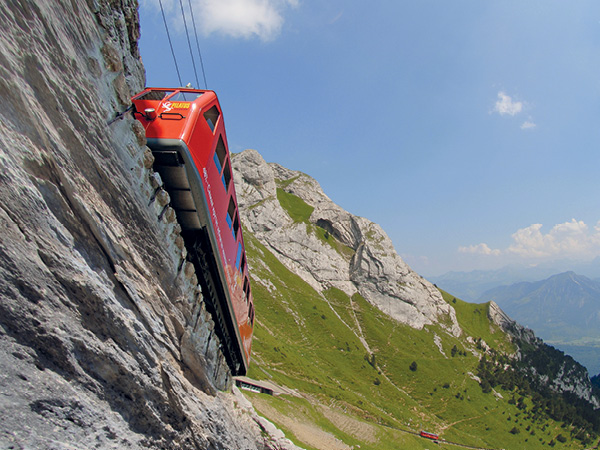
Lake Lucerne Cogwheel Railway
Switzerland is home to the world’s steepest cogwheel railway and can be found in Lake Lucerne.

The cogwheel railway is one of the most popular attractions on Lake Lucerne thanks to its 48-degree gradient. Ascending 1635 metres from Alpnachstad (where the ferry stops), the railway travels 4618 metres up to the fun park of Mt Pilatus. The ride itself takes about 30 minutes and operates between May and November. And it is just one of the many iconic Swiss train journeys in a country synonymous with astonishing railways.

2. World’s longest suspension bridge
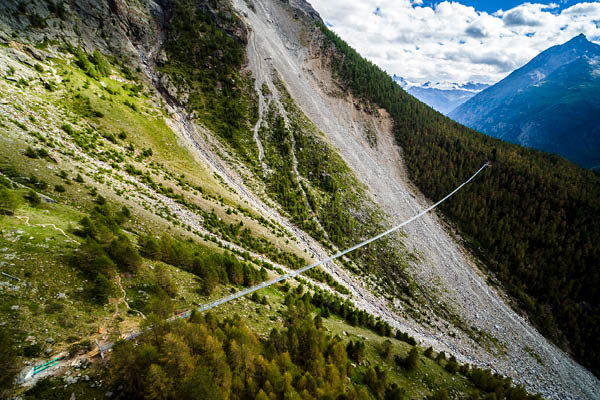
Charles Kuonen Bridge
The Charles Kuonen Bridge is the world’s longest suspension bridge and connects a hiking trail between Grachen and Zermatt.

There’s nothing like crossing a suspension bridge to get your heart rate up, and you’ll find the world’s longest in Switzerland. The Charles Kuonen Bridge connects a hiking trail between Grachen and Zermatt and stretches 494 metres in length. The views from the bridge are equally thrilling, being set against the world’s most recognisable mountain peak, the Matterhorn.

3. World’s longest tunnel
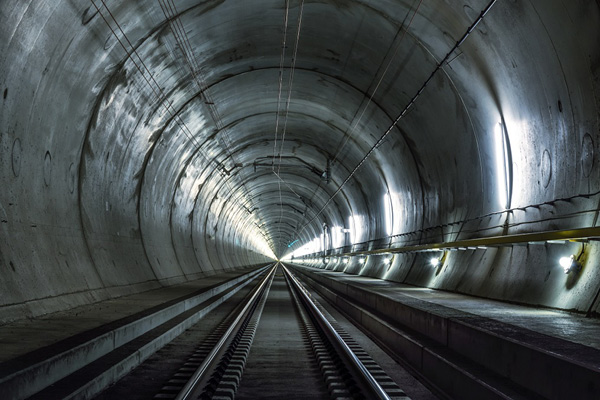
The Gotthard Base Tunnel
The Gotthard Base Tunnel is 57-kilometre long; making it the longest in the world.

The Gotthard Base Tunnel has a long and legendary history originating in the 13th century, but it’s the length of the tunnel that breaks the world record. It took 17 years to construct the 57-kilometre tunnel that runs through the mountain at a depth of up to 2300 metres. Not only is the Gotthard Base Tunnel an engineering feat, but it’s also powered by hydroelectricity.

4. World’s oldest covered wooden footbridge

Chapel Bridge in Lucerne
The world’s oldest covered wooden bridge dates back to the 14th century and can be found in Lucerne.

The Chapel Bridge in Lucerne dates back to the 14th century and was part of the original fortifications of the city. Destroyed in a fire in 1993 , it was quickly restored back to its original form. The bridge is one of Lucerne’s most charming attractions and is decorated with pictorial panels that depict historical life in the country and city during the 17th century.

5. World’s first revolving cable car

The glacier chairlift of Mt. Titlis, the Ice Flyer, is the world’s first revolving chairlift.

Not far from Lucerne is the 3062-metre-high Mt Titlis, home to Europe’s highest suspension bridge and the glacier chairlift ‘Ice Flyer’. To get up there you’ll need to take a 30-minute scenic ride on the Titlis Rotair – which is an experience in itself. As you travel above the spectacular alpine landscape, take note of the fact that you’re riding on the world’s first revolving cable car.

6. World’s highest consumption of chocolate
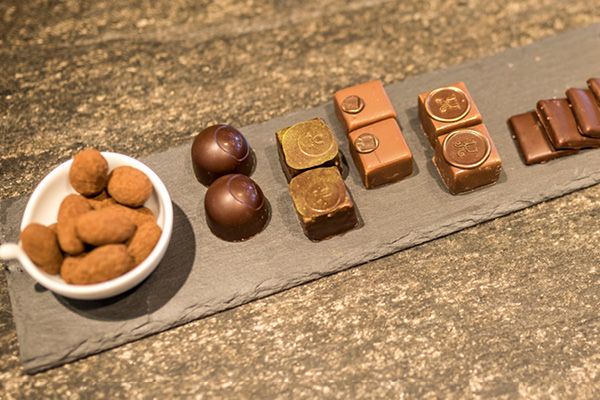
Swiss chocolate
The Swiss enjoy their own chocolate as even more than the rest of the world.

They’ve given the world Nestle, Lindt and Toblerone, so it comes as no surprise that the Swiss are their own biggest fans when it comes to chocolate, taking home the record of consuming the highest amount of the sweet treat in the world. In 2017 alone, the average consumption hit 8.8 kilograms per person. That’s a lot of Lindt balls!

7. World’s highest density of Michelin-starred restaurants per capita
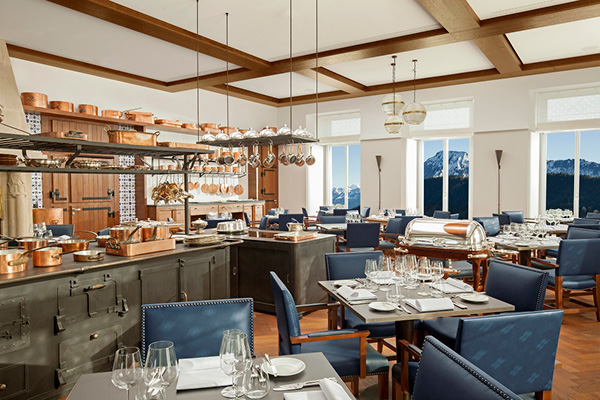
Ritzcoffier Burgenstock
The Michelin starred Ritzcoffier Burgenstock.

Switzerland recorded a total of 128 Michelin starred restaurants in 2019, securing its position as the country with the highest number of top-rated restaurants per capita. Pavillon in Zurich and focus in Vitznau are the country’s most recent restaurants to make their way into the Michelin guide.

8. World’s longest downhill ski race
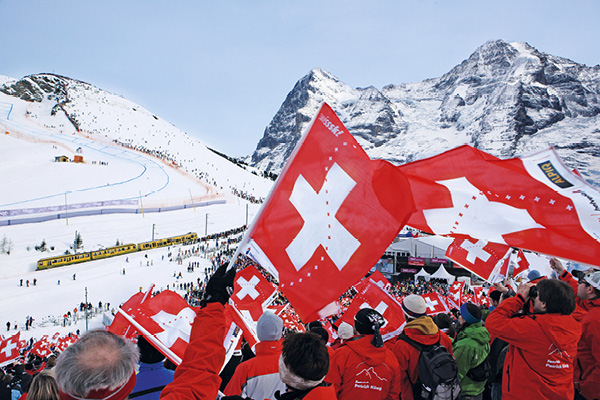
Lauberhorn-Wengen FIS Alpine Ski World Cup
The Lauberhorn-Wengen FIS Alpine Ski World Cup is the world’s longest downhill ski race.

Attracting an average of 30,000 spectators each year, the history of the Lauberhorn-Wengen FIS Alpine Ski World Cup dates back to 1930 and takes place every year in mid-January. With the downhill course stretching over 4.4 kilometres, run times are usually 2.5 minutes where top speeds reach about 160 kilometres per hour.

9. World’s longest staircase
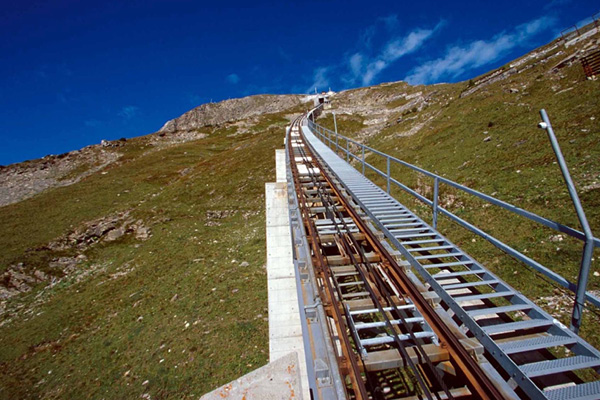
Nieson staircase
You can climb 11,674 steps to reach the peak of Nieson; making it the longest staircase in the world.

Located in the Bernese Alps, the pyramid-shaped mountain peak of Niesen overlooks Lake Thun in Interlaken from 2362 metres above sea level. Ascending the peak can be done via a funicular, which departs every 30 minutes from 8am to 5pm, or by the impressive 11,674 steps.

Weekly travel news, experiences
insider tips, offers,
and more.

10. World’s only peak-to-peak suspension bridge
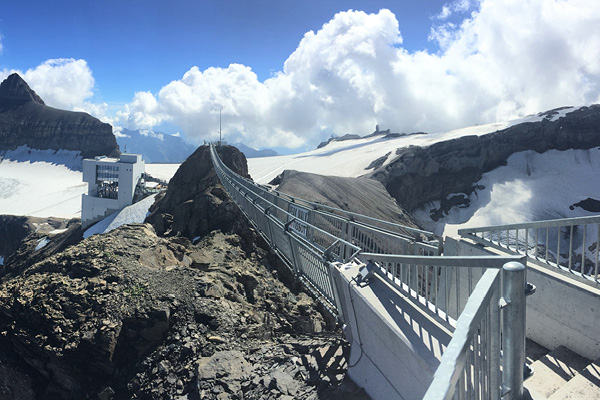
The Peak Walk at Glacier 3000
The Peak Walk at Glacier 3000 is the world’s first suspension footbridge linking two mountains peaks.

Boasting spectacular views of more than 24 snow-capped peaks of at least 4000 metres above sea level including the Eiger, Monch, the Matterhorn, Jungfraujoch and even Mont Blanc, the Peak Walk at Glacier 3000 is the world’s first suspension footbridge linking two mountains peaks.

11. World’s oldest vegetarian restaurant
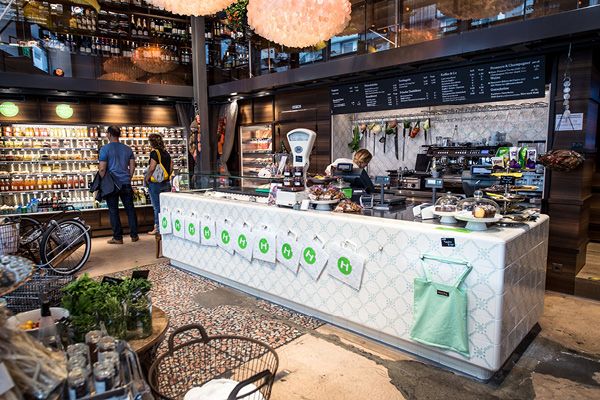
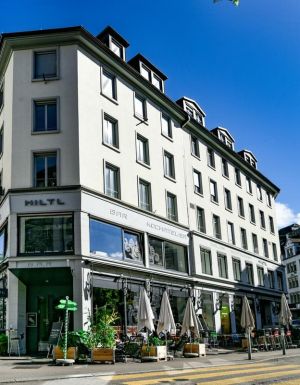
Haus Hiltl in Zurich
Haus Hiltl in Zurich first opened its doors in 1898, and it holds the record for the oldest continuously opened vegetarian restaurant in the world.

Having first opened its doors in 1898, Haus Hiltl in Zurich holds the record for the oldest continuously opened vegetarian restaurant in the world. You can take healthy indulgence to a whole new level at Hiltl, with its selection of 40 varieties of salad, fresh food juices and Indian buffet.

12. World’s best tennis player

Roger Federer
Roger Federer, who was born Basel, is currently the world’s best tennis player.

Apart from incredible natural assets, impressive engineering feats and talented chefs, Switzerland is also home to the world’s best tennis player, Roger Federer, who was born Basel. The nation’s art and architecture capital, Basel is located on the River Rhine and borders France and Germany.


Planning a trip to the home of the Swiss? Make sure you check out the rest of our guide to travelling Switzerland.

Want to see more stories from International Traveller in your Google search results?

  1. Click here to set International Traveller as a preferred source.
  2. Tick the box next to "International Traveller". That's it.
Katie Carlin
Katie Carlin is International Traveller's Head of Content and when she’s not travelling or behind her computer, she’s hosting a dinner party (likely cooking an Alison Roman recipe). She joined International Traveller in 2018 and is responsible for leading the editorial team across print, digital, social, email and native content. Her job is to make sure we create content that connects readers to incredible experiences in around the world. In addition to sharing her expertise on travel through industry speaking engagements, Katie appears on Today, A Current Affair and various radio segments. With a BA in Communications majoring in Journalism and a career that has spanned roles at Fairfax Media and Are Media writing for titles such as The Sydney Morning Herald, The Age, and various lifestyle brands, she brings a wealth of experience to her role. Her most impactful trip to date has been spotting polar bears and beluga whales in Arctic Canada.
View profile and articles
hero media

What the European heatwave means for your summer travel plans

Temperatures are soaring this summer, breaking records across Europe and the UK. 

Euro summer is a feeling like no other. But when a heatwave hits? The dream trip quickly turns into a sweaty mess. Extreme heat is sweeping Europe and the UK this week, with record-high temperatures impacting travel plans across the continent.

And while Australian summers are typically hotter in absolute temperature, many European cities aren’t equipped for high temperatures, resulting in unbearable weather.

Why is it so hot in Europe?

Signs of a hot summer loomed in May, when the mercury hit unprecedented spring highs. Now, extreme high temperature warning alerts have been issued in countries such as Spain, Italy, France, England, the Netherlands and Germany.

France saw its hottest day on record on Wednesday, with an average temperature of 30°C across the day and night. This surpasses the average temperature for June, which is 15°C to 25°C. Dozens of people have died, including 40 from drowning.

In Spain, 212 deaths have been linked to the heatwave.

The UK recorded its hottest June day ever on Wednesday with temperatures soaring to 36.1°C. In an article published by the Met Office – the UK’s national meteorological service – Professor Stephen Belcher CBE, Met Office Chief Scientist, shared his concerns about June’s heat. “To see temperatures like this in the UK in June is sobering. Events like this bring home the implications of climate change, with very high temperatures and humidity bringing significant health implications from heat stress, as well as impacts to a range of sectors such as transport, energy and water supply,” he said.

Heatwaves are becoming increasingly common in Europe and the UK, neither of which is prepared for such extremes. The World Meteorological Organization reported that in 2025, at least 95% of Europe experienced above-average annual temperatures and that the continent was heating up twice as fast as the global average.

How travel is impacted

A pharmacy sign displaying 40 degrees Celcius
A pharmacy broadcasting local weather data. (Credit: Getty/Dragoncello)

During a heatwave, power grids, water systems and transport networks can be affected, resulting in disrupted itineraries for travellers. In France, power outages have left thousands without electricity and early closures have been implemented for two of Paris’s biggest attractions, the Eiffel Tower (early afternoon rather than late at night) and the Louvre (two hours early). Eurostar cancelled its London to Paris and Paris to London services from the 22nd to the 25th, and major UK rail companies have been advising travellers to avoid using trains where possible, or to travel during early hours.

If a heatwave is predicted, being flexible with your itinerary and having fully refundable/changeable tickets is key, as extreme heat can force the cancellation of outdoor activities, impact rail and flight services and change the opening hours of sites and eateries.

Why does summer in Europe often feel hotter than summer in Australia?

people swimming in the Canal Saint-Martin in Paris
People swimming in the Canal Saint-Martin in Paris to cool off. (Credit: Rachael Thompson)

With some of the highest UV levels in the world, Australians are no strangers to the heat, adapting well to intense weather. But our infrastructure is largely equipped to withstand soaring temperatures with climate-responsive passive design, refrigerated air conditioning or evaporative coolers, as well as swimming spots aplenty.

Buildings in Northern and Western Europe and the UK, however, are constructed to retain heat and handle frosty winters. The lack of universal air conditioning means it generally feels hotter even though the temperature on your app might not look it. During a heatwave, it can feel like you’re in a sauna as cities act like heat traps.

How to stay cool and prepare for another heatwave

Relief is expected across Europe and the UK later this week, but more heatwaves are still possible in the coming months. Summer heat typically peaks in July and August.

Public transport often doesn’t have air conditioning, and buses in particular can be swelteringly hot. If you’re heading outside or your accommodation has no air conditioning, it’s worth buying a spray bottle and a handheld fan from a pharmacy or tourist stand. Check ahead of time if restaurants and cafes have air conditioning and make a booking in advance. The highest temperatures typically hit between 3pm and 6pm, so aim to head outdoors outside of these hours.

Rising temperatures invite travellers to enter a more intentional era of seeing the world. Now more than ever is the time to embrace lower-impact “coolcations” and off-season getaways.