hero media

This Atlantic island is Tripadvisor’s no.1 trending destination for 2026

Based on 12 months of review data from its global travel community, Tripadvisor has revealed the destinations travellers think are worth the hype in 2026.

Every year, global travel advice and booking platform Tripadvisor releases its Travellers’ Choice Awards: Best of the Best Destinations. The awards recognise destinations that receive a high volume of exceptional reviews and opinions from the Tripadvisor community over a 12-month period – shining a light on the places travellers love visiting and are most excited about.

The 2026 awards have just been announced, celebrating 270 destinations across 60 countries. As one of the seven award categories, Tripadvisor’s top Trending Destinations in the World reveal emerging places travellers think are worth the hype. The top result for 2026? A small island in the middle of the Atlantic Ocean.

Madeira on the rise

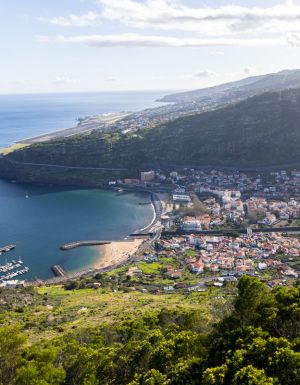
madeira coastline
Explore Madeira’s stunning mountainous coasts. (Image: Unsplash/Julia Solonina)

The Portuguese island of Madeira has been crowned the number one trending destination in the world by Tripadvisor for 2026. Often referred to as the ‘Hawai‘i of Europe’, the autonomous region of Portugal’s striking topography is an obvious drawcard. Volcanic coastal cliffs, natural pools, black sand beaches, dramatic ravines and wild waterfalls laced by jungle all invite exploration, with hiking one of the island’s most popular activities.

madeira waterfall
The Portuguese Island offers lush landscapes and wild waterfalls. (Image: Unsplash/Claire Bodry)

Located off the coast of North Africa in the Atlantic Ocean, Madeira also offers a warm, subtropical climate year-round, making it an excellent destination to visit in low and shoulder seasons. Beyond its lush natural flora, the island’s vibrant architecture reflects its diverse heritage – from monasteries and Baroque churches to colonial Portuguese military forts and traditional thatched-roof houses.

Food-focused travellers are spoilt for choice, too. The island boasts fresh seafood by the coast and hearty meat dishes inland, with specialties including limpets grilled in garlic, butter and lemon, and espetada, bay leaf-marinated beef skewers. Sprawling organic farms harvesting exotic fruits are another highlight.

Tbilisi city
Tbilisi is the vibrant capital of Georgia. (Image: Unsplash/Neil Sengupta)
  1. Madeira, Portugal
  2. Tbilisi, Georgia
  3. Chicago, USA
  4. Quy Nhon, Vietnam
  5. Puerto Escondido, Mexico
  6. Milan, Italy
  7. Glasgow, UK
  8. Abu Dhabi, UAE
  9. Recife, Brazil
  10. San Carlos de Bariloche, Argentina

Following Madeira, Tbilisi – the capital of Georgia – is another place Tripadvisor has named as an emerging destination worth watching. Dramatic valleys meet the cobbled streets of the old town, where Georgian Orthodox churches and domed 17th-century baths attest to its fascinating history.

Milan’s famous Duomo. (Image: Unsplash/Caleb Stokes)

Other trending travel destinations for 2026 include the coastal city of Quy Nhon in Vietnam, renowned for its excellent seafood and relaxed beaches, and the vibrant Mexican port town of Puerto Escondido, where surf grommets flock for top-notch combers. Italian fashion capital Milan and Scottish cultural hotspot Glasgow – boasting a legacy of Victorian heritage – also featured on the list, along with Argentina’s jaw-dropping alpine town of San Carlos de Bariloche.

Along with its Trending Destinations list, Tripadvisor has also revealed its Top Destinations for 2026, showcasing users’ most loved spots across the world. And the results aren’t exactly surprising. Coming in at first place is Bali, the tropical Indonesian hotspot Aussies know and love, followed by the cosmopolitan cities of London and Dubai.

  1. Bali, Indonesia
  2. London, UK
  3. Dubai, UAE
  4. Hanoi, Vietnam
  5. Paris, France
  6. Rome, Italy
  7. Marrakech, Morocco
  8. Bangkok, Thailand
  9. Crete, Greece
  10. New York City, USA

Want to see more stories from International Traveller in your Google search results?

  1. Click here to set International Traveller as a preferred source.
  2. Tick the box next to "International Traveller". That's it.
Eleanor Edström
Eleanor Edström is International Traveller’s Associate Editor. El began her career writing for national magazines including Signature Luxury Travel & Style and Vacations & Travel, and has since developed a soft spot for wild landscapes, thoughtful design and the human stories that bring them to life. She holds an honours degree in English and philosophy from the University of Sydney, and has lived abroad in both Switzerland and France – ostensibly to sharpen her French, though the pastries made a strong supporting case. One day, she hopes to swim with humpback whales off the coast of Mo'orea.
View profile and articles
hero media

What the European heatwave means for your summer travel plans

Temperatures are soaring this summer, breaking records across Europe and the UK. 

Euro summer is a feeling like no other. But when a heatwave hits? The dream trip quickly turns into a sweaty mess. Extreme heat is sweeping Europe and the UK this week, with record-high temperatures impacting travel plans across the continent.

And while Australian summers are typically hotter in absolute temperature, many European cities aren’t equipped for high temperatures, resulting in unbearable weather.

Why is it so hot in Europe?

Signs of a hot summer loomed in May, when the mercury hit unprecedented spring highs. Now, extreme high temperature warning alerts have been issued in countries such as Spain, Italy, France, England, the Netherlands and Germany.

France saw its hottest day on record on Wednesday, with an average temperature of 30°C across the day and night. This surpasses the average temperature for June, which is 15°C to 25°C. Dozens of people have died, including 40 from drowning.

In Spain, 212 deaths have been linked to the heatwave.

The UK recorded its hottest June day ever on Wednesday with temperatures soaring to 36.1°C. In an article published by the Met Office – the UK’s national meteorological service – Professor Stephen Belcher CBE, Met Office Chief Scientist, shared his concerns about June’s heat. “To see temperatures like this in the UK in June is sobering. Events like this bring home the implications of climate change, with very high temperatures and humidity bringing significant health implications from heat stress, as well as impacts to a range of sectors such as transport, energy and water supply,” he said.

Heatwaves are becoming increasingly common in Europe and the UK, neither of which is prepared for such extremes. The World Meteorological Organization reported that in 2025, at least 95% of Europe experienced above-average annual temperatures and that the continent was heating up twice as fast as the global average.

How travel is impacted

A pharmacy sign displaying 40 degrees Celcius
A pharmacy broadcasting local weather data. (Credit: Getty/Dragoncello)

During a heatwave, power grids, water systems and transport networks can be affected, resulting in disrupted itineraries for travellers. In France, power outages have left thousands without electricity and early closures have been implemented for two of Paris’s biggest attractions, the Eiffel Tower (early afternoon rather than late at night) and the Louvre (two hours early). Eurostar cancelled its London to Paris and Paris to London services from the 22nd to the 25th, and major UK rail companies have been advising travellers to avoid using trains where possible, or to travel during early hours.

If a heatwave is predicted, being flexible with your itinerary and having fully refundable/changeable tickets is key, as extreme heat can force the cancellation of outdoor activities, impact rail and flight services and change the opening hours of sites and eateries.

Why does summer in Europe often feel hotter than summer in Australia?

people swimming in the Canal Saint-Martin in Paris
People swimming in the Canal Saint-Martin in Paris to cool off. (Credit: Rachael Thompson)

With some of the highest UV levels in the world, Australians are no strangers to the heat, adapting well to intense weather. But our infrastructure is largely equipped to withstand soaring temperatures with climate-responsive passive design, refrigerated air conditioning or evaporative coolers, as well as swimming spots aplenty.

Buildings in Northern and Western Europe and the UK, however, are constructed to retain heat and handle frosty winters. The lack of universal air conditioning means it generally feels hotter even though the temperature on your app might not look it. During a heatwave, it can feel like you’re in a sauna as cities act like heat traps.

How to stay cool and prepare for another heatwave

Relief is expected across Europe and the UK later this week, but more heatwaves are still possible in the coming months. Summer heat typically peaks in July and August.

Public transport often doesn’t have air conditioning, and buses in particular can be swelteringly hot. If you’re heading outside or your accommodation has no air conditioning, it’s worth buying a spray bottle and a handheld fan from a pharmacy or tourist stand. Check ahead of time if restaurants and cafes have air conditioning and make a booking in advance. The highest temperatures typically hit between 3pm and 6pm, so aim to head outdoors outside of these hours.

Rising temperatures invite travellers to enter a more intentional era of seeing the world. Now more than ever is the time to embrace lower-impact “coolcations” and off-season getaways.