hero media

Hiking China: glass walkways, travertine ponds and giant pandas await

A journey through China’s natural treasures reveals more than soaring mountains, serene valleys and kaleidoscopic lakes. It’s a trek where nature and culture collide, best taken one step at a time.  
Nine Villages Valley
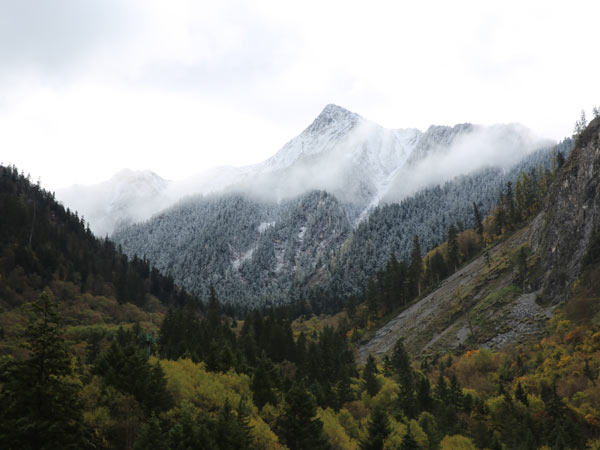
Explore picturesque peaks at Nine Villages Valley. (Image: Christine Aldred)

Right from the outset, we are clearly warned: we’re on a hiking tour of China, but this is not hiking as we know it. “Hiking in China is very different from hiking in your countries," our national tour leader Zhou Qiyu (she’s Jessie to us) explains on our first day of travel. “It means following tracks and walking up and down stairs. China is a country of stairs." It’s a prophetic description. 

“We" are 16 travellers from many backgrounds, embarking on a two-week exploration of China’s Natural Treasures with Wendy Wu Tours. No Beijing skylines or Great Wall stones, but instead a trek through some of the planet’s most remarkable scenery with glimpses of rare wildlife. It turns out hiking in China isn’t just about stairs and vistas. It’s a journey through culture as well as wild landscapes, made accessible by modern technology and infrastructure.  

Sky-high views in Zhangjiajie 
Zhangjiajie National Forest Park
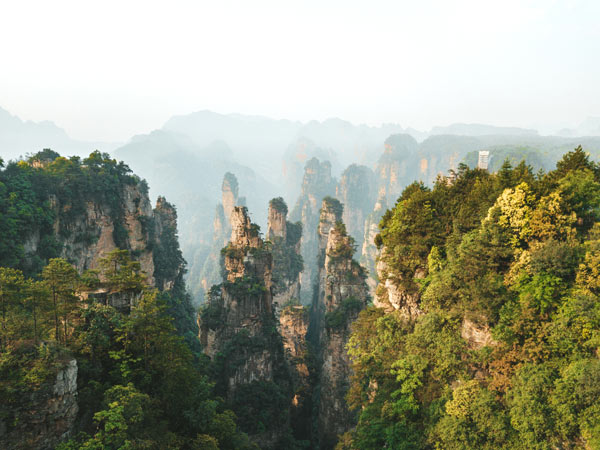
The otherworldly pillars of Zhangjiajie National Forest Park can be viewed from the Bailong Elevator, China. (Image: Getty Images/golero)

Almost straight up, we head for the ethereal world of Zhangjiajie in Hunan Province, a UNESCO-listed realm of mist-shrouded quartz sandstone pillars, rugged cliffs and plunging canyons. Thousands of columns – sculpted over millennia through tectonic uplift and erosion – thrust skyward, their sheer faces softened by tenacious pines clinging improbably to the rock.  

It’s a landscape so surreal it inspired the floating Hallelujah Mountains in the movie Avatar. We explore by trams, cable car and on foot, weaving through forest and drifting cloud, yet hardly scratch the surface of this vast park. 

Rain sets in, but Jessie assures us water signifies money in China, so we’re clearly acquiring wealth, and too awed to be deterred by mere moisture. Poncho-clad, we ascend 7.5 kilometres up Tianmen Mountain in one of the world’s longest cable cars.  

At the summit, a valiant procession of damp souls skirts the cliff edges on glass walkways, weaving around foggy corners to reach a massive natural stone archway known as Heaven’s Gate. The heavy mist means the thrill (or jarring reality, choose your poison) of being on a ledge on a cliff face nearly 1500 metres from ground is diminished, but perhaps that’s a good thing.  

Exploring ponds and peaks in Nine Villages Valley 
Long Lake at Nine VillagesValley,
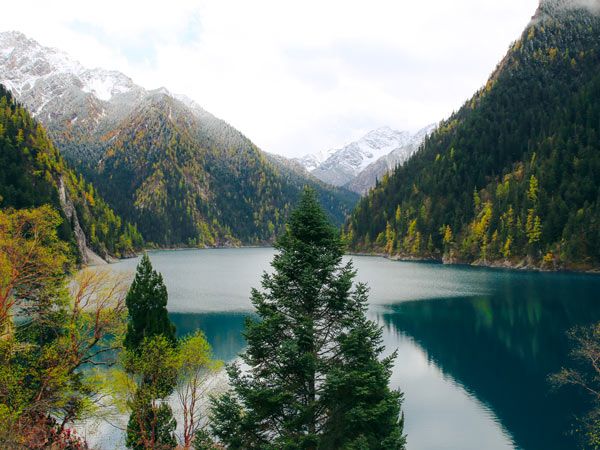
Long Lake at Nine Villages Valley, Sichuan. (Image: Christine Aldred)

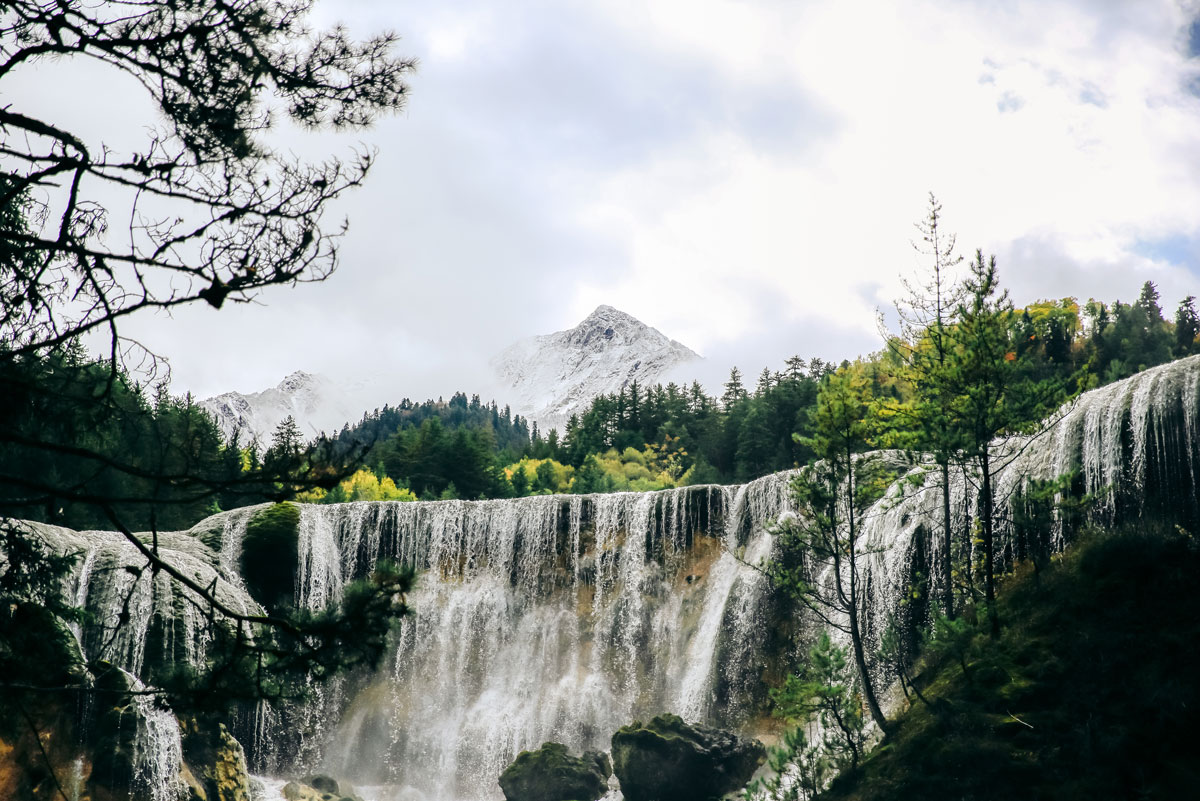
Another world of surreal beauty awaits in the Tibet Autonomous Region. Jiuzhaigou, or the Nine Villages Valley, was little-known until the mid-1970s when it was accidentally discovered by a lumberjack. Another designated UNESCO World Heritage site, the area is famed for its multi-coloured travertine ponds formed from calcium deposits. They cascade down the mountain in shimmering gold and turquoise ribbons, inspiring its name, Huanglong – ‘Yellow Dragon’. 
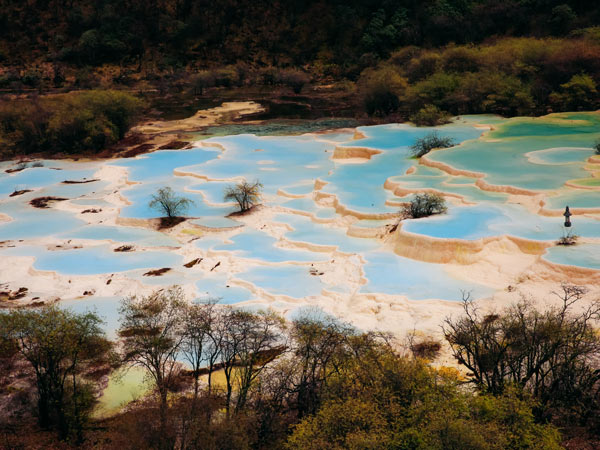
Nine valleys travertine pools
The valley boasts magnificent travertine pools. (Image: Christine Aldred)

It’s an exuberance of colour: impossibly azure lakes mirroring snow-tipped peaks, and diverse forests that pop with vibrant marigold yellows and golds as autumn begins to take hold. 

It’s here the mind-boggling scale of Chinese tourism comes into focus. Paths swarm with people, but no one is impatient. We join the throngs in good spirits and allow ourselves to be whisked up and down the mountains in a steady procession of green buses. In an area visited by up to a capped 41,000 tourists a day, the logistics, in all their “squishy glory" as a fellow traveller observes, are almost as extraordinary as the scenery. 

Hiking through Black Mountain Valley 
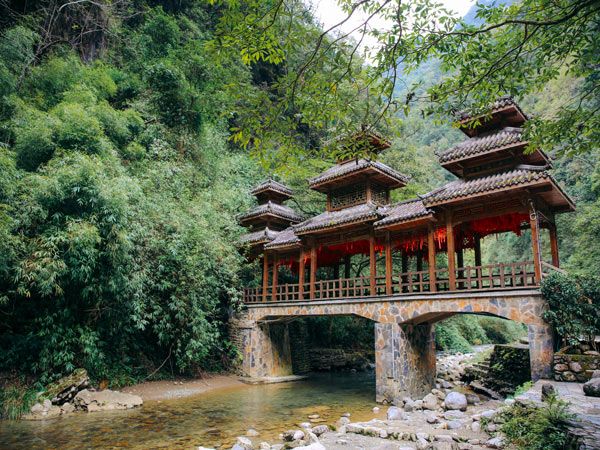
The Yu-Qian Boundary Bridge
The Yu-Qian Boundary Bridge sits within Black Mountain Valley. (Image: Christine Aldred)

Respite comes at Heishan Valley, or Black Mountain Valley, just two hours from Chongqing, China’s largest city and home to 34 million people. Astonishingly, it feels like not a single one of them thought to visit, so we have the entire park to ourselves. Even the cable car is roused from slumber to carry us down a gully where our walk begins.  
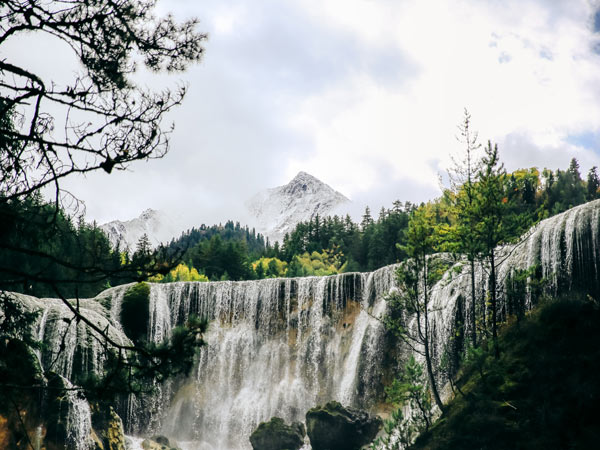
Cascading fallsat Black Mountain Valley
Cascading falls at Black Mountain Valley. (Image: Christine Aldred)

A 13-kilometre gorge trail winds through dense forest, over wooden bridges, past tumbling waterfalls and streams – sometimes gushing, sometimes roaring. Wobbly suspension bridges, metal holds and ropes hint at its canyoning appeal, but I’m all about the gentle meander. The reserve – a natural gene bank – is home to more than 1800 plant species and elusive wildlife. And today, it’s all for us. 

Faith and folklore  
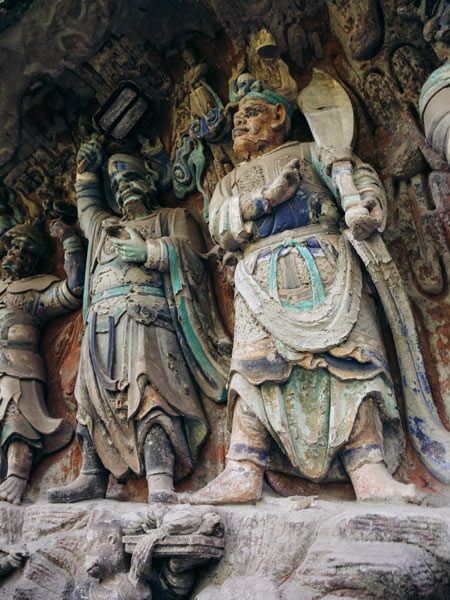
Dazu Caves
The Dazu Caves carvings date from the ninth to 13th centuries. (Image: Christine Aldred)

Across China, nature and spirituality entwine. Taoist, Buddhist and Confucian ideas, along with folk-religious traditions, have merged over centuries, creating landscapes imbued with myth and ancestral presence. They’re places for devotion, reflection and a good dose of fresh air. 

This melding of spirituality and landscape is exemplified at the dazzling Dazu Caves, where intricate sculptures carved into cliffs more than 800 years ago depict Buddhist, Taoist and Confucian deities side by side, telling stories of life, death and seeking enlightenment. 

At He Long Park, we stop at a statue and tomb honouring the Chinese military leader for whom the park is named, but I must admit I’m more enamoured with a glorious grove of ginkgo trees a little beyond, the fan-shaped leaves of these ancient survivors glowing pine-lime in the muted light.  

Even in high-rise cities, nature endures. In Chengdu’s People’s Park, locals stroll under trees, take tea by the water or watch traditional dance performances. At Matchmakers’ Corner on sheets of pink and blue, hopeful parents post profiles of their single children, spruiking their charms and even financial assets, a time-honoured tradition still thriving in the digital age. 

Unforgettable cultural performances 
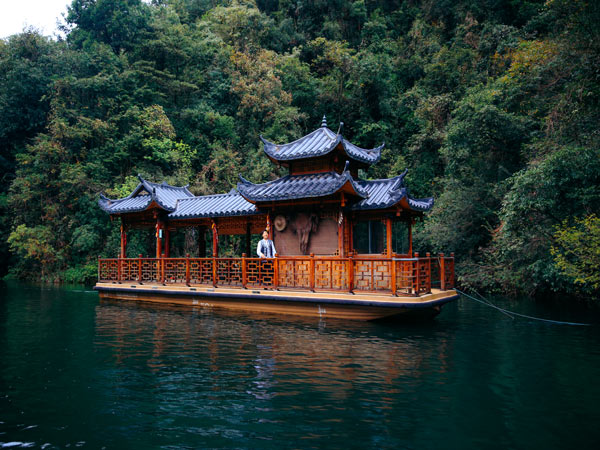
A man sings on BaofengLake
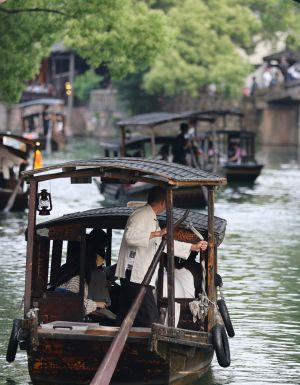
A man sings on Baofeng Lake as sampan boats drift by. (Image: Christine Aldred)

Wherever we travel, cultural depth is on display. Performances showcase regional dance, music and folklore, cuisines shift with regions and domestic tourists dress in traditional outfits for photo ops against dramatic backdrops.  

On the emerald waters of Baofeng Lake, songs from our sampan summon a boy, or girl, depending on who’s singing, a playful nod to a Tjuila folktale. In Tibetan Jiuzhaigou, multi-coloured banners flutter and golden prayer wheels spin in mountain streams, releasing their prayers downstream into the universe, a practice from the ancient Bon religion that predates Buddhism. 
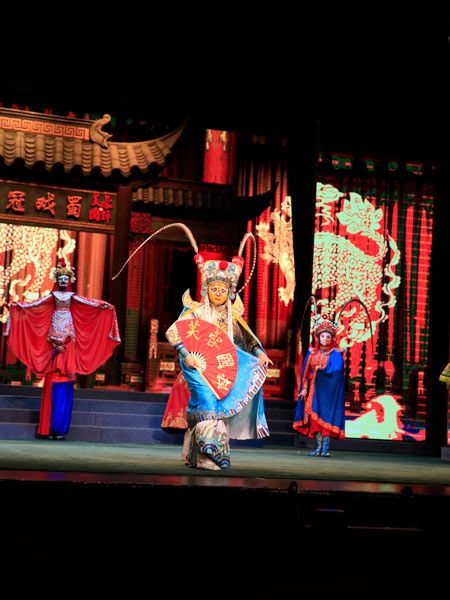
Sichuan opera
Witness cultural shows such as the Sichuan opera in Chengdu. (Image: Christine Aldred)

Each night in Zhangjiajie, the valley of Tianmen Mountain takes centre stage in a spectacular open-air cultural performance – The Fox Fairy Show – against a backdrop of cliffs and forest. In the hands of the musical director of Crouching Tiger, Hidden Dragon, it fuses myth, drama and musical theatre. Hundreds of performers bring the legend to life: a village lights up the mountainside, foxes prance, spirits rise and a 72-strong choir in tinkling costumes fills the valley with voice. Wrapped in a rainbow of plastic ponchos, the audience becomes part of the landscape. 

Must-see wildlife in China 
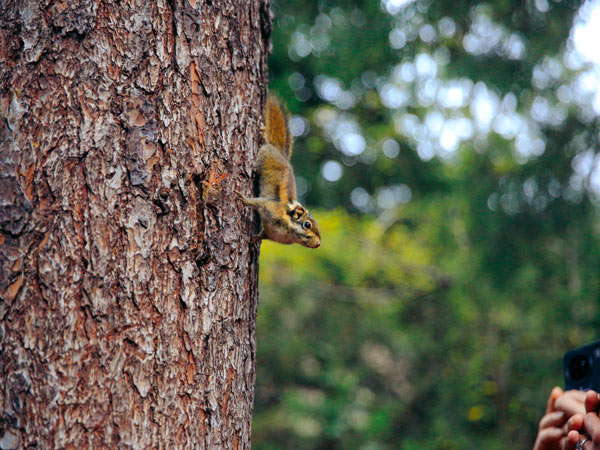
squirrelsin the valley
Spot squirrels in the valley. (Image: Christine Aldred)

Apparently China’s national parks teem with wildlife, though spotting it isn’t easy in such vast terrain. In Zhangjiajie, the notoriously mischievous macaques that usually patrol the paths are missing in action, clearly smart enough to seek cover on rainy days. At Black Mountain Valley, langur monkeys elude me too, but rustling branches and calls in the tree canopy assure me they’re near. 

Jiuzhaigou National Park is home to more than 220 bird species, a handful of which I spot along with butterflies and a cheeky squirrel. Pandas and golden snub-nosed monkeys live here too, though glimpses are rare. 
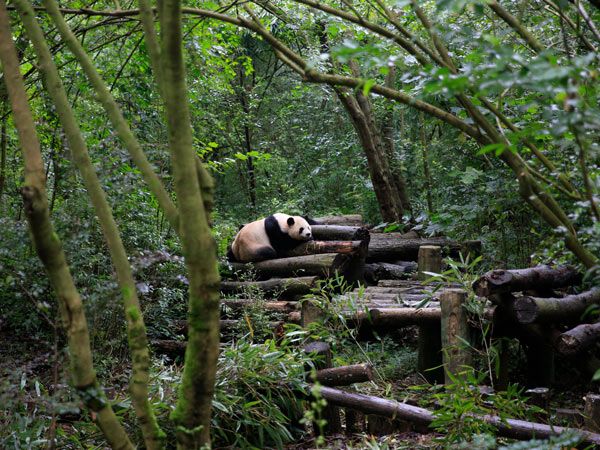
giant panda
Chengdu Research Base of Giant Panda Breeding is home to roughly 120 pandas. (Image: Christine Aldred)

Meeting some of China’s national treasures in all their black and white furry cuteness is assured at Chengdu Research Base of Giant Panda Breeding, with red pandas to boot. It’s a popular place, so brace for crowds, especially when one of the stars stirs – usually for food. Around 120 pandas live here. Gentle Bing Bing isn’t fussy about her food and loves cleanliness while Ya Zai searches out the tastiest shoots. 
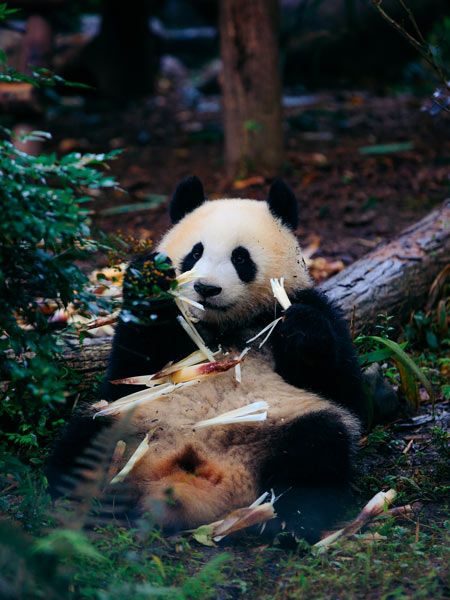
panda
An endearing resident of the Chengdu Research Base of Giant Panda Breeding. (Image: Christine Aldred)

It’s surprising to learn pandas have been around for roughly 8 million years, given their finicky diets and less-than-efficient approach to reproduction. Solitary by nature, fertile for just a few days each year and with diminishing bamboo habitats, their future relies on dedicated breeding programs. Fortunately, their numbers are slowly on the rise, with around 1900 pandas now living in the wild in China, each tracked and monitored. 

Weekly travel news, experiences
insider tips, offers,
and more.

Ease of access

While China’s sprawling landscapes and the myths surrounding them may be ancient, technology is making them more accessible. The bullet train from Chengdu to Jiuzhaigou in Tibet, opened late 2024, is a dazzling feat of engineering, cutting through mountains at up to 200 kilometres an hour and slicing hours off the previous road trip. It’s a small example of China’s immense new web of roads, railways and power grids opening up once-remote regions to travellers. 

This blend of nature and innovation continues at Zhangjiajie, where glass and steel meet ancient stone. Step – tentatively if you must – across the transparent skywalk bridge a dizzying 300 metres above an ancient canyon and watch the world below slide by beneath your slippered feet.  

On the other side, don VR glasses in a stationary hot-air balloon basket to drift virtually through soaring peaks and deep gorges, or zip up to the real land of floating mountains in a glass elevator in the blink of an eye. You can even shoot down an 897-metre escalator straight through Tianmen Mountain as an easy way home. 

A touching goodbye 

On our last evening over a celebratory Cantonese-style banquet, Jessie tells a final joke – fittingly featuring one of those beloved, but in this case rogue, pandas. She gifts each of us, her most recently acquired “family members", a bookmark in the form of a delicate leaf from a banyan tree – the tree of Chongqing, her hometown and our departure-lounge city. Its filigree veins have been delicately exposed and decorated with traditional Chinese ink brushwork, an exquisite fusion of nature and artistry. 

It’s an apt metaphor for our journey: centuries of culture layered over the raw beauty of the natural world – best discovered, perhaps, on foot, even with crowds, rain and mist. Actually, especially with mist. 

A Traveller’s Checklist 

Getting there  

China Southern Airlines offers full-service flights to China from Sydney, Melbourne, Perth, Brisbane, Adelaide and Darwin via its Guangzhou hub and other cities multiple times per day or week. Premium Economy provides extra space and priority attention while Business Class offers lounge access, a flat-lay bed and free-flowing drinks.  

Playing there  

The 16-day Natural Treasures of China Go Beyond Group Tour with Wendy Wu Tours includes return economy airfares and meals, served ‘family style’ on spinning table trays, with scope to try local foods independently. Many activities are included but local cultural shows are optional extras: don’t miss The Fox Fairy Show in the Tianmen Mountain valley. RRP $8980 per person based on a twin share. 

Need to know  

  • Power banks must be marked CCC approved or will be confiscated at airport security.  
  • Access to social media and Google-driven sites is restricted in China, but some eSIMs such as Holafly enable access and offer unlimited data to keep you connected while travelling.  
  • Coffee is not the same as in Australia so embrace the tea, excellent and varied. 

Want to see more stories from International Traveller in your Google search results?

  1. Click here to set International Traveller as a preferred source.
  2. Tick the box next to "International Traveller". That's it.
hero media

These community homestays are changing how travellers experience Nepal

    After youth-led protests in 2025, this year Nepal elected a 35-year-old former rapper as Prime Minister. In a country where tourism is its biggest industry, what’s next for travellers? 

    In 1986, Nepal changed its clock. It had used India Standard Time since 1920 so, to differentiate, it wound its clock 15 minutes ahead of, not behind, its big-brother neighbour. Boss move. “Nepal is strongly opposed to the idea that our identity is connected to India,” says Community Homestay Network (CHN) guide Bikal Khanal.  

    Tharu dance
    Tharu dance is traditionally set to hand drums. (Credit: Kate Lewis)

    Today, Nepal is the only independent country with a 45-minute deviation to universal time; an oddity that’s become a symbol of national pride. The quirk is nearly as endearing as Kathmandu’s Tribhuvan airport where carved varnished wood and shiny red bricks rule. One sign points to a ‘Travelator’ and another to a ‘Grievance Handling Desk’ while visas are noisily stamped at customs for US dollars, cash only. When am I?  

    Nepal gray langur
    Spot the endemic Nepal gray langur. (Credit: Simon Urwin)

    The 15 or 45 minute anomaly sees me tap out completely on timezone calculations. Why bend my brain calculating if it’s quarter to or quarter past elsewhere when I’m in the honking here and now of Kathmandu where the air is high-altitude crisp, the prayer flags flutter and the street dogs howl?  

    How tourism is changing in Nepal

    Bardiya National Park
    Bardiya National Park is rich with wildlife. (Credit: Simon Urwin)

    India is not the only association many Nepalis would like to shake. With eight of the world’s 10 tallest mountains, including Mount Everest and Annapurna, Nepal has long attracted mountaineers and trekkers, and expedition numbers are continuing to rise.  

    Tourism is one of the country’s biggest sources of foreign currency, so this growth is not negative, per se. But according to Ang Tshering Lama, who co-founded Phaplu Mountain Bike Club, being reduced to a mere trekking destination is limiting.  

    “Trekking is just one layer of our identity,” says Ang. “When it becomes the dominant narrative, it limits how we’re seen and how we see ourselves.” Nepal’s recent success, however, in diverting trekkers to less-trafficked areas such as Manaslu mofuntain, where visitor numbers rose by 117 per cent last year, offers hope that tourism can diversify even more radically.   

    Local men in Bhada village
    Local men in Bhada village. (Credit: Simon Urwin)

    The founder of CHN, Shiva Dhakal, wants that change. “The whole idea of the Community Homestay Network is to promote experiences outside of trekking,” he says. “Community tourism changes lives and helps kids stay home instead of coming to the city or migrating to the Middle East.”  

    Ang grew up seeing people leave, “not because they wanted to but because there weren’t enough opportunities to stay”, he states. Yet from remote villages to living traditions; food, art, music and emerging subcultures, “there’s so much that’s not being seen.” 

    CHN is opening some of those doors. It doesn’t own, or fund, any homes. Rather, it promotes homestays to travellers on a single, slick platform, while fostering entrepreneurship in places where women, marginalised castes, Indigenous people and the youth stand to benefit the most.  

    A new generation demanding more

    Dalla Town Hall
    Dalla Town Hall, where volunteers discuss anti-poaching tactics. (Credit: Bheem Thapa)

    The future prospects of next-gen Nepalis can no longer be ignored. On a Kathmandu tour with 33-year-old guide Monica K.C, we pass buildings torched in the September 2025 ‘Gen Z protests’, including the Supreme Court and Parliament House. Seventy-two people died. “They were anti-corruption protests,” says Monica. “Politicians’ children are living a lavish life but the airports are crowded with youngsters leaving to find work.”  

    We stop in ‘little Tibet’ at the wondrous sixth-century Boudha Stupa. “The wheel of life is Buddhism in a nutshell,” says Monica. “Things such as hate, ignorance and anger keep you rotating around the wheel, so you must follow the principles of Buddhism to detach. If you can’t, there’s no nirvana for you.”  

    Boudha Stupa's prayer wheels
    Boudha Stupa’s prayer wheels are used to recite Buddhist prayers. (Credit: Kate Lewis)

    In a sun-drenched twist to the usual temple visit, we ascend the stupa’s sloping plinth and roam its whitewashed dome. Tendrils of diaphanous prayer flags stream from a steeple-like structure where the Buddha’s unblinking eyes stare out. No nirvana for you… 

    bouda stupa prayer flags
    Tibetan-style prayer flags embellish the whitewashed dome of Bouda Stupa, a Buddhist temple. (Credit: Kate Hennessy)

    The dome is delightfully free of guard rails or chiding from security. There is, however, a stern ‘No TikTok’ sign, perhaps in response to the youth’s newly flexed power. The booted-out Prime Minister, K.P. Sharma Oli, was replaced in a resounding election victory in March by 35-year-old Balendra Shah of the Rastriya Swatantra Party (RSP) – a former rapper and mayor of Kathmandu. The RSP’s manifesto indicates tourism is a priority, and that Nepal’s cultural identity in areas such as gastronomy will be strengthened.  

    Boudha Stupa vendors
    Vibrant souvenir shops and cafes around Boudha Stupa. (Credit: Kate Hennessy)

    A more confronting stop awaits at Pashupatinath Temple. Today is Bala Chaturdashi, a Hindu festival where thousands of devotees gather to honour their dead ancestors. Vendors hauling foam mattresses do a lucrative trade as people set up for a night of vigil. This includes burning the bodies of recently deceased relatives on bamboo pyres in the Bagmati River, which flows into the sacred Ganges.  

    A woman at annual Hindu festival Bala Chaturdashi
    A woman at annual Hindu festival Bala Chaturdashi, in Kathmandu. (Credit: Kate Hennessy)

    Wrapped in a shroud, the bodies are positioned with their heads facing north to the Himalayas where Lord Shiva resides. They’re covered with flowers and straw and set alight by male family members.  

    Hours later, the ashes are swept into the river where devotees will take a holy dip the next day. As much as Monica assures us it’s not voyeuristic to watch, I struggle to do so. “Here you see the reality of life because everyone ends up there,” she says, gesturing to the river.  

    Life unfiltered in the Terai region

    tharu woman
    Tharu woman and master weaver Parbati Chaudhary in Bhada Village. (Credit: Bheem Thapa)

    The reality of life needs processing time, which the western Terai region delivers in spades. The Terai is largely separated from India by the Karnali River and Bardiya National Park, where elephants, rhinos and the elusive Bengal tiger roam.  

    Once a nomadic tribe, the Indigenous Tharu people are now the largest ethnic group here. “They didn’t know their daily life was interesting for international travellers but they’re starting to understand now,” says CHN founder Shiva.  

    safari through Bardiya National Park
    Take a Jeep safari through Bardiya National Park. (Credit: Bheem Thapa)

    We fly Buddha Air to Dhangadhi airport and drive five hours to stay in Tharu homes. The journey to Bhada village is a blur of roadside fruit stalls, traffic-stopping sacred cows and fields sown with wheat, rice, mustard, spinach, cauliflower and potatoes. Nepal’s agriculture feeds only Nepal.  

    Marigolds
    Marigolds are an important part of Hindu rituals. (Credit: Simon Urwin)

    “The only thing we export is young people,” says our guide Bikal. As the light dims and we plunge evermore rural, mysterious mounds of compacted hay – some house-sized – loom like the creatures from Where The Wild Things Are. Even our trusty driver gets flummoxed by a dirt road that abruptly ends and we find ourselves hurtling across a paddock.  

    On arrival, some are ferried to mud-walled cottages greened by gourd creepers, with thatched roofs and rustic-chic mosquito nets. Myself and two others are ushered to the home of corner store owner, mechanic and mushroom farmer Man Kumar Chilaruwa and his wife Rajkumari.  

    community homestay entrance
    A warm welcome at a community homestay. (Credit: Simon Urwin)

    They escort us to a bunker-esque back building with steel doors and a folding security gate, behind which is gleaming linoleum, dolphin-printed tiles and a shower cavity that must be gingerly stepped through to reach the toilet.  

    The ceiling lights emit a rainbow of colours (the bathroom light gets stuck in, frankly, a quite frightening red). We’re nevertheless touched that our hosts invested in all this bling when the average salary is around $275 a month.  

    In the coming days, we participate in Tharu traditions such as making moonshine, dancing, weaving straw handicrafts and gold-panning. We’re fed well with staples of rice, mustard greens, lentil pancakes, daal, curried chicken and tomato chutney served on antibacterial saal leaves.  

    food at community homestay
    Dig in. (Credit: Kate Hennessy)

    Sonara community homestay president Indradevi Tharu tells us river snails are often served, and the boiled and pickled flesh of rats hunted in the rice fields. “Perhaps next time?” we say and all have a laugh.  

    The power of community homestays 

    community homestay owners in Nepal
    Barda community homestay owners Parbati Chaudhary and Ram Krishni Devi Chaudhary. (Credit: Simon Urwin)

    Immersing Western visitors in foreign cultural practices is not new. But with the Tharu, I never get that uneasy sensation that I’m being performed for. Despite being the only tourists, there’s no ‘othering’; just warm, composed and ultra-dignified welcomes. Like we’ve always been here.  

    “I love to have travellers in my village so I can see the world,” says local woman Parbati Chaudhary. “Why would I travel the world when the world comes to me?” 

    The graceful acceptance the Tharu offer, as well as the slow pace, works miracles on my frazzled nervous system. One day I even take a nap on a vacant homestay bed. 

    Sonara community room
    An authentic stay in the Sonara community. (Credit: Kate Hennessy)

    Roosters strut and goats bray as we sit on the ground in al fresco kitchens, rolling rice flour into cylinders steamed to make dhikri (dumplings). When water is needed, we fetch it using a hand-operated pump as a family of ducks strolls by, side-eying us like curious neighbours.  

    Animal lovers will delight in Tharu villages. Kind and resourceful inventions are everywhere, such as snacking stations where two posts lean together, with leafy boughs dangling on rope for baby goats to forage from.  

    CHN’s CEO, Aayusha Prasain, nods knowingly when one in our group says she cried when she left her host, Shayam Chaudhary, in Bhada. Shayam’s 17-year-old son, Prashant, had translated, which deepened the connection.  

    “Community tourism turns travel into a relationship, not a transaction,” says Aayusha. “It places decision-making power in the hands of local communities, especially women and youth.” Since 2018, CHN has hosted more than 4000 travellers from 52 countries in 408 households, and estimates women’s participation has increased by 381 per cent.  

    Elephant watch
    Elephant watch. (Credit: Simon Urwin)

    In the Bardiya community, where vexing human-animal conflict has been a balancing act for decades due to elephants raiding crops, long-time homestay operator Salik Ram Chaudhary says young people keep the older ones on their toes.  

    Gathering greens
    Gathering greens. (Credit: Bheem Thapa)

    “We can’t keep homestays stagnant,” he says. “We have to upgrade our service and redefine our product or young people won’t see it as an attractive business. If we can keep evolving with this travelling trend we’re confident the youths will stay and continue it.” 

    Back in Kathmandu, Monica explains that after the deaths of young protestors in September, a determination had spread to not let their sacrifice be in vain. “We want to keep holding the government accountable,” she says. “We don’t know what situation we’re facing, but we’re ready to face it.”  

    Interested in Nepal but prefer to experience it in total comfort? Read our guide to luxury travel in Nepal