A place where happiness is on the national agenda is the type of place we want to be. Glenn A. Baker discovers what it is about Bhutan that brings contentment to its people and to those who make the pilgrimage to this mystical land.
As the sun began to descend over the Phobjikha Valley, the man from the Amankora Gangtey resort bade me to follow him down a track, through a potato shed, over a planted field and up a mountainside.
There waiting for me was a wooden shed with barn doors flung open-wide and, within, a sturdy timber tub.
The water it contained, topped by fragrant green foliage, was tepid. It would not be for long.
To the left of the shed was a fire in a pit, stoked energetically by a gnarled old villager. He could have been roasting meat but the large steel forceps he was wielding weren’t clutching dinner.
From out of the glowing coals he lifted one of a number of large stones which he manhandled to his end of the tub, an end separated from the other two-thirds by a barrier of wood and wire screen.
Having been invited to disrobe and immerse myself in the water, I watched with a great deal of curiosity, and just a little initial fear for my wellbeing, as he loaded one heated stone after another into the tub.
That the water never actually boiled was a testament to his skill and that I enjoyed every moment of my Stone Bath experience was a testament to my trust in it.
Sitting on a log outside the hut in a towel, after my fingers had started to prune from a prolonged soaking, gazing down the mountainside as the final embers of the day’s sunlight were playing across the valley, I was struck by my contentment.
I could assemble a range of other adjectives but suffice to say that I was happy, very happy. And in achieving that state I had fulfilled a tenet of the state, one might say.
One is supposed to be happy in Bhutan and there are plentiful means to be so. It is in the constitution, or something like that, and it may be the one thing about the Dragon Kingdom, the mystical landlocked Himalayan nation near Tibet and Nepal, that most people beyond its borders do know about.
It was some 30 years ago that the fourth king declared formally that, while other nations would measure their progress and standing by GDP, Gross Domestic Product, his would be developed along the lines of GNH, Gross National Happiness.
It was a revolutionary concept, to be sure, and one that has shaped business, education and government since, capturing the attention of the world as it has progressed, in its own holistic way.
The theory behind it all is that rampant consumerism is unsustainable because it perpetuates an endless cycle of greed for more, followed by the inevitable dissatisfaction that more is never enough. The United Nations has taken this onboard, with a recent resolution to adopt Bhutan’s proposal that happiness be the ultimate aim of the UN’s Millennium Development Goals.
The agenda is shaped by member nations’ proposals of their measures of happiness. Chalk one up for the little land up high where, it has been said, if there was actually a Shire of Middle Earth, this is what it would look and feel like.
Just to make sure no one misses the point, Bhutan’s official tourism slogan is ‘Happiness is a Place’.
The journalist Roger Beaumont, who made his way there after stints in Sydney and Bangkok, has said, “On arrival, visitors might feel themselves re-entering childhood, or an innocent and unruly unconscious.As Picasso said, ‘It takes a long time to become young’.
Bhutan can certainly speed up the process. I watched an elderly American lady being greeted by her guide at Paro airport. ‘Welcome to the land of Gross National Happiness!’ he beamed. ‘That’s what worries me’ she said, smiling. ‘I’m not entirely sure how happy I’m supposed to be’."
Well, I played it by ear and felt I was off to a strong start when I was informed that this country of around 700,000 citizens has a traffic-light count of zero.
There apparently was one in place in the capital Thimphu but public agitation had it removed. I tumbled swiftly to the sly sense of humour and again have Beaumont to thank for the observation, “Bhutanese drivers’ philosophy is simple: anybody going slower than you is an idiot and anyone going faster than you is a maniac."
Throw in a national obsession for red chillies, dead-eyed archers calling their pursuit the national sport, endlessly fluttering prayer flags, the realisation that in this egalitarian land women have the same rights as men and participate actively in the nation’s affairs, and a proliferation of signage bearing such decrees as Please Come In Formal Dress During Office Hours, This Is A Highway Not A Runway and, as often as not, Inconvenience Regretted and simply Thank You, and, well, it had me in its palm.
And while I hesitate to say that I was much taken by walls and doorways bearing erect phallus depictions, they certainly did command my attention and comment when I came upon them; though the obscenely large carved wooden one perched on a display stand in somebody’s front yard around Paro is perhaps not something that should be dwelt upon.
However you derive pleasure and satisfaction in travel, the Shangri La aspects of Bhutan are unquestionably plentiful.
The breath is knocked out of you more than once by the sheer physical beauty of its vistas, nooks and crannies. The land sweeps upwards, stage by stage, from luxuriant jungle plains just a few hundred metres above sea level down south by the Indian border to a dozen or so snow-clad mountains (many never climbed) more than 7000 metres high near the Tibetan plateau in the north.
The motif of the country is wide: verdant and artfully cultivated valleys flanked by pine forested mountains with deep ravines, sweeping watercourses, and rich flora and fauna.
With Mahayana (or Tantric) Buddhism the state religion, the only nation where this is so, every eyeline catches a spiritual architectural imprint. While the magnificent dzongs – castle-scale religious fortresses constructed in strategic locations throughout the kingdom early in the 17th century – impact most indelibly upon the consciousness of outsiders, there is the constant aura of peace and serenity radiated by the thousands of chortens (what the Indians would call stupas).
These faith-affirming structures are found on high mountain passes, busy thoroughfares and cross-roads, near monasteries, in villages and in places often unexpected.
They symbolise the universe and its combination of elements – earth, water, fire, air and the ether, what is said to be the essence of the spirit. They constantly remind you just where you are, though that is also accomplished by the gho and kira – traditional male and female garb worn universally, virtually by decree.
If there is a sense that one is an honoured guest in Bhutan rather than a tourist, then it may be because that’s exactly what one would have been not that many decades ago.
There was a time, before the building of Paro airport, when the only foreigners who made it in were personal invitees of the royal family. Even when the first substantial influx of tourists took place, a couple of years after the coronation of the fourth king in 1972, it was an arduous undertaking.
The few hundred who made it into this closed country (where you were restricted to visiting just Paro and Thimphu) either crossed over the borders by limited road access or wrangled a seat on a pair of Drukair 16-seater, twin propeller, unpressurised planes that could barely make it over the cloud line. If you got in, you could be stranded by weather for days or weeks.
In fact, when an international airport was finally opened, landing there was such a challenge that, as recently as 2009, only eight pilots in the world were certified to do so.
For 40 years the Bhutanese operated a low-volume/high-cost tourist policy. They sought and received discriminating travellers who very much wanted to be there and were prepared to meet the not-inconsiderable cost of doing so.
Nowadays it is a misnomer to say that it is a prohibitive destination. Visas are easily obtained and there are hundreds of private tour operators and a wide range of accommodation. Take out the bucket-stop Asian destinations and Bhutan is no more expensive than anywhere else on which you might set your sights, which is not to say that the top end of tourism does not thrive and is not uncommonly enticing and attractive.
Tying it up rather neatly is the Aman group, who under the banner Amankora operate five prestigious properties (only one of which, interestingly, has any exterior signage). Almost all their clientele go for the ‘Aman combo’ moving about the western and central regions of the country in single vehicles with private guide and driver, staying at lodges in Paro, Thimphu, Punakha, Gangtey and, less often, the farther-flung Bumthang.
With similarly designed interiors of considerable comfort, these well-integrated lodges are low profile near-palatial complexes and, in the case of the Punakha property – which is accessed by walking across a suspension bridge over the Mo Chhu River and taking a cart ride up a winding path – a traditional three-storey farmhouse built by a former chief abbot of Bhutan (the highest monk in the land).
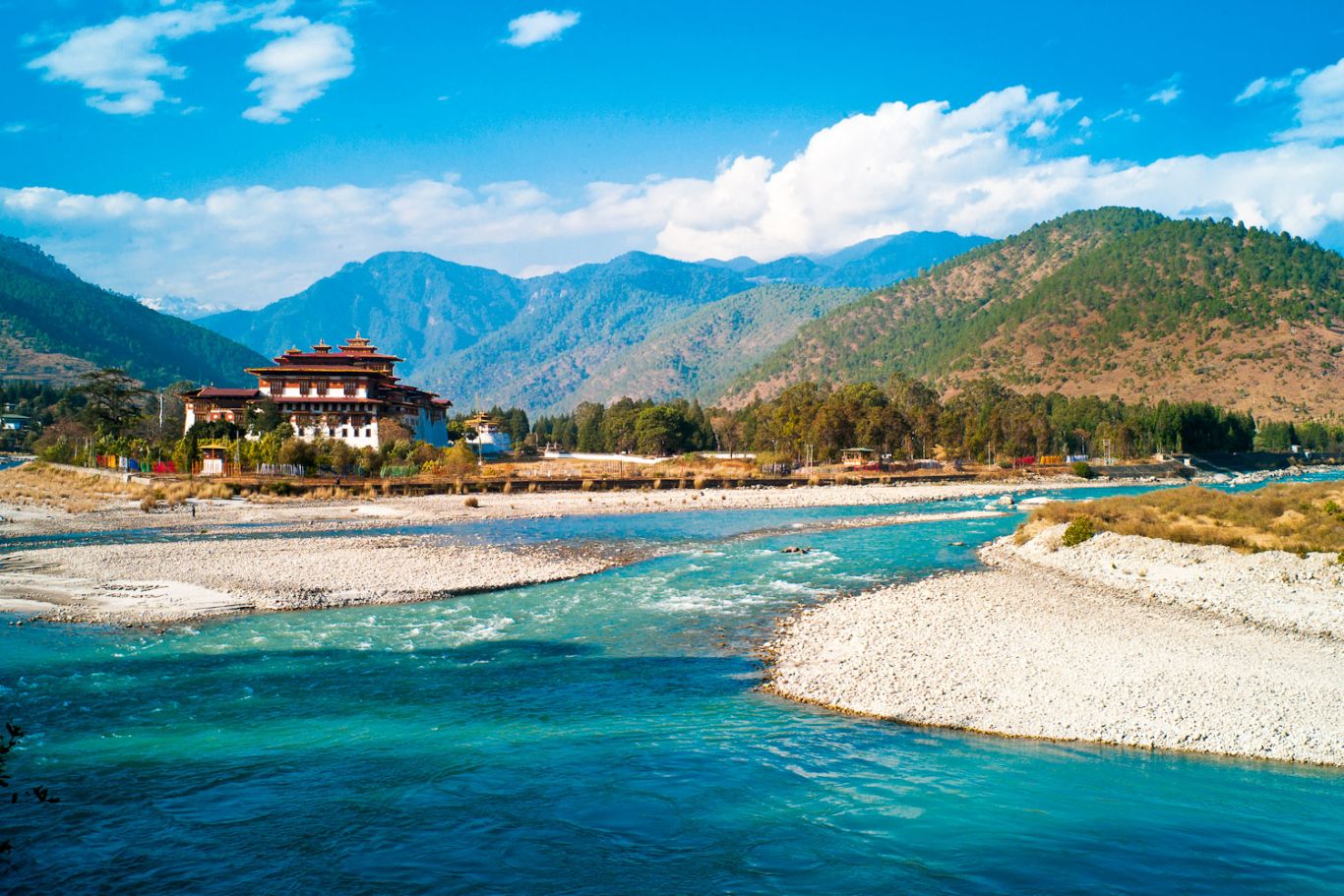
This last Aman proves to be the most amenable, partly because it is sited in the lowest valley (only 1300 metres) and thus has temperate weather and bread-basket ambience, partly because it is at the confluence of the Mother (Mo) and Father (Pho) rivers (there is even white-water rafting) and partly because it is home of the Punakha Dzong, a visually enchanting building which some admirers have put up there with the Taj Mahal and the Angkor temples.
The capital of the country until 1955, this is where kings have their coronations (and where they spend their summers and keep their horses), where the gods and demons of Buddhist mythology are celebrated in elaborate festivals and ceremonies, and where the nation’s religious elite and their vast entourage spend half a year in residence. It is approached by a famous cantilevered bridge that was washed away by a flash flooding around 1957 and painstakingly rebuilt.
Each Aman has its own tone and attractions. The less imposing Aman Gangtey, where I took my stone bath, is perched high (with large glass walls in the dining and recreation area) on the western slopes of the Black Mountains above a valley that plays host to seasonal flocks of endangered migrating black neck cranes.
There are telescopes in place to view them and to look upon the 16th-century Gangtey Goemba monastery on the opposite slope. Make your way there at the right time and you may be able to arrange an audience, if he is in residence, with the highly-revered Tulku.
Seeking out holy figures and places is a popular undertaking for visitors to Bhutan, with the popular outing taking place in the crisp-aired Paro, which sits at an elevation of 2250 metres.
There, most mornings, abundant numbers of foreigners are on their way to the Tiger’s Nest (Taktsang Monastery). At least two hours up and possibly as many down, it is a strenuous near-vertical walk (or horse ride, if I may confess) to the more than 300-year-old site, which sits – some say miraculously – on a precarious precipice 900 metres above the floor of the Paro valley, appearing to be more a product of Hollywood computer-generated imagery than ancient architecture.
Legend has it that, with the right spiritual connections, one can bypass feet and steed and make it up into the clouds on the back of a magic tiger, though they seemed to be in short supply the day I was making my way upward.
Legend also insists that the complex of ornate religious buildings is anchored in place by the hairs of dakinis (celestial females), which is as good an explanation as any for how everything hangs together, I suppose. It clings, as one phrase goes, to the side of the mountain like a gecko.
Returning to normal air space after visiting such rarefied heights is rarely such a rude shock. Certainly it is lacking in GNH.
There is much to take with you as recollection and imprint, snatches of memories spinning along with the prayer wheels – from the roadside apple sellers to child wood-carters to nattily dressed evening strollers in Thimphu.
Wheat threshers, yak herders, artists and scholars all go about their lives with what writer and photographer Robert Dompnier has described as “the gentle light of spring and autumn, the heavy skies of summer and the first snows of winter providing an endless range of subjects, constantly changing in shape and colour, their omnipresent smiles and serene faces clearly expressing their deep faith in the words and teachings of Buddha".
Details
Our accommodation picks
Amankora, across Bhutan
With five properties including Paro and Thimphu (both surrounded by pine forests), Punakha (by the Mo Chhu River), Gangtey (on a scenic valley floor) and Bumthang (within a remote valley town), the Amankora is a unique circuit of intimate luxury lodges.
amanresorts.com
Taj Tashi, Thimphu
Set in the heart of Thimphu Valley, this is everything you would expect from a luxurious Taj: a grand hotel built in a blend of traditional dzong and modern styles, elegantly appointed guest rooms with sweeping views of the mountains, an opulent spa, and four dining options serving a fusion of Bhutanese, Tibetan and European cuisine.
tajhotels.com
Uma by COMO, Paro and Punakha
COMO’s Paro property sits in a beautiful valley setting with all rooms/suites/villas boasting valley or forest views, whereas the Punakha property overlooks the Mo Chhu River.
Both, however, are as stunning as the other, offering traditional Bhutanese cuisine and iconic Shambala Retreat spas.
comohotels.com
Le Meridien, Thimphu
A modern and sophisticated property within an ancient setting and culture, the Le Meridien Thimphu has stylish guest rooms, three dining options with an eclectic cuisine offering, an indoor heated pool and spa.
starwoodhotels.com
Want to see more stories from International Traveller in your Google search results?
- Click here to set International Traveller as a preferred source.
- Tick the box next to "International Traveller". That's it.