hero media

Egypt just unearthed its first pharaoh’s tomb in 100 years!

All eyes are on Egypt after the recent discovery of a pharaoh’s tomb, the first to be excavated since Tutankhamun’s in 1922. But it’s just the latest development stoking interest in this ancient land. Here’s why Egypt is shaping up to be a must-visit destination for 2025.

The recent excavation of a 3500-year-old tomb belonging to Thutmose II is the first royal rock-cut tomb to be unearthed since Tutankhamun, over 100 years ago. Thutmose II’s burial chamber, which is painted blue with stars on the ceiling, was excavated in the Valley of the Kings, a famous burial site for pharaohs who reigned between the 18th and 20th dynasties.
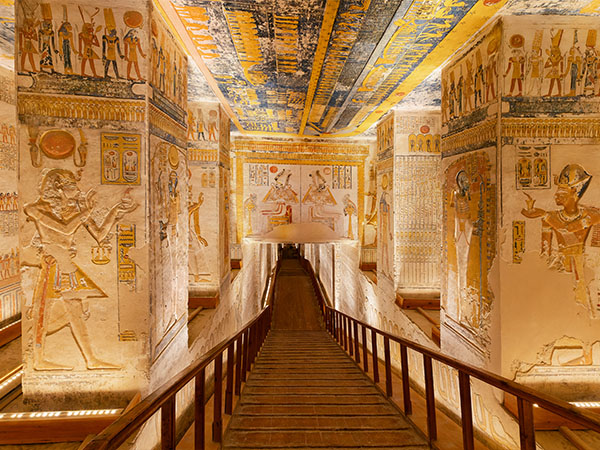
Ramses VI
The Valley of the Kings is home to many tombs of pharaohs who ruled during the 18th-20th dynasties, such as The tomb of Ramses VI. (Image: Getty/Ibrahim Hamroush)

Although Thutmose II reigned for several years (some time between 1493 and 1479 BC), he is known as the ‘missing pharaoh’ due to relatively little being known about him. He’s been overshadowed in the historical record, particularly by his wife Hatshepsut (the second reigning queen in Egyptian history). The status of Thutmose II as a ‘missing’ pharaoh makes the discovery of his tomb even more incredible, providing one more piece of the puzzle to the Ancient Egyptian world. To this day, there are only a few pharaoh tombs in the area that remain unknown. And after 100 years of searching, one more mystery has been solved.
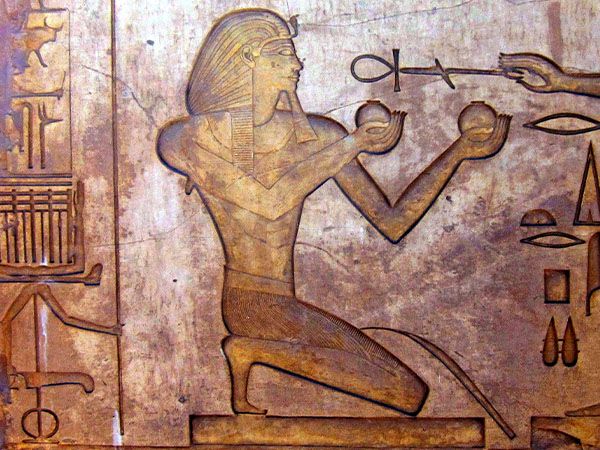
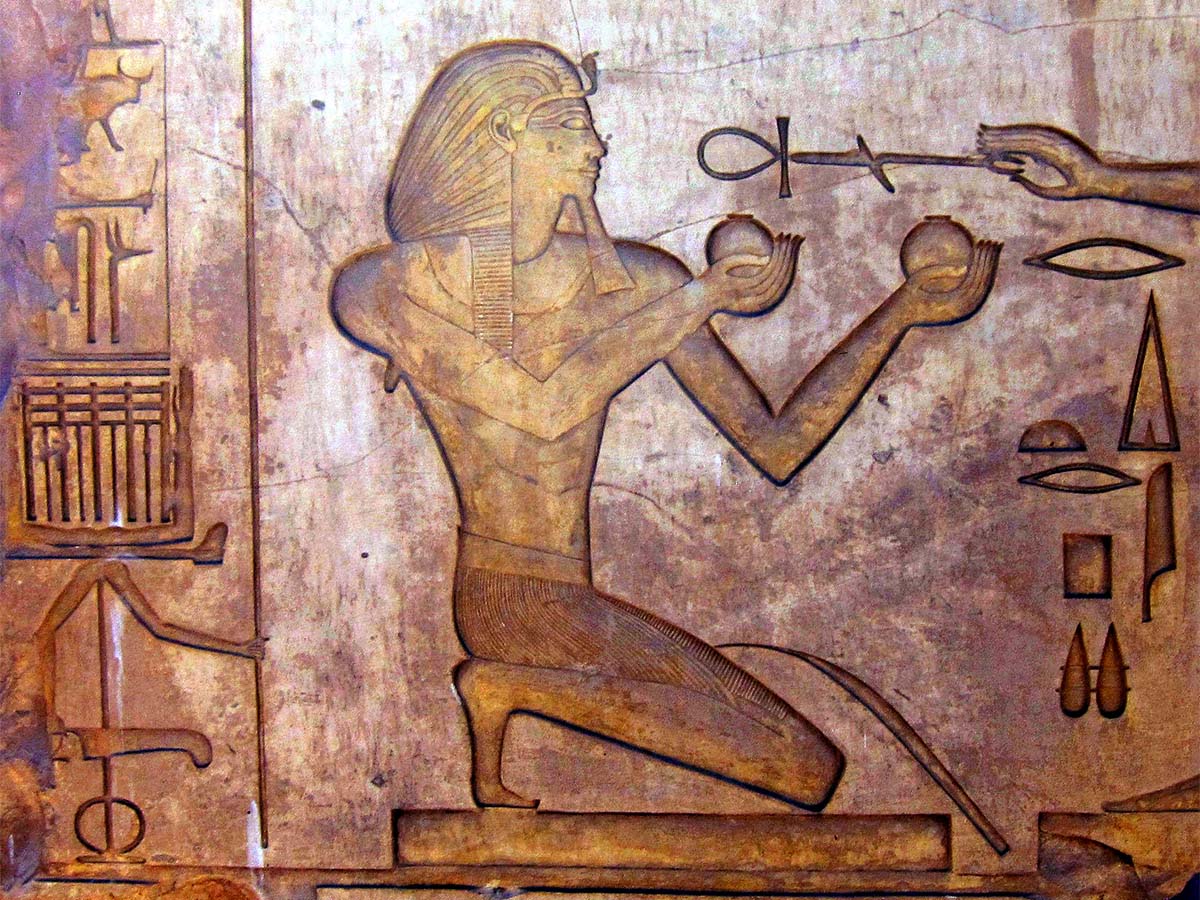
Thutmose II, depicted on this relief found in Karnak temple, is known as the ‘missing king’ due to so little surviving information about him. (Image: Wikimedia Commons)

Another reason to visit Egypt in 2025

But the exciting discovery of the tomb is not the only thing that’s stoking intrigue in this cradle of ancient civilisation. The Grand Egyptian Museum (GEM) has finally opened its doors after more than a decade of anticipation. Parts of the museum opened in 2024, with the rest set to officially open in July 2025. GEM contains over 100,000 artifacts from ancient Egyptian civilization, as well as a complete collection of Tutankhamun artefacts, many of which will be on display for the first time.
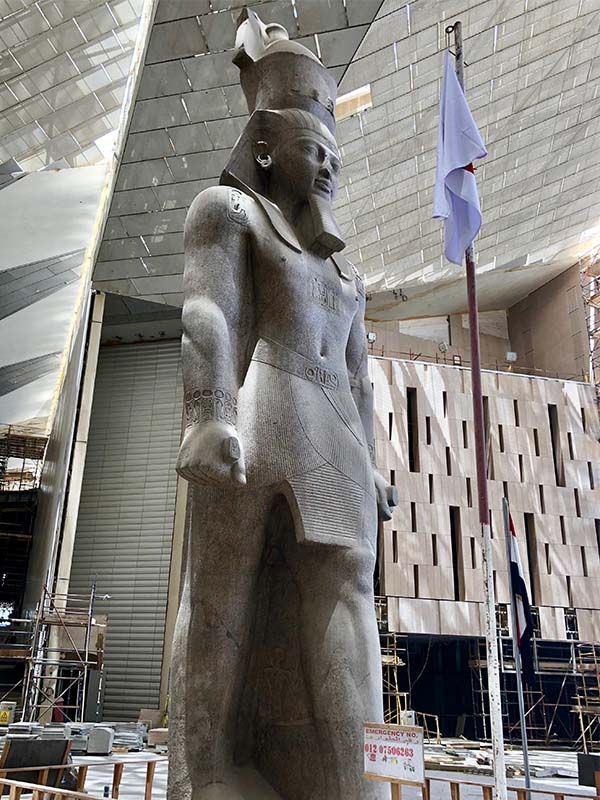
Grand Egyptian Museum
The Grand Egyptian Museum will open in 2025, and host 100,000 artefacts, like this statue of Ramses II. (Image: Flickr/Warren LeMay)

Can you visit the tomb?

You can’t visit the new tomb of Thutmose II yet. However, you can see his mummified body, which is housed in The National Museum of Egyptian Civilization.

Although Thutmose II’s newly discovered tomb is not open to the public, some incredible tombs in the Valley of the Kings are. For example, the tomb of Seti I is widely regarded as one of the most striking tombs in the valley, boasting elaborate decorations throughout the vaulted structure that digs deep underground. Discovered in 1817, this tomb offers visitors a glimpse into the beauty and sophistication of ancient Egyptian burial practices.
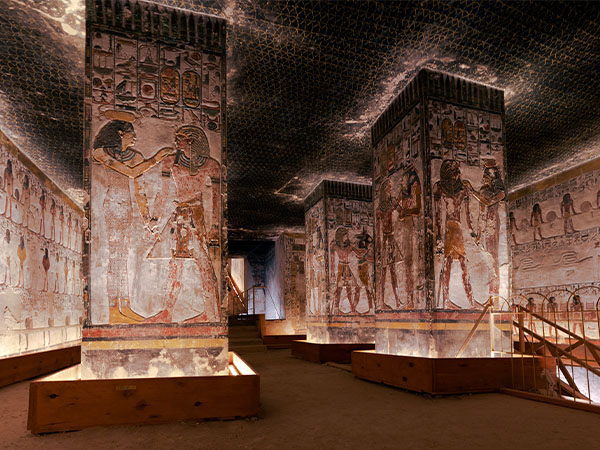
Seti I Tomb
The tomb of Seti I is widely regarded as one of the most beautifully decorated in the Valley of the Kings. (Image: Getty/Ibrahim Hamroush)

The legendary tomb of Tutankhamun is a must-see for obvious reasons, and the tomb of Ramses VI is resplendent in remarkably well-preserved hieroglyphs and New Kingdom paintings. Ultimately, Ancient Egypt will always capture our imagination. But the discovery of a new tomb and a major museum opening is revitalising its allure. A century after the discovery of King Tut sparked Tut-mania, Thutmose II is finally stepping into the limelight, too.

Want to see more stories from International Traveller in your Google search results?

  1. Click here to set International Traveller as a preferred source.
  2. Tick the box next to "International Traveller". That's it.
hero media

At the foot of the pyramids, Egypt finally tells its own story

    Ancient Egyptian history has been scattered across the globe for decades, admired, preserved, and studied, but it’s rarely seen where it actually belongs. The newly opened Grand Egyptian Museum (GEM) brings it home.

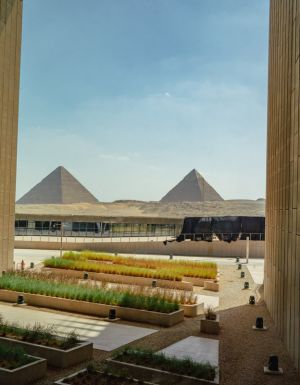
    From a viewing platform inside the Grand Egyptian Museum, the Great Pyramids of Giza rise from the desert, and for a moment, it feels like modern Egypt and ancient Egypt are shaking hands. The museum, grand in name and reality, has been a long time coming—since 1992, to be exact. Towering pharaohs, relics, and entire chapters of civilisation are on display here, all in full view of the pyramids. And because the GEM is the largest archaeological museum in the world dedicated to a single civilisation, it gets to tell Egypt’s story through its own voice, something many overseas institutions, understandably, haven’t quite managed.

    Reshaping Giza

    GEM entrance and gardens
    The GEM holds its own commanding position. (Image: Natasha Bazika)

    You might expect any building beside the Great Pyramids of Giza to fade into the background, but the GEM doesn’t bow to its famous neighbours. Perfectly aligned on the same axis and vast enough to span 70 football fields, the museum is less of an addition to Giza and more of a marker of the shift from a gateway to a cultural district.

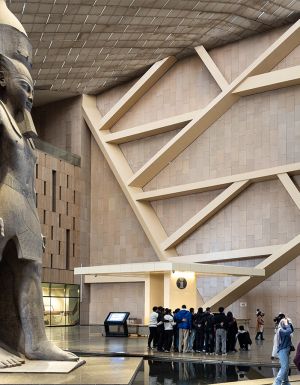
    Inside, hieroglyphs carved from alabaster sweep across the walls and triangles appear everywhere, yet it’s a 3,200-year-old, 11-metre-tall, statue of Ramesses II who commands the room. His scale dictated the soaring atrium ceilings, which pour in natural light, unusual in museums but safe for the stone artefacts displayed.

    Hieroglyphs line the walls of the main entrance of the GEM
    Hieroglyphs line the walls of the main entrance. (Image: Natasha Bazika)

    Unlike many museums, the GEM has really considered how visitors move through it. The six-storey grand staircase leads you chronologically through Egypt’s history, from the Predynastic era to the Coptic period, flanked by statues that grow in scale and complexity as you climb. Elevators and lifts run alongside, keeping the journey accessible to everyone.

    At the top, a viewing wall frames the pyramids before you enter the main gallery to see artefacts rarely seen outside tombs, including the complete contents of Tutankhamun’s tomb, a highlight for many visitors.

    Pharaohs, artefacts and everything in between

    The GEM's showpiece Ramesses II
    The GEM’s showpiece Ramesses II. (Image: Natasha Bazika)

    The GEM holds around 100,000 artefacts across seven millennia, but the experience is entirely modern. Digital panels, QR navigation and clear bilingual signage make self-guided wandering easy, while short, glare-free labels in English, Arabic and braille are colour-coded to move you from broad themes to object-level detail.

    That said, a guide adds context you don’t get from a panel. I was lucky to have Essam Al Ebd Aziz, an Egyptologist, on board a 12-day Uniworld Nile cruise, walk me through some of the museum’s standout pieces.

    Top of the list is, of course, the Tutankhamun exhibit. Almost everything from his tomb, much of it never shown outside the Valley of the Kings, is here, from his golden funerary mask to delicate jewellery and ceremonial objects. But the GEM isn’t just about one boy king.

    GEM entrance is guarded by an 11-metre-tall Ramesses II statue.
    An 11-metre-tall Ramesses II statue guards the entrance. (Image: Natasha Bazika)

    Essam points out the canopic chest of Hetepheres, mother of Khufu, where her organs were stored in alabaster. I loved the forty little marching soldier figurines from the tomb of Mesehti, all lined up and hanging on a wall. And then there’s the statue of Metri, a scribe, with piercing blue eyes carved from lapis lazuli. All these pieces, and thousands more, now sit under one roof. And for the first time, people can see Egypt’s history in one place, told in its own voice, without leaving the shadow of the pyramids. That alone changes everything.

    Egypt just unearthed its first pharaoh's tomb in 100 years!