hero media

Review: Hotel Abruzzi, Rome

Quentin Long finds that location is key when it comes to a hotel in the Eternal City.

If you are visiting Rome, you really want to stay in Rome – in the heart of those narrow cobbled streets, gorging yourself on all that is the Eternal City; that languid sense of time immemorial that comes from a place that has burned bright for more than two millennia.


There are countless locations from which to indulge yourself: Piazza Navona and Bernini’s formidable fountains, card-shredding shopping-joy along the Via dei Condotti and the Spanish Steps; the humbling ruins of the Colosseum and the Forum; the winding streets and nooks of the Campo de’ Fiori.


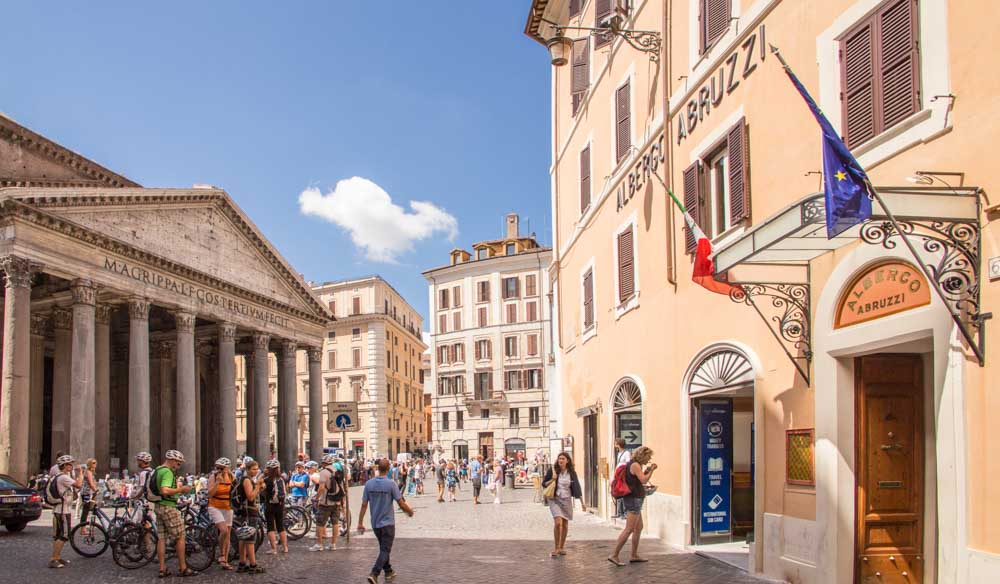
From this embarrassment of riches, a humble hotel on the Piazza della Rotonda offers perhaps the best place from which to explore the city.


With incredible views of the Pantheon, Hotel Abruzzi has that most sought-after of assets: location.


Our Junior Suite exploits this wonderfully – a real room with a view.


A mere 30 metres from where we stand, the enormity of the Pantheon is almost palpable.


Like Brunelleschi, who studied the Pantheon when developing the engineering solution to construct the dome of Florence’s Duomo, we find ourselves mesmerised by this ancient structure.
Hotels rome pantheon
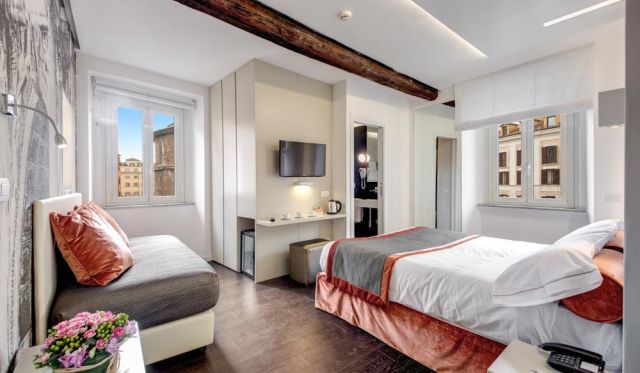
Modern rooms have perfect views of the Pantheon.

The room is in complete contrast to the view: a crisp, mostly white space with flashes of orange and one entire wall emblazoned with a photograph of the Arch of Titus and columns from the Forum.


Our suite is surprisingly roomy (for Rome) and the hubbub of the crowds below makes it something of an oasis.


An exposed wooden beam breaks up the clean modern space; something that carries through to the small but well-designed bathroom.


Most importantly, there’s a decent air conditioning unit, perfect for an afternoon snooze to recharge before a night of carb loading.


The cafes of the Piazza della Rotonda act as de facto hotel restaurants. The reception desk hands out vouchers for whichever particular cafe is serving the included breakfast.


A pre-dinner Campari and blood orange at one of the piazza cafes and people-watching as the sun sets is la dolce vita at its finest.


Considering its location, Hotel Abruzzi is surprisingly unpretentious.


The check-in area can hardly accommodate more than two people and to access the (world’s slowest) lift you walk up one flight of narrow steps.


Don’t fret about your luggage, there is a hotel porter on hand.


Hotel Abruzzi does the most essential things brilliantly; its staff are helpful, the rooms are welcoming, the views and location unbeatable.


Just like the engineering masterpiece over the road, it’s a classic that will stand the test of time. IT


Details: Hotel Abruzzi

Piazza della Rotonda 69, 00186 Rome, Italy; hotelabruzzi.it


The IT Verdict

The perfect Rome hotel for those who want to soak up the city, literally from their window.

Location: 9.5/10

Unbeatable, in the heart of the old city with views of the Pantheon. An easy walk to all the sights.


Style / character: 5/10

There are very few common areas but they are clean and tidy.


Service: 8/10

The concierge and staff are great at making reservations and giving sound local advice.


Weekly travel news, experiences
insider tips, offers,
and more.

Rooms: 8/10

A modern fit-out with ample space by Rome standards. Good design and a thoughtful aesthetic.


Food and drink: 5/10

The cafes that provide breakfast have a typical Roman offering but there is no on-site restaurant.


Value for money: 8.5/10

A Junior Suite during the height of summer averaged $483 per night including taxes and charges.


All IT reviews are conducted anonymously and our writers pay their own way – so we experience exactly what you would.

Want to see more stories from International Traveller in your Google search results?

  1. Click here to set International Traveller as a preferred source.
  2. Tick the box next to "International Traveller". That's it.
hero media

What the European heatwave means for your summer travel plans

Temperatures are soaring this summer, breaking records across Europe and the UK. 

Euro summer is a feeling like no other. But when a heatwave hits? The dream trip quickly turns into a sweaty mess. Extreme heat is sweeping Europe and the UK this week, with record-high temperatures impacting travel plans across the continent.

And while Australian summers are typically hotter in absolute temperature, many European cities aren’t equipped for high temperatures, resulting in unbearable weather.

Why is it so hot in Europe?

Signs of a hot summer loomed in May, when the mercury hit unprecedented spring highs. Now, extreme high temperature warning alerts have been issued in countries such as Spain, Italy, France, England, the Netherlands and Germany.

France saw its hottest day on record on Wednesday, with an average temperature of 30°C across the day and night. This surpasses the average temperature for June, which is 15°C to 25°C. Dozens of people have died, including 40 from drowning.

In Spain, 212 deaths have been linked to the heatwave.

The UK recorded its hottest June day ever on Wednesday with temperatures soaring to 36.1°C. In an article published by the Met Office – the UK’s national meteorological service – Professor Stephen Belcher CBE, Met Office Chief Scientist, shared his concerns about June’s heat. “To see temperatures like this in the UK in June is sobering. Events like this bring home the implications of climate change, with very high temperatures and humidity bringing significant health implications from heat stress, as well as impacts to a range of sectors such as transport, energy and water supply,” he said.

Heatwaves are becoming increasingly common in Europe and the UK, neither of which is prepared for such extremes. The World Meteorological Organization reported that in 2025, at least 95% of Europe experienced above-average annual temperatures and that the continent was heating up twice as fast as the global average.

How travel is impacted

A pharmacy sign displaying 40 degrees Celcius
A pharmacy broadcasting local weather data. (Credit: Getty/Dragoncello)

During a heatwave, power grids, water systems and transport networks can be affected, resulting in disrupted itineraries for travellers. In France, power outages have left thousands without electricity and early closures have been implemented for two of Paris’s biggest attractions, the Eiffel Tower (early afternoon rather than late at night) and the Louvre (two hours early). Eurostar cancelled its London to Paris and Paris to London services from the 22nd to the 25th, and major UK rail companies have been advising travellers to avoid using trains where possible, or to travel during early hours.

If a heatwave is predicted, being flexible with your itinerary and having fully refundable/changeable tickets is key, as extreme heat can force the cancellation of outdoor activities, impact rail and flight services and change the opening hours of sites and eateries.

Why does summer in Europe often feel hotter than summer in Australia?

people swimming in the Canal Saint-Martin in Paris
People swimming in the Canal Saint-Martin in Paris to cool off. (Credit: Rachael Thompson)

With some of the highest UV levels in the world, Australians are no strangers to the heat, adapting well to intense weather. But our infrastructure is largely equipped to withstand soaring temperatures with climate-responsive passive design, refrigerated air conditioning or evaporative coolers, as well as swimming spots aplenty.

Buildings in Northern and Western Europe and the UK, however, are constructed to retain heat and handle frosty winters. The lack of universal air conditioning means it generally feels hotter even though the temperature on your app might not look it. During a heatwave, it can feel like you’re in a sauna as cities act like heat traps.

How to stay cool and prepare for another heatwave

Relief is expected across Europe and the UK later this week, but more heatwaves are still possible in the coming months. Summer heat typically peaks in July and August.

Public transport often doesn’t have air conditioning, and buses in particular can be swelteringly hot. If you’re heading outside or your accommodation has no air conditioning, it’s worth buying a spray bottle and a handheld fan from a pharmacy or tourist stand. Check ahead of time if restaurants and cafes have air conditioning and make a booking in advance. The highest temperatures typically hit between 3pm and 6pm, so aim to head outdoors outside of these hours.

Rising temperatures invite travellers to enter a more intentional era of seeing the world. Now more than ever is the time to embrace lower-impact “coolcations” and off-season getaways.