hero media

Review: Four Seasons Chiang Mai

Head to Northern Thailand, where the Four Seasons has redefined itself on a working organic rice farm where guests bathe water buffalo, plant rice and eat exceptionally well.

The dense rolling hills of the Mae Rim Valley provide Four Seasons Resort Chiang Mai with a dramatic backdrop. The property opened in 1995 and was reflagged for the luxury brand in 2003. Yet, despite its obvious age, I get the impression that accommodation this well-planned and immersive cannot age.

Dated some parts may look, leaning into its natural splendour has worked brilliantly for the long-standing brand, which has enjoyed a resurgence in popularity thanks to speculation that the third season of the HBO series The White Lotus will be filmed there.

The concept has a lot to do with this property’s success, sketching luxury into the uncommon category of agricultural tourism where guests can both relax and get their hands dirty on a working organic farm.

First impressions

First impressions are important for any hotel. I love a good sky lobby, for example. The one at the InterContinental in Downtown Los Angeles has its reception on the 70th floor so you’re checking in almost eye-level with helicopters; I still talk about it years after I first stayed.

Yet, there’s nothing urban life could offer that’d compete with walking into the open-air reception pavilion of Four Seasons Resort Chiang Mai.
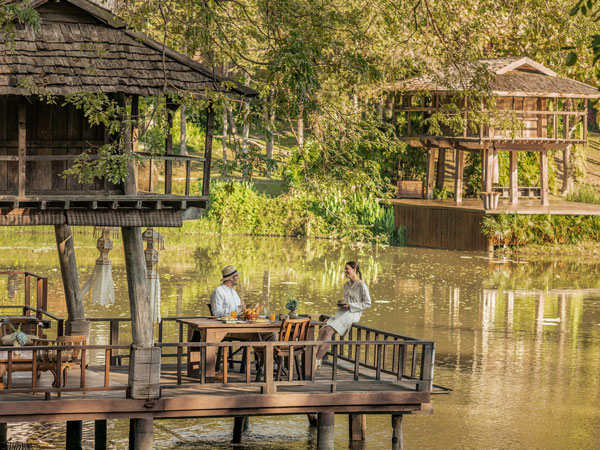
a couple relaxing in the open-air pavilion of Four Seasons Resort Chiang Mai
Four Seasons Chiang Mai lets you escape urban life. (Image: Four Seasons)

I usually rush through check-in because I’m too excited to see the room. Here, I take my time, admiring the spectacular view of the sense Doi Suthep Mountain range set against vivid greenery and teak pavilions. The colours are so strong and sharp that I feel like I’m living inside a postcard. I scan the rice paddies below and spot two water buffalo – one brown and one, oddly enough, piglet pink – tending to the fields.

This property couldn’t be recreated in many other places around the world. Yet, that kind of one-of-one luxury can’t rely on location alone.
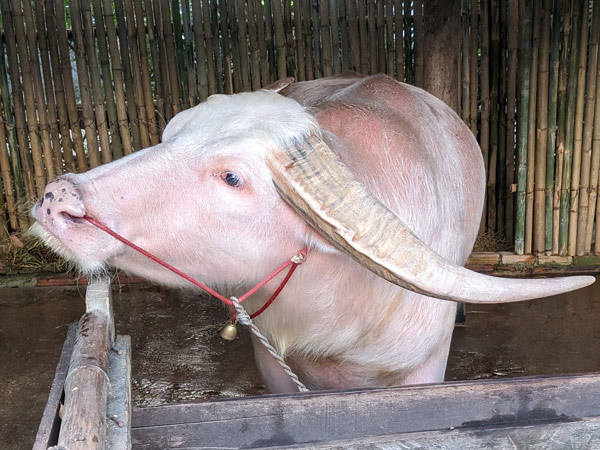
pink water buffalo in a thatched hut at Four Seasons Resort Chiang Mai
Hang out with a pink water buffalo. (Image: Chris Singh)

The room

Four Seasons Chiang Mai is popular with bigger groups and special occasions (like weddings). There are 64 pavilions clustered around the central pond and rice paddies, but the bigger buildings scattered around the 13-hectare property host 22 private residences and 12 (very private) pool villas. If you want seclusion, you’ll find it. Conversely, if you want to feel a connection to the land and the exceedingly helpful staff, that’s just as easy.
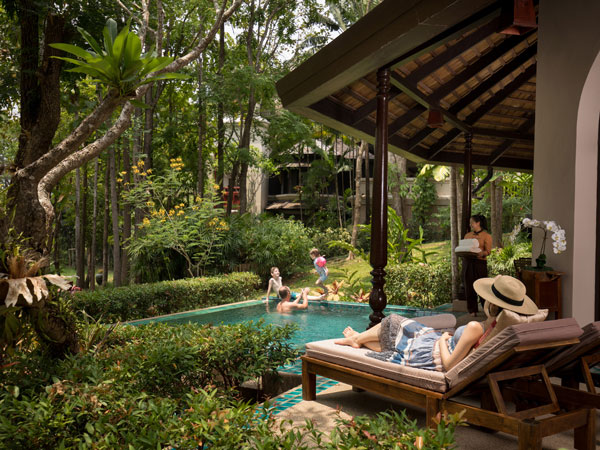
guests relaxing in a private pool villa at Four Seasons Resort Chiang Mai
Stay in a pool villa. (Image: Four Seasons)

Much like the rest of the resort, the accommodation is designed in the Lanna style characteristic of old-world Thai architecture. My Upper Rice Terrace Pavilion is 70 square metres of incredibly distinctive localised luxury.
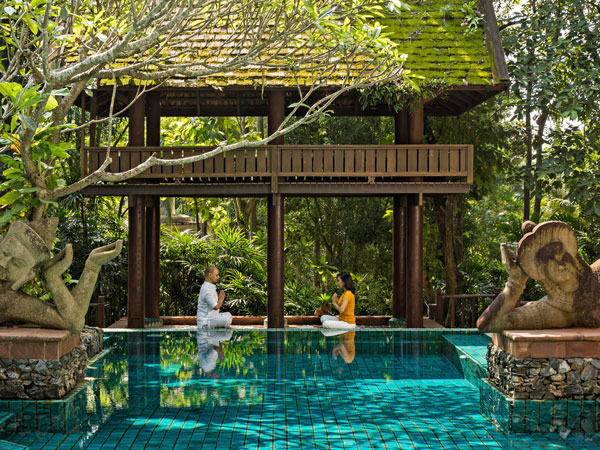
two people meditating by the pool at Four Seasons Resort Chiang Mai
Find your zen in this luxe oasis. (Image: Four Seasons)

Inside is an abundance of teak and gilded motifs – typical of traditional Thai design. Fine silk has been used extensively for a premium look. I can immediately tell the room hasn’t been updated in quite some time. But dated as it may be, it’s also polished with a timeless look. The bathroom, however, could use a refurbishment.

Pavilions are stacked on top of each other, and the upper rooms are more desirable because each pavilion comes with an outdoor bridge leading to your very own sala. That is, an open-air pavilion and private lounge with a swing chair looking over the rice paddies.

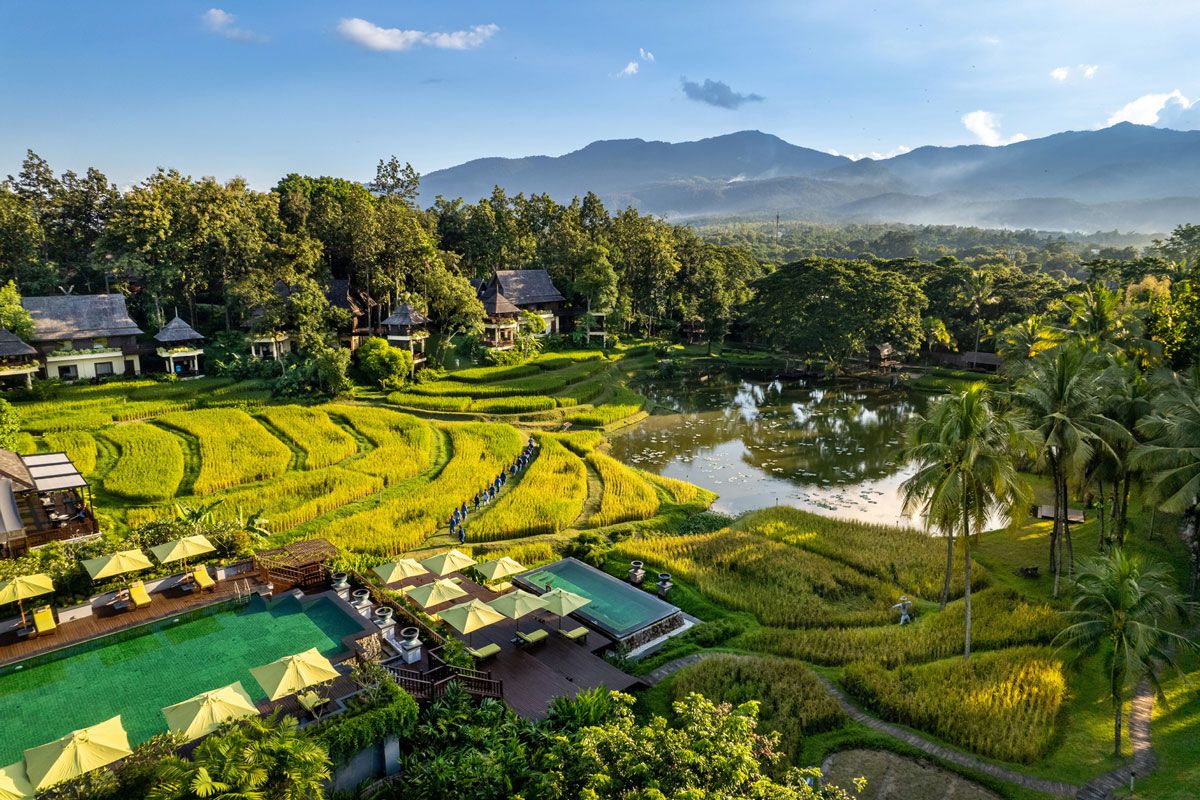
The upper ones naturally offer better views; on one side, I could admire the rice paddies which look lush and beautiful in the sunset, especially when a small infinity pool peers over them. Turning my head to the left would give me a glimpse of the four water buffalo in their stables.
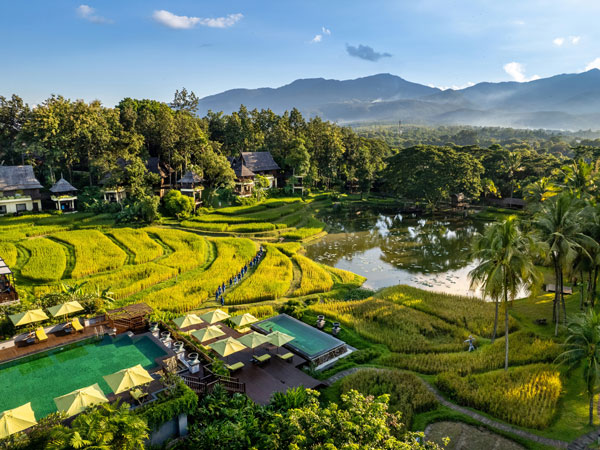
an aerial view of the surrounding rice paddies at Four Seasons Resort Chiang Mai
Be surrounded by lush green rice paddies. (Image: Four Seasons)

There aren’t many luxury resorts where you can plant rice, shape pottery and bathe water buffalo all on the same day. Guests rotate through these activities, and watching them hard at work while relaxing in your private sala is a great way to understand just how much thought Four Seasons has put into this immersive pastoral-luxe experience.
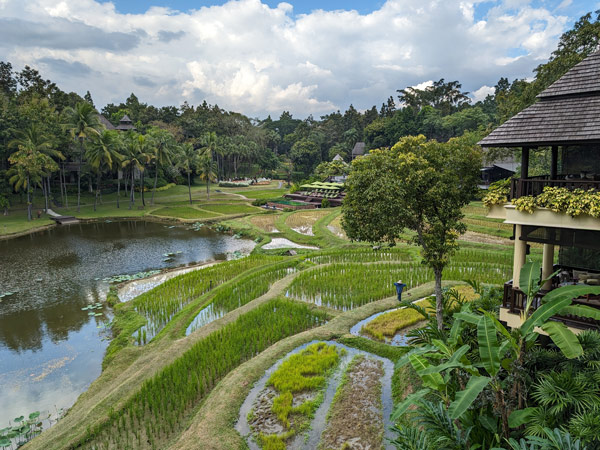
the lush greenery and rice paddies at Four Seasons Resort Chiang Mai
Be surrounded by vibrant rice paddies. (Image: Chris Singh)

Food and drink

Just shortly after I arrive at the resort, I make my way to the more traditional of the resort’s three restaurants, Khao.

The space benefits from the ornate whimsy of Thai design and full-size windows looking out to the rice paddies and the mountains in the distance. It reminds me of some of the more high-end restaurants I’ve been to in Bangkok, although the food and drink are dedicated to Northern Thai.

Regionality is always such a big thing in Thailand, so I’m not surprised when I finish a bowl of creamy, caramelised khao soi and excitedly tell the chef that it’s the best I’ve ever had. And khao soi is pretty much all I eat whenever I’m in Thailand.
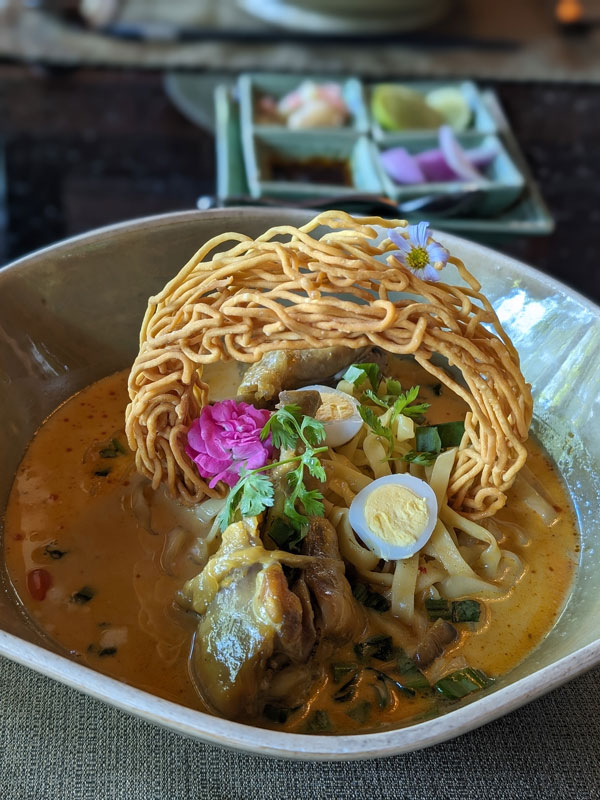
a bowl of creamy, caramelised khao soi
The khao soi is a must-try. (Image: Chris Singh)

The food at North, the resort’s more worldly open-air terrace restaurant, is more than just serviceable but the standard Western options have me craving a visit to Khao again. I’m more impressed by the Bill Bensley design which connects North to the pool area and a nice spread of lounges.

A third restaurant, Rim Tai Kitchen, is the most interesting. Again, the famous Bill Bensley took the reigns for this space with an abundance of teak and several distinctive cooking stations. This is where guests can take a comprehensive Northern Thai cooking class across multiple courses. I’m told aside from bathing water buffalo, it’s the most popular add-on activity at Four Seasons Chiang Mai.
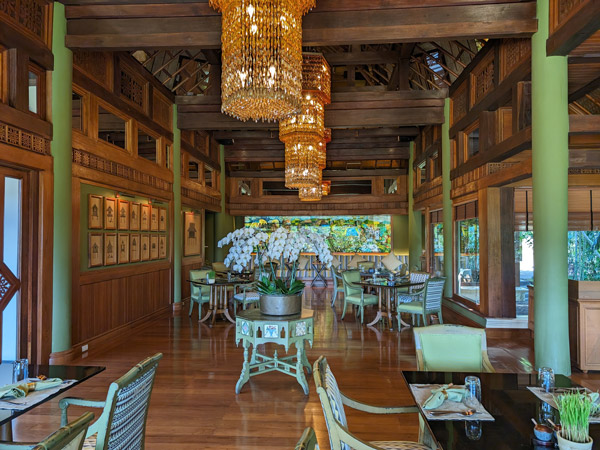
a look inside Kao restaurant at Four Seasons Resort Chiang Mai
The resort has three restaurants to dine at. (Image: Chris Singh)

Amenities and facilities

Aside from a small library and an indoor gym offering Muay Thai lessons to guests, almost every facility across Four Seasons Chiang Mai is designed to pull in the natural landscape. This is most true of the massive Wara Cheewa Spa which has seven treatment rooms set in a massive temple-esque building covered with mythical serpents.

The outdoor treatment rooms are probably more ideal during the day but my visit is at 9pm. Once the sun goes down, the land loses all of its visual appeal. Guests should look into the comprehensive wellness packages which include yoga and guided meditation.
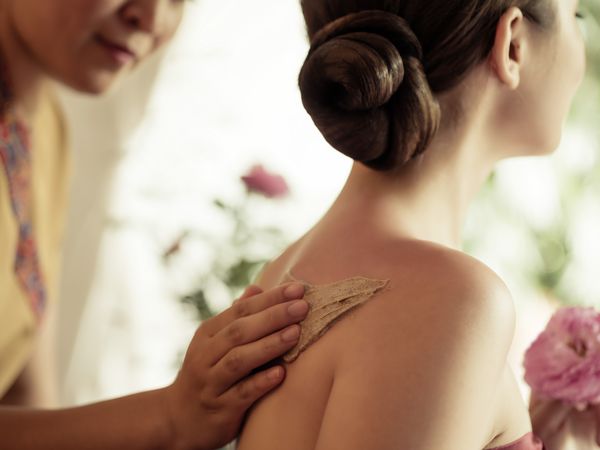
a woman having a spa treatment at Four Seasons Resort Chiang Mai
Pamper yourself at the spa. (Image: Four Seasons)

A spa is a given. And while it is an exceptional spa, the resort’s most interesting offering is the Chaan Baan. This is where most of the activities are offered, designed like a Thai farmer’s quarters (there’s even a traditional kiln) with staff teaching guests the art of pottery and tie-dying. This is also where you’ll find the buffalo stables so you’ll often find guests waiting to hose these majestic beasts down.

Behind the reception is also a hidden collection of shops selling fine Thai silk and other goods, although anyone who has blown their budget on the accommodation might want to go into town for the epic night markets instead.
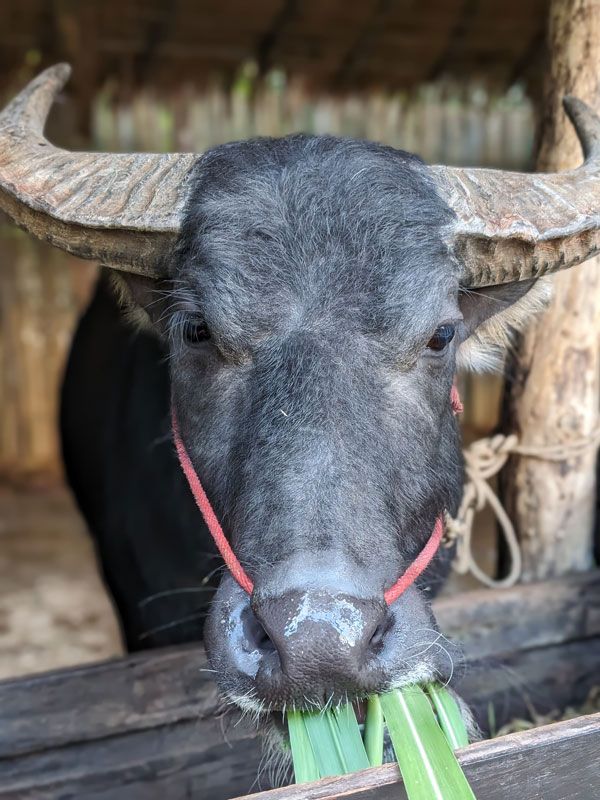
a water buffalo eating grass
See water buffalo up close. (Image: Chris Singh)

Weekly travel news, experiences
insider tips, offers,
and more.

Getting there 

Four Seasons Resort Chiang Mai is buried in the heart of the Mae Rim Valley so feels secluded and appropriately regional. Yet it’s only a 30-minute drive out of the city. This also means it’s very close to Chiang Mai International Airport so convenience is without question.
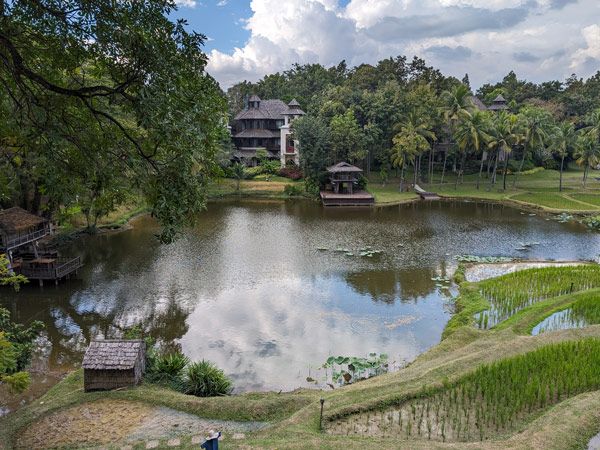
the scenic landscape at Four Seasons Resort Chiang Mai
Four Seasons Resort Chiang Mai has a secluded feel. (Image: Chris Singh)

The verdict

The resort could have easily gotten by on its spectacular concept and setting, but the small details like exceptional food, service and getting guests involved in the work (should they want to) help make Four Seasons Resort Chiang Mai what it is. Having that agricultural element is a different type of wellness, offering more of a connection to the location that goes beyond massages and design stories. Plus, you get to pet a bright pink buffalo.

Location: 9/10

Its Mae Rim Valley location makes Four Seasons Resort Chiang Mai an unforgettable scene.

Style/character: 9/10

Renowned architect Bill Bensley is prolific for the Lanna style of architecture; here he gently works it into the natural setting without overwhelming the region’s beauty.

Service: 8/10

Helpful, attentive and gentle. Great service is expected in Thailand and Four Seasons has assembled a team of seasoned professionals.

Food and drink: 9/10 

Some of the best Northern Thai food I’ve ever tasted as well as a fun cooking class means Four Seasons Chiang Mai is as delicious as it is beautiful.

Value for money: 8/10

A night at the resort will set you back around $939 per night. Many of the resort’s activities are add-ons and it will be impossible to resist temptation so do factor that into the cost.
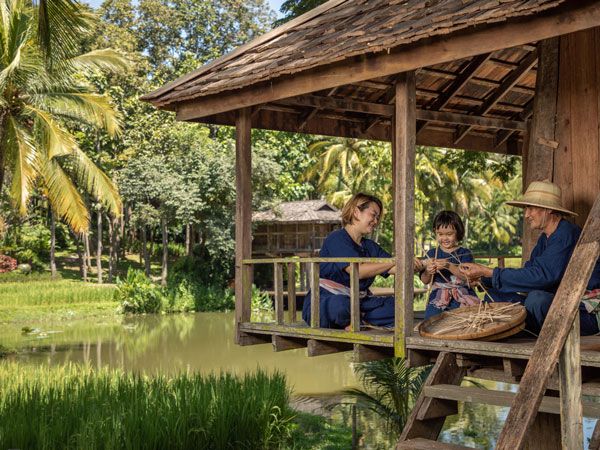
a local farmer showing guests their rice growing practices at Four Seasons Resort Chiang Mai
Try your hand at crafting at Four Seasons Resort Chiang Mai. (Image: Four Seasons)

Want to see more stories from International Traveller in your Google search results?

  1. Click here to set International Traveller as a preferred source.
  2. Tick the box next to "International Traveller". That's it.
Chris Singh
Chris Singh is an arts, travel and food journalist with 17 years of experience in digital media and 4 years of experience in SEO writing. He is the former travel editor of premium men's lifestyle title Boss Hunting and currently balances his role as Deputy Editor-At-Large of the AU review with freelance travel writing gigs at Australian Traveller, Luxury Escapes, Cruise & Travel and Sydney Travel Guide. Chris holds a Bachelor of Arts & Sciences (Sociology and Psychology) from the University of Sydney and once worked as a line dancer for steakhouse chain Lone Star (no, seriously). He's always got his finger on the pulse for good live music and delicious new restaurants, has a particular love of historic hotels and is starting to see the restorative value of the ever-present wellness industry. Although he is a born-and-bred Sydneysider, his favourite Australian cities are Hobart and Adelaide. Internationally, he can never get enough of big cities like Tokyo, New York and Chicago. If you're looking for him, he's either at a concert, on a plane or behind a laptop.
View profile and articles
hero media

5 things every hotel needs for a more restorative stay

    Kate Bettes Kate Bettes
    Wellbeing means different things to different travellers. Here’s how to pick a hotel that gets it right for you.

    The best wellness holidays aren’t necessarily spent wrapped in a spa robe. Sometimes they’re found around a dinner table in Cambodia, on a hiking trail in New Zealand or after finally beating jet lag on the other side of the world. The hotel you choose is what makes them happen.

    1. Easy access to good food

    meals from Novotel Bangkok Sukhumvit 20
    Taste delicious meals at Novotel Bangkok Sukhumvit 20.

    One of the quickest ways to derail healthy habits on holiday is to spend half of it working out where to eat instead of digging into the culture around you. Thankfully, Novotel has done much of the hard work already, with chefs building menus that lean into the flavours, ingredients and traditions of each destination.

    In Sihanoukville, Cambodia, Korkor soup – often dubbed ‘Cambodian ratatouille’ – sits alongside raw blue crab dressed with lime and chilli, best enjoyed with views across the Gulf of Thailand.

    In the lovingly chaotic city of Bangkok, the presence of food cranks up the sociability. At Novotel Bangkok Sukhumvit 20, you can settle in with mango sticky rice and stranger-turned-friends beside the pool at Sky on 20 rooftop bar, or bring them along to tackle river prawns and stir-fried crab with holy basil at the buzzing Crab Paradise Dinner Buffet.

    Then Novotel Dubai Al Barsha welcomes you with a laidback twist on the level of indulgence the Middle Eastern city is best known for up on Deck Se7en. Looking towards Burj Al Arab, the rooftop lounge has everything from Mediterranean-style dishes like seabass ceviche to Italian prosecco sundowners.

    At the other end of the scale, in the hills that surround the Novotel Bali Ubud Resort, calm comes from nature. At Siralada restaurant, Balinese traditions shape the menu while thunder rumbles over the surrounding jungle – proving the setting is as nourishing as the food itself.

    While at Novotel Nha Trang, chef Kieu Thi My Hanh and her team showcase Vietnam’s knack for balancing freshness, texture and fragrant herbs. Pho remains a favourite, while seafood salad with pomelo and mango brings those flavours together in one bright dish.

    It’s all an approach backed by partnerships with expert food creators such as Alfie Steiner, whose plant-forward recipes prove healthy food should never taste plain.

    2. Better sleep options

    Novotel Bali Ubud Resort room
    Sleep deeply with Novotel.

    There are few travel experiences more disappointing than arriving in a new country, determined to seize the day, only to fall asleep fully clothed by 3pm.

    For Australian travellers, jet lag is often an unavoidable part of the journey. That’s one reason Novotel runs sleep-focused initiatives that help guests adjust quickly without compromising on health. We’re talking partnerships with Sydney-based sleep specialist Olivia Arezzolo, known for her advice on everything from better sleep habits to beating jet lag, alongside features like pillow menus, in-room yoga content and tailored sleep guidance.

    The sooner you’re operating on local time, the sooner you can get back to more pressing matters – like deciding which spa treatment to book.

    3. More ways to move

    woman hiking around queenstown new zealand
    Stay at Novotel Queenstown Lakeside and explore local hiking trails. (Credit: GettyI mages/ naruedom)

    Every place in the world has its own way of getting you moving: whether that’s hiking up ice-bitten mountains before a sauna or gentle stretching by the pool before a facial. From fitness centres to spas, Novotel recognises that wellbeing rarely looks the same.

    At Novotel Queenstown Lakeside, activity is inescapable. Here, hiking trails, ski fields, bungee jumps, and white-water rafting have made the region famous. The hotel’s location on the shores of Lake Wakatipu means less time spent organising yourself and more time out there experiencing them. To top it all off, you can book a private hot tub for the evening before heading back into the wilderness tomorrow.

    Bali, of course, takes a softer approach. At Novotel Bali Ubud Resort or Novotel Bali Nusa Dua, movement is less about conquering a mountain and more about a dance class between the tropical gardens and lagoon pools. Afterwards, the spa takes over, with traditional treatments like a Lulur body scrub: a combination of rice, turmeric, sandalwood, ginger and jasmine that’ll soothe muscles already relaxed by the Balinese heat.

    4. Better connections

    Novotel Sharm El Sheikh
    Kids will love a stay at Novotel Sharm El Sheikh.

    One of the best things about travel is that it gives your family stories you’ll be telling for years. Novotel helps create them with activities that bring everyone together, whether that’s trying something new, learning a local skill, or simply spending more time together.

    Go for a distinctly Thai twist at Novotel Phuket Vintage Park, where many of the family activities draw on local culture. Kids can try everything from beginner Thai boxing and language lessons to umbrella painting and – a pastime beloved by children the world over – pool foam parties. Everyone is welcome to join in, whether that’s getting splashed, covered in paint, or simply watching their children discover a new side of Thailand during the dedicated Family & Kids Day.

    A different adventure awaits at Novotel Sharm El Sheikh. Kids could be perfectly content with discos, drawing classes and new holiday friends, but the Red Sea has other ideas. Sitting on the edge of Naama Bay, days here might involve snorkelling colourful reefs, taking a boat trip to Ras Mohammed National Park or heading into the desert by quad bike or camel for a Bedouin-style dinner beneath the stars.

    5. Location is everything

    Surin Beach, Choeng Thale, Thalang District, Phuket, Thaiföld
    Explore Phuket’s gorgeous beaches. (Credit: Bence Biczo)

    Everyone’s idea of wellness looks a little different. With more than 600 hotels across 65 countries, Novotel gives guests the freedom to choose the destination that suits them best. Whether that’s a beachside escape in Phuket, an alpine expedition in Queenstown or a city break in Bangkok, there’s a good chance a Novotel isn’t far away.

    All that’s left? Choosing your version of wellbeing.

    Discover stays to inspire your everyday at novotel.accor.com.